Mental fatigue recovery comes down to two things: a break that takes you properly off the task, and enough sleep in the nights that follow. The clearest trial of an active break used 30 minutes of moderate cycling straight after the hard work. It did better than stretching on most measures, and better than a sitcom by smaller margins. Caffeine before demanding work and relaxing music also have decent support. Short NSDR sessions have a few small trials, with mixed results.
The seven protocols below aren't a ranking. Each one says how much evidence sits behind it.
The short version:
- Thirty minutes of moderate cardio after hard mental work has the clearest trial behind it.
- Caffeine before demanding work helps. Keep the last coffee 8.8 hours before bed.
- Relaxing music during a long task kept fatigue lower in one study of 36 students.
- Six hours of sleep or less, night after night, builds deficits you won't notice in yourself.
- Ten minutes of NSDR eased self-rated stress a little in two trials. A third found nothing.
- Cap hard focus at about 90 minutes, then take 10 to 30 minutes off.
- Plan a walk, a short nap or NSDR for the mid-afternoon dip.
What mental fatigue is (and why rest alone doesn't always fix it)
Mental fatigue is the worn-down state that follows long stretches of demanding thinking. Effort feels expensive, and easy options look better than they should. A 2022 review describes it as a state that impairs physical as well as cognitive performance (Proost et al.).
What a day of hard thinking does to your brain
The best-known study comes from the Paris Brain Institute, published in Current Biology in 2022 (Wiehler et al.). Forty volunteers spent about six hours on letter tasks at a computer, 24 on hard versions and 16 on easy ones.
By evening, the hard group had more glutamate, an excitatory brain messenger, in the lateral prefrontal cortex, a region that handles cognitive control. Their choices shifted too. Through the day their choices shifted toward rewards that came sooner or needed less effort. The easy group's choices didn't move.
The authors' reading is that as glutamate builds, using that region costs more, so the brain steers you toward easier options. It's one study and one model, and two details matter. The glutamate gap came mostly from levels falling in the easy group rather than rising in the hard one. And both groups rated themselves equally tired, so feeling tired didn't track how hard they'd worked. The authors note that glutamate falls during sleep, and say recovery at rest or in sleep still needs studying.
Why it lingers after you stop
Feeling better comes first. Performance catches up later. In a 2020 study, 15 people did a 32-minute demanding task. Over the next 20 minutes their sense of fatigue eased, though not back to where it started, while their brain rhythms and a timed arm-pointing task still showed fatigue at the 20-minute mark (Jacquet et al.).
So "I feel fine" five minutes after a hard block is a weak signal. Give the break its full length before the next demanding task.
Mental fatigue vs burnout (the difference matters)
Mental fatigue builds over a demanding day or week and eases with breaks and sleep. Burnout has a different cause. The World Health Organization describes it as the result of chronic workplace stress that hasn't been successfully managed, with three features: exhaustion, growing mental distance or cynicism about your job, and reduced professional efficacy (WHO). WHO lists it as an occupational phenomenon and doesn't classify it as a medical condition.
As a rough guide, if a good weekend sorts it out, it was fatigue. If it lasts for weeks despite rest, burnout is one possibility, and so are low mood and medical causes (more on that below).
What the recovery research shows
The direct evidence on recovery is thin, and one of the better studies found no winner. In a 2020 crossover study, 24 students did an hour-long fatiguing task four times, each followed by a different 20-minute break: a power nap, slow systematic breathing, breathing plus mental imagery, or a plain control break. Everyone recovered somewhat with time, and none of the three strategies beat the control (Loch et al.). Time off the task did much of the work.
A 2022 review of 33 studies found caffeine, odours, music and extrinsic motivation had the most support, and called the way any of them work speculative (Proost et al.). So treat the list below as options to test. For more ways to use downtime, see these ways to rest without sleeping.
The 7 mental fatigue recovery protocols
Protocol 1: Aerobic movement reset, 30 minutes
In a 2021 trial, 99 healthy adults spent 60 minutes on a demanding battery of tests. Then they were randomly assigned to one of three 30-minute treatments: moderate cycling at 65 to 75% of their peak aerobic capacity, gentle lower-body stretching, or a popular sitcom (Oberste et al.).
The cyclists recovered best. Against stretching, they did better on cognitive flexibility (switching between tasks), tiredness, motivation and mood, with the biggest gap for flexibility. Against the sitcom the gains were small, tiredness came out about even, and the sitcom did better on restlessness.
Use it straight after hard mental work, as the trial did. A brisk walk or easy jog at a similar effort is a reasonable stand-in, though only cycling was tested.
Protocol 2: Caffeine before the hard work
The 2022 review rated caffeine taken before a fatiguing task among the most promising countermeasures. Caffeine blocks adenosine receptors, which improves vigilance, attention and reaction time (McLellan et al.). The cost is sleep. In a 2023 meta-analysis, caffeine cut total sleep by 45 minutes on average, and the authors put the cutoff for a coffee at 8.8 hours before bed, about 2pm for an 11pm bedtime (Gardiner et al.). Doses and timing are covered in caffeine timing for focus.
Protocol 3: Sensory downshift with music, 5-10 minutes
In a 2015 study, 36 students did an hour-long attention task, half of them with relaxing music playing. The music group reported less mental fatigue at the end, and their reaction times held steady while the control group's slowed (Guo et al.). The 2022 review also listed music among the best-supported countermeasures.
The music in that study played during the task, so calm music while you work counts. Between blocks, try five to ten minutes with your eyes closed, calm music on and your phone face down. A 2022 review of eight studies found that mindfulness-based practices also reduced mental fatigue, though its authors want more rigorous trials (Cao et al.).
Protocol 4: Sleep, enough of it and unbroken
"We know sleep loss can make us feel physically exhausted, but it can contribute to mental exhaustion, too," says Dr. Chester Wu, who is double board-certified in psychiatry and sleep medicine (Rise Science).
The classic evidence is a 2003 lab study of 48 adults. Those held to 6 hours or less in bed for 14 nights built up thinking deficits equal to up to two nights without any sleep. Their sleepiness ratings barely rose after the first days, so they were largely unaware of how impaired they'd become (Van Dongen et al.).
Unbroken sleep matters too. In a 2014 study of 112 adults, more continuous sleep went with better inhibitory control, the ability to hold back an automatic response, and in the younger adults with better working memory too (Wilckens et al.). Glutamate falling during sleep, as the Wiehler team noted, is one possible reason sleep helps, though it hasn't been tested.
The basics are cheap. Get daylight outdoors in the morning. Huberman suggests about 5 minutes on a clear day, 10 under cloud and 20 to 30 when it's heavily overcast (Sleep Toolkit). Keep the bedroom around 65 to 68°F (18 to 20°C), the range the Sleep Foundation says most doctors recommend.
Protocol 5: NSDR (non-sleep deep rest), 10 minutes
NSDR is a short guided practice. You lie down, slow your breathing and move your attention through your body as a voice directs. Three small trials have tested it, all in physically active adults and none in people with ongoing mental fatigue.
- In 2024, 65 adults did 10 minutes of NSDR or sat quietly. The NSDR group then had better grip strength, reaction times and accuracy on a computer task, and rated their stress and tension lower (Boukhris et al., 2024).
- A 2026 trial of 102 adults found lower sleepiness, fatigue and stress after 10 minutes of NSDR. The effects were small, and the reaction-time gain had gone by the 20-minute check (Boukhris et al., 2026a).
- A second 2026 trial compared a 25-minute nap, 10 minutes of NSDR and a control. Forty minutes later the nap group felt more ready to perform than the NSDR group, and NSDR showed no significant effects (Boukhris et al., 2026b).
The "65% more dopamine" claim you may have seen comes from one small PET study (Kjaer 2002: 8 male yoga teachers, one 72-minute yoga nidra session). It estimated 65% more dopamine released during the session than at rest, never measured baseline levels, and studied yoga nidra. There's more on what the NSDR studies measured.
So NSDR may help a little, and a nap may help more if you have 25 minutes. The case for NSDR is practical. It takes ten minutes, and you stay awake, so there's no grogginess to shake off. Start with a guided 10-minute track, the length all three trials used, since following a voice is easier than steering yourself. Longer versions are in NSDR session options by goal and length.
Protocol 6: 90-minute focus blocks
Huberman suggests capping hard focus at about 90 minutes, then taking at least 10 and up to 30 minutes of what he calls "deliberate defocus", meaning easy, low-concentration tasks with your eyes off your phone (Focus Toolkit). The 90 minutes comes from sleep's roughly 90-minute cycles. A 1995 study that tested 60 people every 10 minutes for nine hours found no 90-minute rhythm in waking performance (Neubauer & Freudenthaler), so treat it as a sensible cap that the biology only loosely supports. More in ideal focus session length.
Protocol 7: The afternoon dip protocol
Some people hit a dip in alertness in the mid-afternoon, roughly 2 to 5pm by Huberman Lab's account. It has roots in human biology, may be linked to the body clock, and can happen even if you skip lunch, though a high-carbohydrate lunch makes it worse (Monk 2005). Huberman Lab suggests NSDR for it, but in the one head-to-head trial, the 25-minute nap did better. There are more fixes in the guide to the afternoon energy crash.
How to build a daily mental fatigue recovery system
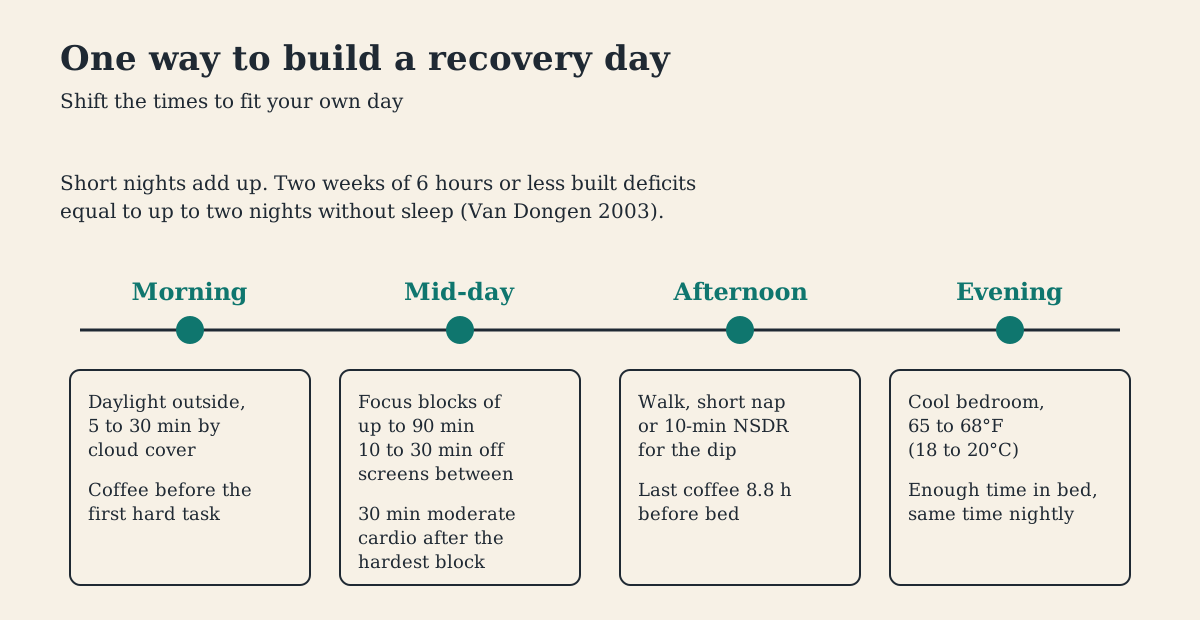
Here is one way to put the seven together. Shift the times to fit your day.
Morning
Get outside in daylight soon after waking, for longer when it's cloudy. Have your coffee before the first demanding task.
Mid-day
Work in blocks of up to 90 minutes, with 10 to 30 minutes away from screens between them. After your hardest block, do 30 minutes of moderate cycling, brisk walking or jogging if you can.
Afternoon
When the dip arrives, take a walk, a short nap or a 10-minute NSDR session. Make the last coffee at least 8.8 hours before bed.
Evening
Keep the bedroom cool and give yourself enough time in bed, at roughly the same time each night. Short nights add up, and you won't feel how much.
When your brain needs more than recovery protocols
Mental fatigue vs burnout at work
A better break routine won't fix burnout on its own, because the cause is unmanaged work stress. Use the WHO's three features as a check. Are you exhausted, increasingly cynical about your job, and less effective at it? If all three fit, raise the workload itself with your manager, occupational health or a professional.
Signs you need professional support
See a doctor if fatigue doesn't improve despite enough rest and sleep, if it comes with low mood, or if it gets in the way of daily life. Persistent fatigue can come from depression, burnout, thyroid problems, anaemia and other conditions that need checking (Doctronic).
Recovery timeline expectations
- After one hard session. The feeling of fatigue eases over about 20 minutes, though not back to where it started, and performance can still lag at the 20-minute mark.
- After a hard week. There's no good research on this. A few nights of full sleep and some lighter days are a fair test.
- Diagnosed stress-related exhaustion. This runs on a different scale. In a Swedish follow-up of 217 patients, almost half still reported fatigue 7 years after first seeking care, and a third were clinically judged to be still exhausted (Glise et al.).
This article is general information and doesn't replace advice from your doctor.
FAQ
How long does mental fatigue recovery take?
Recovery from one demanding session can take longer than it feels. In a small 2020 study, feeling tired eased partly over 20 minutes while performance still lagged at the 20-minute mark. There's little research on recovering from a hard week. Fatigue that doesn't improve despite enough rest and sleep needs a doctor's view, and diagnosed stress-related exhaustion can take years.
What is the fastest way to recover from mental fatigue?
No trial has compared which way to recover from mental fatigue is fastest. The clearest result for an active break is 30 minutes of moderate exercise right after the hard work: in a 2021 trial of 99 adults it did better than stretching, and better than a sitcom by smaller margins. Shorter options, such as 10 minutes of NSDR or a short nap, have smaller and mixed results.
Can mental fatigue cause physical symptoms?
Yes, mental fatigue often comes with physical symptoms. Rise Science lists headaches or muscle pain, trouble sleeping, digestive issues, appetite changes and slower reactions. Many of these overlap with other conditions, so see a doctor if they persist.
What is the difference between mental fatigue and burnout?
Mental fatigue comes from demanding thinking and eases with breaks and sleep. Burnout, in the WHO's definition, comes from chronic work stress that hasn't been managed, and shows up as exhaustion, cynicism about your job and reduced effectiveness at work. Rest helps you cope with burnout, but it doesn't change the cause.
Does NSDR help with mental fatigue recovery?
NSDR may help a little. In two trials of physically active adults, 10 minutes of NSDR lowered self-rated stress and sped up reaction time compared with a control. The larger trial also found less fatigue, though the speed gain faded within 20 minutes. A third trial found no effect, and a 25-minute nap did better.
Sources
- Wiehler A, Branzoli F, Adanyeguh I, Mochel F, Pessiglione M (2022). A neuro-metabolic account of why daylong cognitive work alters the control of economic decisions. Current Biology. https://pubmed.ncbi.nlm.nih.gov/35961314/
- Proost M et al. (2022). How to tackle mental fatigue: a systematic review of potential countermeasures and their underlying mechanisms. Sports Medicine. https://pubmed.ncbi.nlm.nih.gov/35543922/
- Jacquet T, Poulin-Charronnat B, Bard P, Lepers R (2020). Persistence of mental fatigue on motor control. Frontiers in Psychology. https://pubmed.ncbi.nlm.nih.gov/33488457/
- Loch F et al. (2020). Acute effects of mental recovery strategies after a mentally fatiguing task. Frontiers in Psychology. https://pubmed.ncbi.nlm.nih.gov/33424674/
- Oberste M et al. (2021). Acute aerobic exercise to recover from mental exhaustion: a randomized controlled trial. Physiology & Behavior. https://pubmed.ncbi.nlm.nih.gov/34516957/
- McLellan TM, Caldwell JA, Lieberman HR (2016). A review of caffeine's effects on cognitive, physical and occupational performance. Neuroscience & Biobehavioral Reviews. https://pubmed.ncbi.nlm.nih.gov/27612937/
- Gardiner C et al. (2023). The effect of caffeine on subsequent sleep: a systematic review and meta-analysis. Sleep Medicine Reviews. https://pubmed.ncbi.nlm.nih.gov/36870101/
- Guo W, Ren J, Wang B, Zhu Q (2015). Effects of relaxing music on mental fatigue induced by a continuous performance task: behavioral and ERPs evidence. PLoS ONE. https://pubmed.ncbi.nlm.nih.gov/26305353/
- Cao S et al. (2022). Mindfulness-based interventions for the recovery of mental fatigue: a systematic review. International Journal of Environmental Research and Public Health. https://pubmed.ncbi.nlm.nih.gov/35805484/
- Van Dongen HP, Maislin G, Mullington JM, Dinges DF (2003). The cumulative cost of additional wakefulness: dose-response effects on neurobehavioral functions and sleep physiology from chronic sleep restriction and total sleep deprivation. Sleep. https://pubmed.ncbi.nlm.nih.gov/12683469/
- Wilckens KA et al. (2014). Role of sleep continuity and total sleep time in executive function across the adult lifespan. Psychology and Aging. https://pubmed.ncbi.nlm.nih.gov/25244484/
- Boukhris O et al. (2024). The acute effects of nonsleep deep rest on perceptual responses, physical, and cognitive performance in physically active participants. Applied Psychology: Health and Well-Being. https://pubmed.ncbi.nlm.nih.gov/38953770/
- Boukhris O et al. (2026a). Time course of perceptual, cognitive, physical and physiological responses to a single non-sleep deep rest session in physically active young adults. Applied Psychology: Health and Well-Being. https://pubmed.ncbi.nlm.nih.gov/42383502/
- Boukhris O, Suppiah H, Driller M (2026b). Comparing the effects of a short nap and non-sleep deep rest on perceptual, cognitive, and physical performance in active adults. Clocks & Sleep. https://pubmed.ncbi.nlm.nih.gov/42783005/
- Kjaer TW et al. (2002). Increased dopamine tone during meditation-induced change of consciousness. Brain Research. Cognitive Brain Research. https://pubmed.ncbi.nlm.nih.gov/11958969/
- Neubauer AC, Freudenthaler HH (1995). Ultradian rhythms in cognitive performance: no evidence for a 1.5-h rhythm. Biological Psychology. https://pubmed.ncbi.nlm.nih.gov/7669837/
- Monk TH (2005). The post-lunch dip in performance. Clinics in Sports Medicine. https://pubmed.ncbi.nlm.nih.gov/15892914/
- Glise K, Wiegner L, Jonsdottir IH (2020). Long-term follow-up of residual symptoms in patients treated for stress-related exhaustion. BMC Psychology. https://pubmed.ncbi.nlm.nih.gov/32188513/
- World Health Organization (2019). Burn-out an "occupational phenomenon": International Classification of Diseases. https://www.who.int/news/item/28-05-2019-burn-out-an-occupational-phenomenon-international-classification-of-diseases
- Huberman A (2022). Focus Toolkit: Tools to Improve Your Focus & Concentration. Huberman Lab podcast #88. https://www.hubermanlab.com/episode/focus-toolkit-tools-to-improve-your-focus-and-concentration
- Huberman A (2022). Sleep Toolkit: Tools for Optimizing Sleep & Sleep-Wake Timing. Huberman Lab podcast. https://www.hubermanlab.com/episode/sleep-toolkit-tools-for-optimizing-sleep-and-sleep-wake-timing
- Huberman Lab. Dr. Andrew Huberman's Guide to NSDR. https://www.hubermanlab.com/nsdr
- Sleep Foundation. Best Temperature for Sleep. https://www.sleepfoundation.org/bedroom-environment/best-temperature-for-sleep
- Rise Science. How To Deal With Mental Exhaustion. https://www.risescience.com/blog/how-to-deal-with-mental-exhaustion
- Doctronic. Mental Fatigue: Why Your Brain Feels Exhausted and How to Reset. https://www.doctronic.ai/blog/mental-fatigue-why-your-brain-feels-exhausted-and-how-to-reset/