Learning how to rest without sleeping means bringing your arousal down on purpose while you stay awake. Slow your breathing, lie or sit still with your eyes closed, or follow a guided session. In lab studies, ten quiet minutes after learning something new improved memory, and slow breathing raises the part of heart rate variability linked to rest. None of it replaces sleep. Below are five methods, from a two-minute breathing reset to a 20-minute guided session, with what the studies found and when to use each.
In short:
- Fastest: one to three physiological sighs, two breaths in through the nose and a long breath out.
- Five minutes: breathe out for about twice as long as you breathe in.
- Straight after learning: 10 quiet minutes with your eyes closed.
- Ten to 20 minutes: a body scan or an NSDR session.
- Short on sleep, with time and a quiet place: a short nap usually does more than any of these.
Why your body can rest without sleep
Rest and sleep are different states
Sleep runs in stages, from light sleep down to deep slow-wave sleep and REM. Rest keeps you conscious. You lower the load on your body and attention, but you miss the deep and REM sleep that support memory and immune function, so rest can't stand in for a night's sleep.
The nervous system switch
Your autonomic nervous system has two broad settings. The sympathetic side speeds up your heart and breathing when you're under pressure. The parasympathetic side, often called rest and digest, slows them down again.
You can nudge that switch while awake, and breathing is the clearest lever. A 2022 meta-analysis of 223 studies found that slow breathing raises vagally mediated heart rate variability, a marker of parasympathetic activity, during a session, straight after one, and after a run of sessions.
What quiet rest does for your brain
Doing nothing with your eyes closed has measurable effects. In a 2012 Edinburgh study, people heard two stories. After one they rested quietly for 10 minutes, and after the other they played a spot-the-difference game. They remembered more of the story followed by rest, both 15 to 30 minutes later and a week later.
Motor skills showed something similar. In a 2018 study, 15 minutes of eyes-closed rest after practising a finger-tapping sequence improved performance compared with a distractor task, though a group tested 4 hours later showed no benefit. A 2019 review by Erin Wamsley links the effect to memory-related brain activity during the rest itself.
Guided rest vs just lying down
Guided rest may add something, but the evidence is thin. In a 2024 trial of 65 active adults, 10 minutes of NSDR beat 10 minutes of sitting passively on reaction time, accuracy and grip strength. A 2026 trial that also tested a nap found no effect from the same dose, another found only small, short-lived gains, and no study has compared NSDR with plain eyes-closed rest. Lying still is a real option. The protocols below help when your mind won't settle.
How to rest without sleeping: 5 protocols
They run from fastest to longest. All of them work sitting up, and the first four need nothing but a timer.
1. The physiological sigh (under 2 minutes)
Breathe in through your nose. When your lungs feel full, take a second, shorter breath in on top. Then breathe out slowly through your mouth until you're empty. Breathing entirely through your nose is fine too.
Huberman says one to three of these is the fastest way he knows to bring stress down, though that dose hasn't been tested. The trial behind it, a one-month Stanford study of 108 adults, had people do cyclic sighing for 5 minutes a day. It improved mood and slowed resting breathing more than mindfulness meditation did, and the authors credit the long exhale. Your body sighs on its own every few minutes to reinflate the tiny air sacs in your lungs, and the second breath in does that job on purpose. More on what the physiological sigh does.
Best for: acute stress, anywhere, including a meeting or a parked car.
2. Extended exhale breathing (5 minutes)
Breathe in for a count of 4, out for a count of 8. Keep going for 5 minutes. If a count is about a second, that's around 5 breaths a minute.
Two lines of evidence back it. In a lab study of 30 people, breathing out for longer than they breathed in felt more relaxing, and at 6 breaths a minute it also raised a heart rate variability measure linked to the vagus nerve. The 223-study meta-analysis above found slow breathing raises that measure during and straight after a session. Nobody has tested this exact 4-and-8 pattern, so if 8 counts feels like a strain, use 3 in and 6 out.
Best for: a reset between tasks, or a lead-in to a longer session.
3. Quiet wakefulness (10 to 15 minutes)
Lie down or sit back, close your eyes and rest without trying to sleep. No technique and no goal. Set an alarm so you don't have to check the time. If you doze for a few minutes, that's fine.
The memory studies tested exactly this, for 10 minutes in Edinburgh and 15 in the motor-skill study. Both compared it with doing a task, so part of the benefit comes from what you avoid. Scrolling your phone is a task.
Best for: right after studying, or when you have no energy for a protocol.
4. Body scan (10 to 15 minutes)
Lie on your back or sit with your feet flat. Move your attention slowly through your body: feet, calves, knees, thighs, hips, belly, chest, hands, arms, shoulders, neck, face. At each spot, notice what's there and let the muscles soften. If you find tension, breathe out slowly and let it go. If your mind wanders, go back to the last body part you remember.
No trial has tested a self-guided body scan as a rest break, so treat it as quiet rest with a structure. It needs no audio, so it works on a plane or when your phone is in another room.
Best for: self-directed rest when you know the sequence.
5. NSDR (10 to 20 minutes)
NSDR, non-sleep deep rest, is Andrew Huberman's term for practices that bring deep relaxation without falling fully asleep, yoga nidra among them. A guided track slows your breathing and moves your attention through your body while you lie still. Huberman Lab says sessions can be as short as ten minutes or as long as an hour or more.
Sleep physician Brandon Peters, who reviewed the Sleep Foundation's NSDR article, writes that "NSDR may slow the brain's electrical waves, inducing a state of relaxation with measurable benefits." Most people stay awake: in an EEG study of yoga nidra, 26 of 30 beginners were scored awake for the whole session after two weeks of practice.
The direct evidence is small: four trials use the NSDR name, and two found clear benefits. In one, 65 active adults improved reaction time, accuracy and grip strength. In the other, a pilot trial in 45 heart patients, the group given eight 20-minute NSDR sessions saw anxiety and stress scores fall more than with standard care, with no significant difference from virtual reality therapy. A trial of 102 adults found small drops in sleepiness, fatigue and stress, with a reaction-time gain that faded by 20 minutes. In the fourth, with 60 adults, a 25-minute nap opportunity beat 10 minutes of NSDR on readiness, and NSDR showed no effect.
You may have seen the "65% more dopamine" figure. It comes from one small PET study (Kjaer 2002: 8 male yoga teachers, one 72-minute yoga nidra session) that estimated 65% more dopamine released during the session than at rest. It never measured baseline levels. More on how NSDR works and where the term comes from.
Best for: an afternoon slump when you can't nap, or a longer reset that you'd rather follow than lead yourself.
When to use each protocol
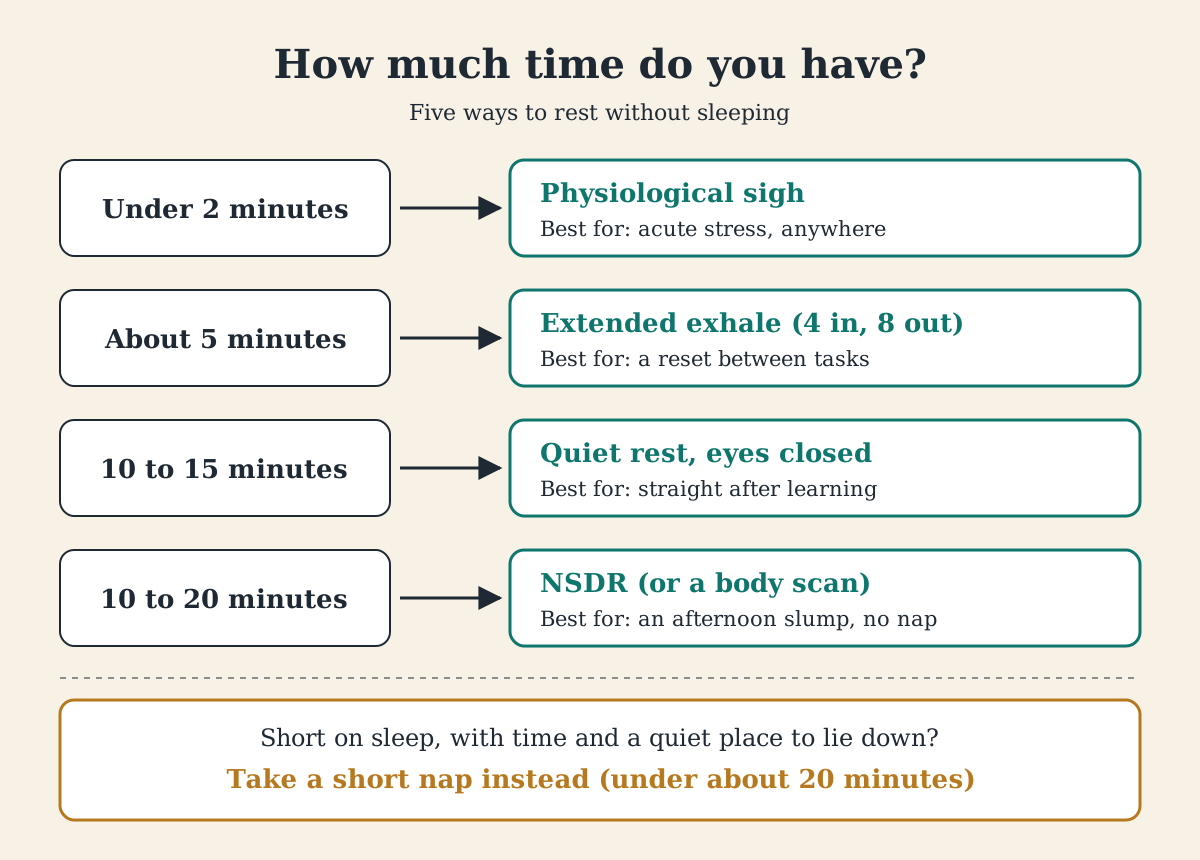
Pick by the situation you're in. Four come up most.
You can't nap at work
It's mid-afternoon and your focus has gone. The post-lunch dip is real for many people, though not everyone, and it's linked to a rise in sleepiness at that time of day.
If you have 10 minutes and somewhere quiet, do an NSDR session or quiet rest with headphones in. If you only have your chair, do three physiological sighs, then a few minutes of extended exhales. There are more ways to recover from mental fatigue at work.
You slept poorly and need to recover
After a short night, a nap has the better evidence. In one lab study, after nights cut to about 5 hours, a 10-minute afternoon nap improved sleepiness, fatigue and performance straight away.
If you can't nap, Huberman says that after a short night he does 10 minutes of NSDR, or ideally 30 to 60. No NSDR trial has tested people after lost sleep, so treat it as a way to rest, not a fix. Here's a same-day plan after a bad night.
You just finished studying or learning something hard
Rest straight away, before you check messages. The Edinburgh study used 10 quiet minutes immediately after learning, and the motor study used 15. Huberman suggests a short NSDR session or a 20-minute nap within an hour of a learning session. NSDR itself hasn't been tested for memory, so quiet rest is the closest match to the studies. See NSDR after learning for how to fit it in.
You're lying awake in bed at night
Lying still with your eyes closed is still rest, so don't panic about it. But if you've been in bed for about 15 to 20 minutes without falling asleep, insomnia therapy's standard advice is to get up. Go to another room, do something quiet for at least 30 minutes, then go back to bed. This is stimulus control, part of cognitive behavioural therapy for insomnia. It stops your bed becoming a place where you lie awake.
Rest helps, but it doesn't treat a sleep problem. If you're tired most days or lie awake most nights, see a doctor.
NSDR vs napping: which is better?
On current evidence, a short nap does more if you can fall asleep. In the only trial that compared them, 60 active adults had either a 25-minute nap opportunity, 10 minutes of NSDR, or a control. The nappers felt more ready to perform 40 minutes later, and NSDR showed no effect.
NSDR's clear advantage is that there's no grogginess to wait out. Naps under about 20 minutes avoid the worst of it. Longer ones can leave you foggy, usually for up to 30 minutes and sometimes an hour or more after deep sleep or a short night. So nap if you're short on sleep and have a quiet place, and use NSDR when you need to get straight back to work. See NSDR vs napping compared in full.
FAQ
Is lying down with eyes closed the same as sleeping?
Lying down with your eyes closed isn't sleep, because you stay conscious and don't get deep or REM sleep. It still counts as rest. In lab studies, 10 to 15 minutes of quiet rest after learning improved memory compared with doing a task. If you drift into light sleep for a few minutes, that's fine.
How long should I rest without sleeping to feel a difference?
About 10 minutes is a sensible start if you're learning how to rest without sleeping and want to feel a difference. Three of the four NSDR trials and the Edinburgh memory study used 10 minutes, and nobody has shown that 20 or 30 minutes beats 10 for an afternoon reset. For acute stress, one to three physiological sighs take under a minute.
Can NSDR replace sleep?
NSDR can't replace sleep. You stay awake, so you don't get the deep or REM sleep your body needs for memory and immune function. Huberman Lab's own NSDR page says "nothing can completely replace sleep." Use it on the days sleep isn't available, and protect your nights.
What's the best time of day to do NSDR?
The best time for NSDR depends on why you're doing it. Huberman suggests it after a short night and within an hour of a learning session. The early-afternoon dip is the other common slot, because it's when many people feel like napping and can't. Before bed, a session built for sleep makes more sense.
Is NSDR the same as meditation?
NSDR overlaps with meditation but isn't the same as the focused kind. Focused meditation asks you to hold your attention on one thing, like your breath, and bring it back when it wanders. NSDR asks you to follow a voice through your body and let your muscles go slack, usually lying down. Huberman's term covers yoga nidra and some forms of meditation, so the line between them is blurry.
Sources
- Dewar M, Alber J, Butler C, Cowan N, Della Sala S (2012). Brief wakeful resting boosts new memories over the long term. Psychological Science. https://pubmed.ncbi.nlm.nih.gov/22829465/
- Humiston GB, Wamsley EJ (2018). A brief period of eyes-closed rest enhances motor skill consolidation. Neurobiology of Learning and Memory. https://pubmed.ncbi.nlm.nih.gov/29883710/
- Wamsley EJ (2019). Memory consolidation during waking rest. Trends in Cognitive Sciences. https://pubmed.ncbi.nlm.nih.gov/30683602/
- Laborde S et al. (2022). Effects of voluntary slow breathing on heart rate and heart rate variability: a systematic review and a meta-analysis. Neuroscience & Biobehavioral Reviews. https://pubmed.ncbi.nlm.nih.gov/35623448/
- Van Diest I et al. (2014). Inhalation/exhalation ratio modulates the effect of slow breathing on heart rate variability and relaxation. Applied Psychophysiology and Biofeedback. https://pubmed.ncbi.nlm.nih.gov/25156003/
- Balban MY et al. (2023). Brief structured respiration practices enhance mood and reduce physiological arousal. Cell Reports Medicine. https://pubmed.ncbi.nlm.nih.gov/36630953/
- Li P et al. (2016). The peptidergic control circuit for sighing. Nature. https://pubmed.ncbi.nlm.nih.gov/26855425/
- Boukhris O et al. (2024). The acute effects of nonsleep deep rest on perceptual responses, physical, and cognitive performance in physically active participants. Applied Psychology: Health and Well-Being. https://pubmed.ncbi.nlm.nih.gov/38953770/
- Wrzeciono A et al. (2024). Non-sleep deep rest relaxation and virtual reality therapy for psychological outcomes in patients with coronary artery disease: a pilot randomized controlled trial. Journal of Clinical Medicine. https://pubmed.ncbi.nlm.nih.gov/39685636/
- Boukhris O et al. (2026). Time course of perceptual, cognitive, physical and physiological responses to a single non-sleep deep rest session in physically active young adults. Applied Psychology: Health and Well-Being. https://pubmed.ncbi.nlm.nih.gov/42383502/
- Boukhris O, Suppiah H, Driller M (2026). Comparing the effects of a short nap and non-sleep deep rest on perceptual, cognitive, and physical performance in active adults. Clocks & Sleep. https://pubmed.ncbi.nlm.nih.gov/42783005/
- Kjaer TW et al. (2002). Increased dopamine tone during meditation-induced change of consciousness. Cognitive Brain Research. https://pubmed.ncbi.nlm.nih.gov/11958969/
- Datta K et al. (2022). Electrophysiological evidence of local sleep during yoga nidra practice. Frontiers in Neurology. https://pubmed.ncbi.nlm.nih.gov/35903117/
- Brooks A, Lack L (2006). A brief afternoon nap following nocturnal sleep restriction: which nap duration is most recuperative? Sleep. https://pubmed.ncbi.nlm.nih.gov/16796222/
- Tassi P, Muzet A (2000). Sleep inertia. Sleep Medicine Reviews. https://pubmed.ncbi.nlm.nih.gov/12531174/
- Monk TH (2005). The post-lunch dip in performance. Clinics in Sports Medicine. https://pubmed.ncbi.nlm.nih.gov/15892914/
- Besedovsky L et al. (2019). The sleep-immune crosstalk in health and disease. Physiological Reviews. https://pubmed.ncbi.nlm.nih.gov/30920354/
- CDC/NIOSH. Training for Nurses on Shift Work and Long Work Hours, Module 7: Sleep inertia. https://www.cdc.gov/niosh/work-hour-training-for-nurses/longhours/mod7/03.html
- CDC/NIOSH. Training for Nurses on Shift Work and Long Work Hours, Module 7: Napping. https://www.cdc.gov/niosh/work-hour-training-for-nurses/longhours/mod7/05.html
- University of Pennsylvania Behavioral Sleep Medicine. Stimulus control (CBT-I handout). https://www.med.upenn.edu/cbti/assets/user-content/documents/Stimulus%20Control%20Handout.doc
- Sleep Foundation (medically reviewed by Brandon Peters MD). What is non-sleep deep rest (NSDR)? https://www.sleepfoundation.org/meditation-for-sleep/what-is-non-sleep-deep-rest
- Huberman Lab. Non-sleep deep rest (NSDR). https://www.hubermanlab.com/nsdr
- Huberman Lab. Tools for managing stress & anxiety. https://www.hubermanlab.com/episode/tools-for-managing-stress-and-anxiety
- Huberman Lab. Fitness toolkit: protocol & tools to optimize physical health. https://www.hubermanlab.com/episode/fitness-toolkit-protocol-and-tools-to-optimize-physical-health
- Huberman Lab newsletter. Teach & learn better with a "neuroplasticity super protocol". https://hubermanlab.com/newsletter/teach-and-learn-better-with-a-neuroplasticity-super-protocol