The best Brain.fm alternative for most people is free focus music with binaural beats and a Pomodoro timer. Brain.fm is a well-made app with its own peer-reviewed study, but it costs $14.99 a month or $99.99 a year, and there's no permanent free tier. Free tools cover the basics: rhythmic focus audio, background sound and timed work blocks. Brain.fm still wins if you want no setup, offline downloads or its ADHD setting.
What Brain.fm does and what it costs
How the music is made
Brain.fm starts with human-composed music. A patented algorithmic system arranges it and adds modulation designed to affect brain activity, which the company calls phase-locking neural modulation. For focus music that means fast volume modulation, 12-20 Hz per its white paper. Its focus music also filters out high frequencies that can be distracting, and its sleep music uses 3D spatial audio.
The company is firm about what it isn't: "Brain.fm is not 'binaural beats'!"
Modes and features
Brain.fm has four modes: Focus, Relax, Sleep and Meditate. Each has sub-activities, including Power Nap under Sleep.
Brain.fm has a built-in Pomodoro timer. The timer options are Infinite, which counts up, Timer, which counts down, and Interval. A short onboarding quiz sets your stimulation level, and there's an ADHD boost called High Neural Effect. Music downloads for offline use, and the app runs on web, iOS, Android and desktop.
Price, trial and the free-tier question
Brain.fm costs $14.99 a month or $99.99 a year, about $8.33 a month on the yearly plan (prices checked October 2026). Paying monthly comes to about $180 a year. Active students get 20% off.
There's a free trial, and billing starts automatically when it ends unless you cancel. You can cancel any time. After the trial, as Brain.fm's own blog says, "There is no permanent free tier."
The yearly cost, no free tier and no exact frequency control send people looking elsewhere.
The science behind the alternatives
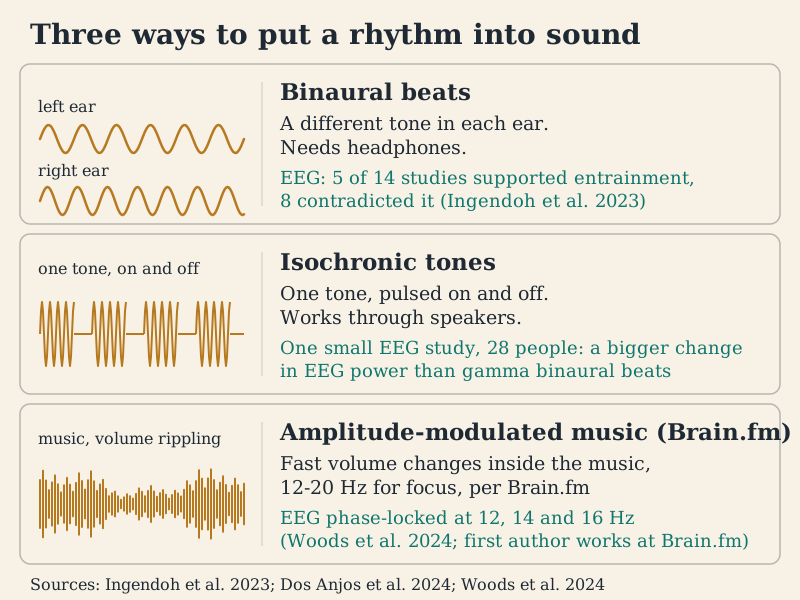
There are three common ways to put a rhythm into focus audio, and each has a different level of evidence behind it.
Binaural beats
Play one tone in your left ear and a slightly different one in your right, and you perceive a beat at the difference frequency. The idea is that brain rhythms entrain to it. It needs headphones.
A 2019 meta-analysis by Garcia-Argibay and colleagues pooled 22 studies (35 effect sizes) and found a medium overall effect, g = 0.45, across memory, attention, anxiety and pain. A 2023 systematic review by Ingendoh and colleagues found 5 of 14 EEG studies supported entrainment, 8 contradicted it and 1 was mixed. The authors called that literature "inconclusive at best". There's more in the complete guide to binaural beats for focus.
Isochronic tones
Isochronic tones use one tone, pulsed on and off. The rhythm is in the sound itself, so it works through speakers. One 2024 EEG study of 28 people (Dos Anjos et al.) found an isochronic-style stimulus changed EEG power more than gamma binaural beats. That's one small study. myNoise has free generators.
Amplitude modulation in music (Brain.fm's approach)
Here the rhythm is a fast change in volume inside the music. In Woods et al. 2024, published in Communications Biology, EEG showed phase-locking at the modulation rates of 12, 14 and 16 Hz, and fMRI showed more activity in attention networks. In the first experiment, strong modulation helped sustained attention when it was played early in the session.
The first three experiments tested 83 people online, 34 in fMRI and 40 in EEG. They compared a Brain.fm track with a calmer focus track by another artist and with pink noise. A fourth experiment, with 175 people online, changed only the modulation in otherwise identical music. In it, beta-range modulation at 16 Hz helped people with more self-reported ADHD symptoms more than other rates did. No study has compared Brain.fm with binaural beats or with the free apps named here. The first author, Kevin Woods, is Brain.fm's director of science.
All three aim to entrain brain rhythms. The EEG evidence is strongest for pulsing built into the sound and mixed for binaural beats.
What you're paying for
Convenience
Press play and the music starts. There are no frequency settings and no sounds to stack.
Music that doesn't sound like test tones
The tracks are human-composed, from lo-fi to classical, plus nature soundscapes. Pure tones can be tiring over long sessions, which is why most tools layer them under music or ambient sound. Brain.fm builds the rhythm into the music.
Purpose-built tracks, offline and an ADHD setting
Every focus track is made for the job, and Brain.fm says it tests its music against placebo versions of the same music. It also has the ADHD boost and offline downloads, which help on flights.
Its own research
Brain.fm has one peer-reviewed study of its music, from 2024, plus a 2019 preprint. Free binaural-beat tools rely on the general literature.
What you're not paying for
The basic idea isn't owned
Nobody owns the idea that brain rhythms lock onto rhythmic sound. The 2023 review checked it across 14 EEG studies of binaural beats. Brain.fm patents its specific way of doing it. No study has compared Brain.fm head-to-head with free binaural-beat tools, so whether a free Brain.fm alternative matches it is an open question.
Free tools worth knowing
- NSDR.co Focus Mode. It's free and has four modes, each with a preset binaural-beat frequency arc, plus ambient sounds, a timer, a Pomodoro timer and 49 focus sessions.
- myNoise. It has binaural-beat generators with 10 carriers, plus isochronic beats. It's free and ad-free, funded by donations.
- YouTube. It has plenty of binaural-beat focus music, free with ads. Quality varies, and most videos don't say what frequency they use.
- Spotify and Apple Music focus playlists. These offer focus music without binaural beats. Spotify's ad-supported plan is free; Apple Music needs a subscription.
Guided NSDR sessions
Brain.fm covers focus, relaxation, sleep and guided meditation, including body scans and a Power Nap activity, but it lists no NSDR sessions. If you want guided NSDR between work blocks, you need another tool.
NSDR.co has 50+ free guided NSDR and sleep sessions on the same site as Focus Mode. A 10-minute session before your first block is the simplest way to fit one in.
Brain.fm vs free tools: head-to-head comparison
Brain.fm prices are from its pricing page in October 2026.
| Brain.fm | NSDR.co Focus Mode | Other free tools (myNoise, YouTube, Spotify) | |
|---|---|---|---|
| Price | $14.99/month or $99.99/year | Free, always a free plan | Free (ads, donations or a free tier) |
| Free option | Free trial; no permanent free tier | Free to use | Free |
| Sound method | Amplitude modulation in human-composed music | Binaural beats | Binaural, isochronic or plain music |
| Frequency / intensity control | Adjustable level; no Hz control | Preset frequency arc per mode | Pick the Hz in many generators |
| Timer and Pomodoro | Yes (Infinite, Timer, Interval; built-in Pomodoro) | Yes (timer and Pomodoro) | Separate app |
| ADHD setting | Yes (ADHD boost / High Neural Effect) | None specific | None |
| Other sessions | Relax, Sleep, Meditate, Power Nap | 50+ guided NSDR and sleep sessions | Varies |
| Offline and platforms | Downloads; web, iOS, Android, desktop | Browser-based, needs a connection | Varies |
| Research | Own peer-reviewed study (2024) plus a 2019 preprint | General binaural-beat research (mixed) | Same general research (mixed) |
Brain.fm leads on offline use, the ADHD setting and product-specific research. Free tools lead on price and frequency choice.
When Brain.fm is worth it
- You want one button. There's no setup and no frequency to pick.
- Binaural beats haven't done anything for you. Brain.fm says binaural beats produce weak neural synchrony and that its modulation, built into each stereo channel, has much stronger effects on brain activity. That's the company's claim, but it's a different method and worth a trial.
- You have ADHD symptoms. Of the tools here, Brain.fm is the only one with its own ADHD-related study. In its 2024 study's fourth experiment, run online, 16 Hz modulation helped people with more self-reported ADHD symptoms more than other rates did. Focus music isn't a treatment for ADHD; talk to a clinician about treatment.
- You work offline or mostly on your phone. Brain.fm has downloads plus iOS and Android apps.
- You want a wide music library. The library runs from lo-fi to classical, plus nature soundscapes.
When free alternatives win
- A free tool already does the job. If a free Brain.fm alternative keeps you on task, you keep $100-180 a year.
- You want to pick the exact frequency. Brain.fm gives you modes and an intensity level, with no Hz setting. Many free generators let you choose.
- You want guided NSDR sessions next to your focus music. Brain.fm has none. NSDR.co's free sessions sit on the same site as Focus Mode.
- You're still testing whether focus audio helps you at all. The effects are modest, so start free.
- You have ADHD and want to try audio before paying. See free focus music for ADHD. One limit is that none of the free tools here has been tested for ADHD, and there's no research on NSDR plus focus music for ADHD.
Building your free focus stack
The quick setup
- Put on headphones, since binaural beats need a separate tone in each ear.
- Open NSDR.co's Focus Mode.
- Pick one of the 4 modes and stay with it for a few sessions, so you can tell what it does.
- Add an ambient sound if the tones alone get tiring.
- Start the Pomodoro timer, or set the timer yourself.
- Work until it ends.
Treat the frequencies as a starting point and keep whatever helps. One 25-minute block, the technique's standard length, is enough for a first try.
Adding rest between blocks
Start with a 10-minute NSDR session to settle in. Then run Pomodoro blocks: 25 minutes of work, 5 of break, and a 15-30 minute break after 4 work intervals. More on pairing the Pomodoro technique with binaural beats.
Prefer plain noise? Brown noise has no beat in it. One untested idea is to start with a lower frequency to warm up, then switch to a higher one for deep work.
Test it against a Brain.fm trial
Use the free trial to compare like with like: the same kind of task, several sessions with each tool. Keep the one you'd rather work with, and cancel before billing starts if free wins.
The research reality check
The 2019 meta-analysis found a medium average effect, g = 0.45. Its authors also found that the size and direction of the effect depended on the frequency, the listening time and when people listened, so the average can't tell you what one session will do. Brain.fm's own result is narrow. Strong modulation helped sustained attention early in the task, and in a separate experiment 16 Hz modulation helped people with more self-reported ADHD symptoms more than other rates did. No study has tested Brain.fm against binaural beats or the free apps named here.
Rhythmic sound may help sustained attention. The evidence is mixed for binaural beats, and for amplitude-modulated music it rests mainly on Brain.fm's own peer-reviewed study.
Sleep, exercise and clear tasks matter more than any soundtrack. For the rest, see focus techniques that don't rely on audio.
Start free, and pay for Brain.fm only if a trial clearly beats it for you.
FAQ
Is there a free Brain.fm alternative?
Yes, NSDR.co Focus Mode, myNoise, YouTube and Spotify's free plan are each a free Brain.fm alternative. Brain.fm offers a free trial but no permanent free tier, so afterwards you pay $14.99 a month or $99.99 a year.
Is Brain.fm the same as binaural beats?
No, Brain.fm is not the same as binaural beats. Binaural beats play a different tone in each ear and need headphones. Brain.fm adds amplitude modulation to the music itself, and says its method has much stronger effects on brain activity than binaural beats.
Does Brain.fm work?
One peer-reviewed 2024 study suggests Brain.fm can work, within limits. Strong modulation helped sustained attention early in the task, and in a separate online experiment 16 Hz modulation helped people with more self-reported ADHD symptoms more than other rates did. The first author works for Brain.fm, and the study compared it with pink noise and one other focus track, not with binaural beats or free apps.
Is Brain.fm worth $99.99 a year?
Brain.fm is worth $99.99 a year if the convenience, offline downloads or ADHD setting matter to you and a trial beats free tools for your work. If not, free tools save you $100-180 a year.
What's the best Brain.fm alternative for ADHD?
No free Brain.fm alternative here has been tested for ADHD, so the research can't name a best one. Of the tools here, only Brain.fm has its own ADHD-related study, which measured self-reported symptoms in an online sample. Free tools are still a reasonable first try. Focus music isn't a treatment for ADHD, so talk to a clinician about treatment.
Sources
- Woods KJP, Sampaio G, James T, Przysinda E, Cordovez B, Hewett A, Spencer AE, Morillon B, Loui P. (2024). Rapid modulation in music supports attention in listeners with attentional difficulties. Communications Biology, 7, 1376. https://www.nature.com/articles/s42003-024-07026-3
- Ingendoh RM, Posny ES, Heine A. (2023). Binaural beats to entrain the brain? A systematic review of the effects of binaural beat stimulation on brain oscillatory activity, and the implications for psychological research and intervention. PLOS ONE, 18(5), e0286023. https://pubmed.ncbi.nlm.nih.gov/37205669/
- Garcia-Argibay M, Santed MA, Reales JM. (2019). Efficacy of binaural auditory beats in cognition, anxiety, and pain perception: a meta-analysis. Psychological Research, 83(2), 357-372. https://pubmed.ncbi.nlm.nih.gov/30073406/
- Dos Anjos T, Di Rienzo F, Benoit CE, Daligault S, Guillot A. (2024). Brain wave modulation and EEG power changes during auditory beats stimulation. Neuroscience, 554, 156-166. https://pubmed.ncbi.nlm.nih.gov/39004412/
- Woods KJP, Hewett A, Spencer A, Morillon B, Loui P. (2019). Modulation in background music influences sustained attention. arXiv preprint 1907.06909 (not peer-reviewed). https://arxiv.org/abs/1907.06909
Product and pricing pages:
- Brain.fm home page: https://www.brain.fm
- Brain.fm pricing: https://www.brain.fm/pricing
- Brain.fm science: https://www.brain.fm/science
- Brain.fm white paper: https://www.brain.fm/pdfs/white-paper.pdf
- Brain.fm Pomodoro timer page: https://www.brain.fm/procrastination
- Brain.fm blog, "Is Brain.fm worth it": https://www.brain.fm/blog/is-brain-fm-worth-it
- Brain.fm on the App Store: https://apps.apple.com/us/app/brain-fm-focus-sleep-music/id1110684238
- myNoise: https://mynoise.net
- Spotify plans: https://www.spotify.com/us/premium/
- Apple Music: https://www.apple.com/apple-music/
- Pomodoro technique (TechTarget): https://www.techtarget.com/whatis/definition/pomodoro-technique