The Huberman sleep cocktail is three supplements taken 30 to 60 minutes before bed: 145 mg magnesium threonate, 50 mg apigenin and 100 to 400 mg L-theanine. On some nights he adds 2 g glycine and 100 mg GABA, and on others 900 mg myo-inositol. These doses come from his 2021 "Toolkit for Sleep" newsletter and his 2022 Sleep Toolkit episode. No trial has tested the combination, and he suggests starting with one supplement, or none.
Health note: supplements don't treat sleep disorders. If you take any medication, are pregnant or breastfeeding, or have kidney disease, check with your doctor before trying them.
The Huberman sleep cocktail: exact supplements and doses
| Supplement | Dose | How often | Where he says it |
|---|---|---|---|
| Magnesium threonate | 145 mg | Before bed | 2021 newsletter, 2022 episode |
| Magnesium bisglycinate (alternative to threonate) | 200 mg | Before bed | 2021 newsletter only |
| Apigenin | 50 mg | Before bed | 2021 newsletter, 2022 episode |
| L-theanine | 100 to 400 mg | Before bed | 2021 newsletter, 2022 episode |
| Glycine + GABA | 2 g + 100 mg | "3-4 nights per week" (newsletter), "every third or fourth night" (episode) | Both |
| Myo-inositol | 900 mg | Every other night, never on glycine and GABA nights | 2022 episode only |
The first three are the core, and the rest are extras for some nights. He suggests taking them 30 to 60 minutes before bed, especially if you haven't eaten for about three hours.
Why other sites list different doses
First, 145 mg refers to the magnesium alone. Momentous, the brand his newsletter names, states on its label "Magnesium 145mg (from 2g Magtein® Magnesium L-threonate)". Second, his numbers changed. In his January 2021 episode "Master Your Sleep" he said he took "3 or 400 milligrams of magnesium threonate" and 100 to 200 mg of theanine. Third, inositol isn't in the newsletter. It first appears in his 2022 episode.
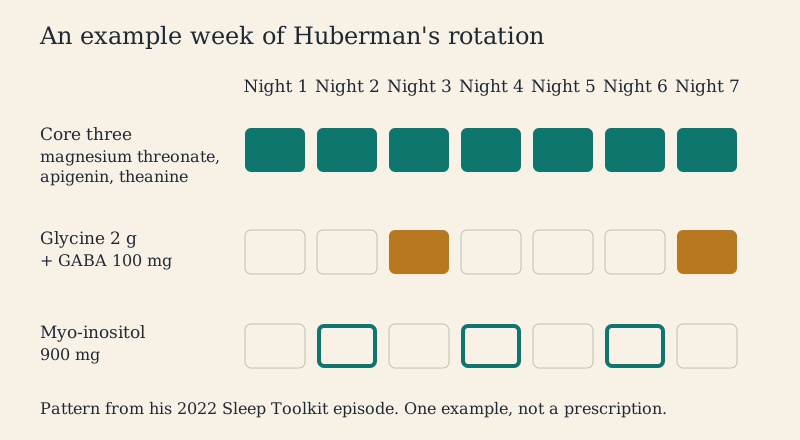
An example week
He adds glycine and GABA only every third or fourth night because, in his words, "if I take it too often, I find that the entire sleep stack doesn't work quite as effectively." Inositol goes on alternate nights, never on a glycine night.
Who should skip parts of the stack
- Theanine, if you sleepwalk or have intense dreams. His newsletter is blunt: "Don't take theanine if you have overly intense dreams, sleep-walk, or have night terrors." In the 2022 episode he says some people find theanine's dreams vivid enough to wake them, even at 100 mg.
- Apigenin, if you want to keep your estrogen where it is. In "Master Your Sleep" Huberman calls apigenin "a fairly potent estrogen inhibitor" and says women who want to keep their estrogen levels where they are should probably avoid it. Men need estrogen too, he adds. That's his caution, not a trial result.
- Magnesium, if it upsets your stomach. Huberman puts this at about 5% of people, and his advice is to stop taking it.
- Magnesium, if you have kidney disease. Your kidneys control magnesium balance, and dangerously high blood magnesium is seen almost only in people with poor kidney function who take a lot of it in supplements or antacids.
- Anything, if you take sleep or anxiety medication. Ask your doctor first if you take a sleeping pill, a benzodiazepine or other sedative, or anxiety medication. In a 1995 lab study, apigenin bound the same brain receptor site as benzodiazepines.
- Anything, if you're pregnant, breastfeeding or under 18. These are adult doses. Ask your doctor.
What the evidence says for each ingredient
Huberman says the three core supplements "together can really enhance the speed at which one falls asleep and people's ability to stay asleep". One published trial has tested that combination. In 2026, 25 healthy adults took it every evening for two weeks, and their sleep-disturbance scores were no different from placebo (Mastrofini 2026, funded by the supplement maker Momentous). The rest of the evidence below is for each ingredient alone.
Magnesium threonate
Threonate was developed to raise magnesium in the brain, and in a 2010 study it did that in rats. The main human sleep trial gave 80 adults aged 35 to 55 with self-reported sleep problems 1 g a day of magnesium L-threonate or a placebo for 21 days. Oura ring scores for deep and REM sleep improved, as did next-day mood and energy ratings. Three of the authors work for AIDP, which sells the ingredient. More in magnesium threonate for sleep.
Apigenin
Apigenin is a plant compound found in chamomile, though Momentous makes its version from grapefruit. In a 1995 lab and mouse study it bound the benzodiazepine site and made mice less anxious without sedating them. Ten times the dose made them mildly sedated. No published trial has tested 50 mg of apigenin for sleep in people. The closest is a pilot in 34 adults with chronic insomnia who took 270 mg of chamomile extract twice a day for 28 days, and their sleep diaries didn't differ from placebo. See apigenin for sleep.
L-theanine
Theanine is an amino acid from tea. In a small Unilever-funded EEG study, 50 mg raised alpha brain activity in people resting with their eyes closed, a sign of a relaxed mind without drowsiness. An independent 2025 meta-analysis of 19 studies and 897 people found small gains, and every significant one was self-rated. A 2025 review by British American Tobacco researchers settled on 200 to 450 mg a day, above Huberman's 100 mg floor. More in L-theanine for sleep.
Glycine and GABA
Glycine lowered core body temperature and sped up sleep onset in rats. In people, Ajinomoto, which makes glycine, reports better self-rated sleep in people with insomnia tendencies who took it before bed, and less next-day fatigue after 3 g in sleep-restricted volunteers. Huberman takes 2 g. See glycine for sleep.
GABA is the brain's main calming messenger, but there's little evidence that swallowing it helps sleep. A 2020 review of 14 studies found "very limited evidence" that oral GABA helps. One 40-person trial of 300 mg a day did report faster sleep onset after four weeks.
Myo-inositol
Huberman says inositol "turns out to be especially useful for people who have a tendency to wake up in the middle of the night and have a hard time falling back asleep." That comes from his own use. A PubMed search turned up no sleep trial of inositol.
How to start: one supplement at a time
From his newsletter: "I would start with one supplement (or none!) and then add one at a time as needed." In the 2022 episode he puts supplements third in line, after "behavioral tools first, then look to nutrition".
- Trouble falling asleep. Start with one core supplement. Magnesium threonate and theanine have small human sleep trials. Apigenin has none.
- Waking in the night and staying awake. That's what Huberman uses inositol for.
- Still stuck after a week or two. Add the next one. The gap is a rule of thumb, and no study has tested it.
If something goes wrong
- Stomach upset: stop the magnesium.
- Disruptive dreams: drop the theanine.
- Groggy mornings: Huberman says theanine and magnesium together make some people sleep so deeply they struggle to wake, so adjust the doses.
- No change: go back to light, caffeine timing and a cool room. Insomnia that lasts months needs a doctor.
If you wake at 3 am and can't get back to sleep, his newsletter suggests "doing an NSDR protocol when you wake up". NSDR for sleep covers how to do it in bed.
Momentous or another brand
Huberman's newsletter says he uses Momentous, "or you can pick another source you like and trust." Momentous's "huberman-sleep-stack" web address now redirects to Nightly Sleep, a blend of 200 mg magnesium bisglycinate, 200 mg L-theanine and 50 mg apigenin, with no threonate. The single products list at $49.99 for magnesium L-threonate, $24.99 for apigenin and $39.99 for L-theanine, checked on 8 October 2026.
Single-ingredient products let you change one dose without touching the others, which is why Huberman points people to them. For the rest of his stack, see Huberman's full supplement list.
Why no melatonin?
Huberman leaves melatonin out on purpose. Most products, he says, contain "far, far, far greater" doses than the body makes, and melatonin interacts with other hormone systems, including puberty in children. He adds that occasional use for jet lag is probably fine.
The research gives it a modest role. A 2013 meta-analysis of 19 studies in 1,683 people with sleep disorders found melatonin helped them fall asleep about 7 minutes faster and sleep about 8 minutes longer than placebo. Small doses can work: in an MIT sleep-lab study, 0.3 mg in the evening shortened the time to fall asleep with no hangover the next day. Labels are unreliable, though. A 2017 test of 31 supplements found melatonin content from 83% below to 478% above the stated dose.
FAQ
How long does the Huberman sleep cocktail take to work?
Nobody knows how long the Huberman sleep cocktail takes. The one trial of the combination lasted two weeks and found no effect on sleep in healthy adults. The magnesium threonate trial ran for 21 days. As a rule of thumb, give each new supplement a week or two before judging it.
Can you take all the supplements together?
Huberman takes the three core supplements together and adds glycine and GABA or inositol on separate nights. He still recommends starting with one.
Should women take apigenin?
Huberman says women who want to keep their estrogen where it is should probably avoid apigenin. No human trial has checked his concern. Magnesium and theanine are the other core options, and if you use hormone therapy, ask your doctor.
What if I sleepwalk?
If you sleepwalk, skip the theanine. His newsletter says not to take it if you sleepwalk, have night terrors or have overly intense dreams.
Is it safe to take the Huberman sleep cocktail every night?
Huberman calls the core three his standard stack, and he limits glycine and GABA because taking them more often seemed to make the stack work less well for him. Nobody has studied the long-term safety of the combination, so if you take medication or have kidney disease, ask your doctor first.
Sources
- Mastrofini GF et al. 2026. Modulating stress and sleep through a multi-compound dietary supplement: a randomized, double-blind, placebo-controlled trial. Journal of the International Society of Sports Nutrition. https://pubmed.ncbi.nlm.nih.gov/42829807/
- Huberman A. 2021. Toolkit for Sleep. Huberman Lab Neural Network newsletter, 20 September 2021. https://www.hubermanlab.com/newsletter/toolkit-for-sleep
- Huberman A. 2022. Sleep Toolkit: Tools for Optimizing Sleep & Sleep-Wake Timing. Huberman Lab podcast, 8 August 2022. https://www.hubermanlab.com/episode/sleep-toolkit-tools-for-optimizing-sleep-and-sleep-wake-timing
- Huberman A. 2021. Master Your Sleep & Be More Alert When Awake. Huberman Lab podcast, 11 January 2021. https://www.hubermanlab.com/episode/master-your-sleep-and-be-more-alert-when-awake
- Momentous. Magnesium L-Threonate (label) and Nightly Sleep product pages, checked 8 October 2026. https://www.livemomentous.com/products/magnesium-threonate and https://www.livemomentous.com/products/nightly-sleep
- Slutsky I et al. 2010. Enhancement of learning and memory by elevating brain magnesium. Neuron. https://pubmed.ncbi.nlm.nih.gov/20152124/ [rats]
- Hausenblas HA et al. 2024. Magnesium-L-threonate improves sleep quality and daytime functioning in adults with self-reported sleep problems: a randomized controlled trial. Sleep Medicine: X. https://pubmed.ncbi.nlm.nih.gov/39252819/ [AIDP co-authors]
- Nutritional Outlook. AIDP now distributing patented magnesium ingredient for cognitive health. https://www.nutritionaloutlook.com/view/aidp-now-distributing-patented-magnesium-ingredient-cognitive-health
- Viola H et al. 1995. Apigenin, a component of Matricaria recutita flowers, is a central benzodiazepine receptors-ligand with anxiolytic effects. Planta Medica. https://pubmed.ncbi.nlm.nih.gov/7617761/ [lab and mouse study]
- Zick SM et al. 2011. Preliminary examination of the efficacy and safety of a standardized chamomile extract for chronic primary insomnia: a randomized placebo-controlled pilot study. BMC Complementary and Alternative Medicine. https://pubmed.ncbi.nlm.nih.gov/21939549/
- Nobre AC, Rao A, Owen GN. 2008. L-theanine, a natural constituent in tea, and its effect on mental state. Asia Pacific Journal of Clinical Nutrition. https://pubmed.ncbi.nlm.nih.gov/18296328/ [Unilever]
- Bulman A et al. 2025. The effects of L-theanine consumption on sleep outcomes: a systematic review and meta-analysis. Sleep Medicine Reviews. https://pubmed.ncbi.nlm.nih.gov/40056718/
- Cotter J et al. 2025. Examining the effect of L-theanine on sleep: a systematic review of dietary supplementation trials. Nutritional Neuroscience. https://pubmed.ncbi.nlm.nih.gov/41176609/ [British American Tobacco R&D authors]
- Kawai N et al. 2015. The sleep-promoting and hypothermic effects of glycine are mediated by NMDA receptors in the suprachiasmatic nucleus. Neuropsychopharmacology. https://pubmed.ncbi.nlm.nih.gov/25533534/ [rats; Ajinomoto]
- Bannai M, Kawai N. 2012. New therapeutic strategy for amino acid medicine: glycine improves the quality of sleep. Journal of Pharmacological Sciences. https://pubmed.ncbi.nlm.nih.gov/22293292/ [Ajinomoto]
- Bannai M et al. 2012. The effects of glycine on subjective daytime performance in partially sleep-restricted healthy volunteers. Frontiers in Neurology. https://pubmed.ncbi.nlm.nih.gov/22529837/ [Ajinomoto]
- Hepsomali P et al. 2020. Effects of oral gamma-aminobutyric acid (GABA) administration on stress and sleep in humans: a systematic review. Frontiers in Neuroscience. https://pubmed.ncbi.nlm.nih.gov/33041752/
- Byun JI et al. 2018. Safety and efficacy of gamma-aminobutyric acid from fermented rice germ in patients with insomnia symptoms: a randomized, double-blind trial. Journal of Clinical Neurology. https://pubmed.ncbi.nlm.nih.gov/29856155/
- Van Laecke S. 2019. Hypomagnesemia and hypermagnesemia. Acta Clinica Belgica. https://pubmed.ncbi.nlm.nih.gov/30220246/
- Ferracioli-Oda E, Qawasmi A, Bloch MH. 2013. Meta-analysis: melatonin for the treatment of primary sleep disorders. PLoS ONE. https://pubmed.ncbi.nlm.nih.gov/23691095/
- Zhdanova IV et al. 1995. Sleep-inducing effects of low doses of melatonin ingested in the evening. Clinical Pharmacology & Therapeutics. https://pubmed.ncbi.nlm.nih.gov/7768078/
- Erland LA, Saxena PK. 2017. Melatonin natural health products and supplements: presence of serotonin and significant variability of melatonin content. Journal of Clinical Sleep Medicine. https://pubmed.ncbi.nlm.nih.gov/27855744/