
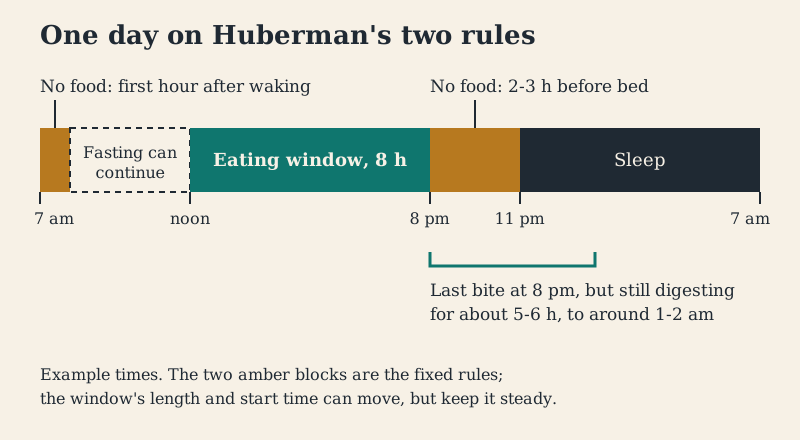
The Huberman fasting protocol has two fixed rules: no food for at least the first hour after you wake up, and no food or liquid calories for two, ideally three, hours before bed. Everything else, including how long your eating window is, he treats as adjustable, with 8 hours as his usual target. Below are both rules in his words, how to pick and place your window, what does and doesn't break a fast, and what the human trials have found since the episode aired in October 2021.
Huberman's two core fasting rules
The source is Huberman Lab episode 41, "Effects of Fasting & Time Restricted Eating on Fat Loss & Health". Andrew Huberman is a Stanford professor of neurobiology and ophthalmology, and he says he consulted Satchin Panda of the Salk Institute, whose lab did much of the early work on time-restricted eating. About 40 minutes in, he sets out the two rules:
“"One of the key pillars of intermittent fasting is that, for the first hour after you wake up and potentially for longer, to not ingest any food. The second major pillar, that's well supported by research, is that for the two and ideally three hours prior to bedtime you also don't ingest any food, or liquid calories for that matter."
“
Window length and start time are the parts he lets you adjust, though he also wants the window in roughly the same place every day.
Why the 8-hour window is 8 hours
The 8-hour number comes from mice. In Panda's 2012 study, mice ate a high-fat diet either around the clock or for 8 hours a day. Both groups ate the same calories, but the 8-hour mice were protected against obesity, high insulin, fatty liver and inflammation.
Why 8 and not 9 or 10? By Huberman's account, which he notes isn't in the paper, the study needed "the constant presence of the graduate student or postdoc there to ensure that the food is in the cages at particular times and not in the cages at other times". Mice even hide food in their jowls. An 8-hour window already meant 10- to 12-hour lab days, and the researcher's partner wouldn't accept longer ones.
"So when we hear the eight-hour feeding windows are holy, they are not holy," he says. He still lands on 8 hours as "the best target feeding window, at least by my read of the literature", and says a 7- to 9-hour window gets the main benefits.
How to choose and place your eating window
Aim shorter than your goal
Panda's app data showed that almost everyone underestimates their eating window by one or even two hours, thanks to a glass of wine after dinner or a bite of cookie with tea. So Huberman's advice is:
“"if you'd like to be on a 10-hour feeding window, that you should probably select an eight-hour feeding window, because there's always a little bit of a taper on either side of that eating window."
“
By the same logic, if you want 8 hours, set 6 or 7.
How long a window
| Window | What Huberman says |
|---|---|
| 7 to 9 hours (8 as the target) | Gets the main benefits, and people seem to stick with it. Don't go below 8 if you train hard |
| 4 to 6 hours | Improved some markers, such as insulin sensitivity and blood pressure, but weight stayed the same or rose, likely from overeating |
| One meal a day | Very few studies; people maintained or lost weight, but it "may actually cause people to undereat" |
When to place it: best, better, worst
Best for health is the middle of the day, say 10 am to 6 pm, which extends the fast on both sides of sleep. He also calls it "an absolutely dreadful schedule for anyone that wants to have some semblance of a normal life".
Better is starting around 10 am or noon and finishing by 6 or 8 pm. Noon to 8 pm, give or take half an hour, is "a perfectly reasonable schedule".
Worst is a window running from 2 or 3 pm to 10 or 11 pm. You go to bed still digesting, which in his view costs you the fast that happens during sleep.
Keep it in the same place
A window that shifts on weekends, say noon to 8 pm on weekdays and brunch at 10 on Sunday, is "effectively like jet lagging your system", he says, and takes at least two to three days to recover from. To move to a new window, take a week to 10 days, shifting about an hour a day.
Eating isn't the same as being fasted
Your last bite doesn't start the fast. In Huberman's words, "the clearance of that food from our gut and the processes in our cells and organs that are related to digestion and the utilization of that food takes about five to six hours."
So if dinner ends at 8 pm and you go straight to the couch or to bed, you aren't fasted until around 1 or 2 am. A smaller, lower-fat meal clears faster, sometimes in about three hours, and a large, fatty one takes longer.
That's the reason for the bedtime rule. In Huberman's view the fasting you do during sleep matters most, and eating too close to bed "will disrupt that fasting-related sleep." For the rest of the evening, see a full-day sleep hygiene checklist.
Three ways to speed up the switch to fasted
A 20- to 30-minute walk after eating
Huberman repeats the old advice that "if you take a 20- or 30-minute walk after dinner, that it accelerates the rate at which you digest that food. And indeed it does." It doesn't have to be fast, and air squats and push-ups work if you can't get outside.
The blood sugar part has decent support: a 2022 meta-analysis of seven one-day trials, mostly in adults with overweight or obesity, found that short light-walking breaks during long sitting lowered post-meal glucose and insulin compared with sitting straight through. For longer easy sessions, see Zone 2 cardio.
High-intensity intervals, later in the day
Huberman says high-intensity interval training, "provided it's done in the second half of the day, can lower blood glucose and speed the transition from fed to fasted states." The timing point fits a small 2019 trial: in 11 men with type 2 diabetes, two weeks of afternoon HIIT lowered blood sugar and morning HIIT raised it. If you need caffeine for an evening session and it wrecks your sleep, he says it's a net loss.
Berberine and metformin
Metformin is a prescription drug and berberine is sold over the counter. Huberman says both "will lead to very dramatic reductions in blood glucose", and he's blunt about the downside:
“"If you take berberine and you have not ingested carbohydrates, many people, including myself, experience a splitting headache. You become hypoglycemic because it is a glucose clearing agent."
“
He says the response "varies tremendously from one individual to the next", that for some people the right dose is zero, and that a walk is far easier to adjust than a pill. Of people taking them to mimic fasting, he says, "I'm not necessarily suggesting that you do that". Don't use either for fasting without your doctor, especially if you take other medication.
What breaks a fast
On the Huberman fasting protocol, the answer depends on where you are in the fast, because blood glucose is the main readout. In his example, "eating one peanut when deep in a fasted state will not break your fast", but one peanut an hour after a large or carb-heavy meal could.
| Item | Breaks a fast? (Huberman's view) |
|---|---|
| Water, plain tea, black coffee, caffeine pills | No |
| Anything with sugar, such as sweetened coffee or soda | Likely yes |
| Pure fat, such as a splash of cream | Probably not, if you've fasted 5 hours or more |
| Artificial or plant sweeteners | Depends on the amount and type; probably fine in moderation |
| Toothpaste | No, unless you swallow it |
| Half a glass of wine a couple of hours after dinner | Yes |
If you feel shaky or lightheaded before your window opens, he suggests a pinch of salt in water, especially if you drink coffee, which makes you lose sodium (see how long caffeine stays in your system). People with high blood pressure should be wary of extra sodium, he adds.
What the human trials found
Huberman opens the episode with a warning: in a 2021 study, higher fasting blood glucose was linked to higher mortality in humans and monkeys but lower mortality in mice. Much of the time-restricted eating story started in mice.
The human study he cites for the 8-hour window, Gabel 2018, put 23 adults with obesity on a 10 am to 6 pm window for 12 weeks. Compared with a historical control group, they lost 2.6% of their body weight, ate about 341 fewer calories a day without counting, and saw systolic blood pressure fall by about 7 mmHg. Fasting glucose, insulin and cholesterol didn't differ.
Two larger randomized trials have tested it since:
- TREAT (2020). 116 adults ate only between noon and 8 pm for 12 weeks. Weight loss was no different from a group eating three meals a day.
- Liu et al. (2022, NEJM). 139 adults with obesity cut calories for 12 months, with or without an 8 am to 4 pm window. The window group lost 8.0 kg and the calorie-only group 6.3 kg, a difference that wasn't significant.
The fairest reading is that a fixed window can help some people eat less, and eating less is what moves weight. The 23 people in Gabel's pilot ate about 341 fewer calories a day, but in TREAT intake didn't differ from the three-meals group. Huberman himself says calories still decide weight loss, and the 2022 review he leans on calls the human results promising but asks for more trials.
Two smaller claims in the episode have limits too. The drop in Lactobacillus gut bacteria was shown in mice, and the study linking fatty liver to less active brown fat (60 adults) didn't test fasting.
Huberman's own fasting routine
He isn't strict. He says, "in my case, I use a 10-hour feeding window or so", and later describes "a kind of eight- to 10-hour-ish window, either early in the day or late in the day." Waiting until noon, 1 or 2 pm to eat is easy for him. He exercises early, and after hard weight training or sprints at 7 or 8 am he's very hungry by 11. More of his habits are in Huberman's wider daily routine.
Who should be careful
Huberman flags these groups himself:
- People who train hard. "I would not suggest that people restrict their feeding window to less than eight hours, especially if they're training hard on a regular basis." In a 4-week trial, 16 elite young cyclists were split between normal eating and eating their full calories from 10 am to 6 pm. In the 10-to-6 group, free testosterone and IGF-1 fell.
- People trying to conceive. He warns against a window that's too short.
- Anyone who feels worse. "Some people do not do well on intermittent fasting either in terms of mood or hormone health."
- People with diabetes. He tells everyone, and people with diabetes especially, to talk to their physician first.
The same goes for anyone on glucose-lowering medication.
This is general information, not medical advice. If you have diabetes, take medication, are pregnant or have a history of disordered eating, check with your doctor before changing when you eat.
FAQ
Does black coffee break a fast?
No, black coffee doesn't break a fast on the Huberman fasting protocol, and neither do water, plain tea or caffeine pills. Sugar in the coffee likely does; a splash of cream probably doesn't if you're five or more hours in.
How long should my eating window be?
An eight-hour eating window is Huberman's usual target, with 7 to 9 hours getting the main benefits. Set it an hour or two shorter than you're aiming for, because most people eat a little outside it.
How long does it take to adjust to a new eating window?
Adjusting to a new eating window takes about a week to 10 days. Move it by roughly an hour a day rather than all at once.
Does time-restricted eating help you lose weight?
Time-restricted eating may help some people eat less, which seems to be how it helps with weight when it does. But in two larger trials it did no better than eating normally (116 adults, 12 weeks) or cutting calories without a window (139 adults, 12 months).
Sources
- Huberman A (2021). Effects of Fasting & Time Restricted Eating on Fat Loss & Health. Huberman Lab Podcast, episode 41, 11 October 2021. Transcript: https://www.hubermanlab.com/episode/effects-of-fasting-and-time-restricted-eating-on-fat-loss-and-health. Video: https://www.youtube.com/watch?v=9tRohh0gErM
- Hatori M et al. (2012). Time-restricted feeding without reducing caloric intake prevents metabolic diseases in mice fed a high-fat diet. Cell Metabolism. https://pubmed.ncbi.nlm.nih.gov/22608008/
- Gabel K et al. (2018). Effects of 8-hour time restricted feeding on body weight and metabolic disease risk factors in obese adults: a pilot study. Nutrition and Healthy Aging. https://pubmed.ncbi.nlm.nih.gov/29951594/
- Lowe DA et al. (2020). Effects of time-restricted eating on weight loss and other metabolic parameters in women and men with overweight and obesity: the TREAT randomized clinical trial. JAMA Internal Medicine. https://pubmed.ncbi.nlm.nih.gov/32986097/
- Liu D et al. (2022). Calorie restriction with or without time-restricted eating in weight loss. New England Journal of Medicine. https://pubmed.ncbi.nlm.nih.gov/35443107/
- Manoogian ENC, Chow LS, Taub PR, Laferrère B, Panda S (2022). Time-restricted eating for the prevention and management of metabolic diseases. Endocrine Reviews. https://pubmed.ncbi.nlm.nih.gov/34550357/
- Moro T et al. (2020). Time-restricted eating effects on performance, immune function, and body composition in elite cyclists: a randomized controlled trial. Journal of the International Society of Sports Nutrition. https://pubmed.ncbi.nlm.nih.gov/33308259/
- Savikj M et al. (2019). Afternoon exercise is more efficacious than morning exercise at improving blood glucose levels in individuals with type 2 diabetes: a randomised crossover trial. Diabetologia. https://pubmed.ncbi.nlm.nih.gov/30426166/
- Buffey AJ, Herring MP, Langley CK, Donnelly AE, Carson BP (2022). The acute effects of interrupting prolonged sitting time in adults with standing and light-intensity walking on biomarkers of cardiometabolic health in adults: a systematic review and meta-analysis. Sports Medicine. https://pubmed.ncbi.nlm.nih.gov/35147898/
- Palliyaguru DL et al. (2021). Fasting blood glucose as a predictor of mortality: lost in translation. Cell Metabolism. https://pubmed.ncbi.nlm.nih.gov/34508697/
- Zarrinpar A, Chaix A, Yooseph S, Panda S (2014). Diet and feeding pattern affect the diurnal dynamics of the gut microbiome. Cell Metabolism. https://pubmed.ncbi.nlm.nih.gov/25470548/
- Ahmed BA et al. (2021). Lower brown adipose tissue activity is associated with non-alcoholic fatty liver disease but not changes in the gut microbiota. Cell Reports Medicine. https://pubmed.ncbi.nlm.nih.gov/34622234/