The window of tolerance is the range of arousal in which you can think, feel and cope without being overwhelmed or shutting down. Above it, you tip into hyperarousal: wired, panicky, irritable, quick to react. Below it, you drop into hypoarousal: numb, flat, detached, withdrawn. It's a clinical model that therapists use as a map. It isn't a diagnosis, and we found no trial that has tested it.
This guide covers what the model says, what each side can feel like, what tends to narrow your window, what the evidence says about widening it, and what to try when you're outside it.
What is the window of tolerance?
The idea comes from Dan Siegel, who introduced it in 1999 in his book The Developing Mind. Think of your arousal as a level that rises and falls through the day. Inside the window, stress still happens, but you can take it in, think about it and respond. Outside it, you either get overwhelmed or shut down.
Therapists use the model to explain emotional regulation, especially with people who have been through trauma. A clinician guide from Psychology Tools describes the window as dynamic. It says the window can shift with stress or tiredness, and that consistent practice and therapy can widen it.
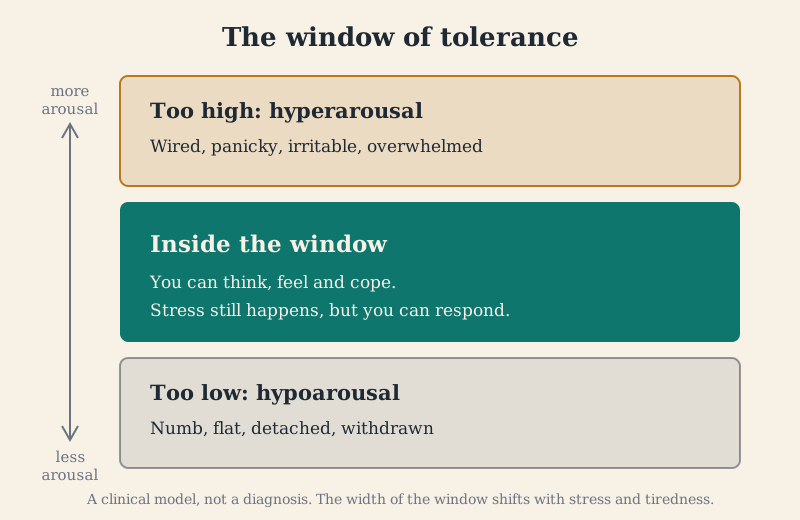
The picture is a simplification. Your window isn't a fixed width, and the edges aren't sharp lines. What it gives you is a way to ask, in the moment, "Am I too high, too low, or OK?"
Hyperarousal and hypoarousal
These are the two ways out of the window. The signs below are common ones, not a checklist, and having some of them doesn't mean anything is wrong with you.
| What it can feel like | What you might do | |
|---|---|---|
| Too high (hyperarousal) | A faster heartbeat and tense muscles. Overwhelmed, worrying constantly, panicky, hard to concentrate | Snap at people, act on impulse |
| Too low (hypoarousal) | Numb, with few or no feelings. Disconnected from yourself and the world around you | Withdraw from people |
The top row overlaps with the signs of stress the NHS lists. The bottom row comes from how clinicians describe hypoarousal: emotional numbing, dissociation and withdrawal.
You may also hear about hypervigilance, which the NHS describes as feeling very anxious and looking for danger all the time. It belongs on the high side.
For longer lists of signs on both sides, see our guide to nervous system dysregulation.
What narrows your window
No study has measured any of these against the window itself. Some have research behind a related effect, and others are common experience, and each item says which.
- Sleep loss. In a small 2007 brain-scan study of 26 healthy adults aged 18 to 30, the amygdala, a brain region involved in processing emotion, responded about 60% more strongly to unpleasant pictures after about 35 hours awake than in people who had slept normally. That was a full day and night without sleep, not a short night, and the study measured brain activity, not mood.
- Caffeine. It's a stimulant, and many people find it leaves less room to cope. Its effects can start 15 to 30 minutes after you have it and last for hours, and in healthy adults it takes about four hours on average to clear half of it. More in our caffeine half-life guide.
- Stress that never lets up. Most people feel stressed sometimes. The NHS adds that if you're stressed all the time, it can become a problem. Our guide to allostatic load explains why rest alone may not undo it.
- Too much input. Common experience: noise, screens, people and tasks all at once. That moment has its own guide: overstimulated.
- Being unwell. In a small 2026 interview study, 11 adults described being more irritable and reactive while ill, with everyday stress they would normally handle becoming overwhelming.
- Past trauma. The Psychology Tools guide describes PTSD and complex PTSD as marked by narrowed or unstable windows. If you think past trauma is part of what's going on, a trained therapist is the right route, not an article.
Is the window of tolerance evidence-based?
Not yet. The window of tolerance is a clinical model drawn from trauma care. It's a useful way to describe what happens, and we found no trial that tested it as such.
A PubMed search on 21 October 2026 found 30 papers with the phrase in the title or abstract. None was indexed as a clinical trial. Several were about something else entirely, such as immune-system "tolerance". The psychology papers among them are mostly theory papers, interview studies and questionnaire studies, which describe or discuss the model rather than test it.
Some explanations of the window pair it with polyvagal theory. In 2026, 39 experts in vagus nerve physiology and evolution co-authored a paper concluding that theory is "untenable". Nothing in this post depends on it.
So when people talk about widening the window, they mean getting better at handling stress and settling afterwards. We found no study that measured the width of a window. The practices below are judged on what they did for stress, anxiety or mood in their own studies.
What may help widen your window
No study has shown that any of these widens the window. Some have evidence for a related effect, the rest are general advice, and all are cheap to try.
Regular sleep. One full night without sleep changed brain responses to unpleasant pictures in the 2007 study, so protecting your sleep is a sensible place to start. Keep caffeine earlier in the day if evenings are hard.
Slow breathing. Your heart speeds up a little on each breath in and slows a little on each breath out, which researchers think is mostly the vagus nerve at work.
Cyclic sighing. In a 2023 Stanford trial (108 people enrolled), five minutes a day of cyclic sighing for a month raised daily positive mood and slowed breathing more than mindfulness meditation. Anxiety fell in both the breathwork and mindfulness groups, with no significant difference between them. More in our guide to the physiological sigh.
HRV biofeedback. This is training with a heart-rate sensor that shows your heart rhythm while you breathe slowly. A 2017 meta-analysis of 24 studies with 484 adults found it went with a large drop in self-reported stress and anxiety. Every outcome was self-reported, and the authors called for better-controlled studies.
Movement and time with people. The NHS suggests exercise and talking about your feelings to a friend, family member or health professional as ways to help with stress. Neither has been tested against the window itself.
For a step-by-step plan that puts several of these together, see how to reset your nervous system.
If you'd like slow, body-led practices to try at home, our guide to gentle somatic exercises gives seven, each with a plain line on what the research shows.
When you're outside the window
These are general suggestions, not treatment. Pick what suits the side you're on.
If you're too high (wired, panicky, irritable):
- Cut the input. Leave the room, turn the screen face down, put headphones on.
- Try the NHS breathing exercise for stress. Breathe in gently through your nose and out through your mouth, counting from 1 to 5 each way if that helps, for at least 5 minutes.
- Use a slow sigh. Breathe in through your nose, take a second, shorter breath in on top when your lungs feel full, then breathe out slowly until they feel empty. You can do it all through your nose.
- Walk slowly for a few minutes.
Never practise breathwork in water or while driving.
For more options, see how to calm down fast. If noise and people are the problem, our overstimulated guide goes further.
If you're too low (flat, numb, disconnected):
- Move gently. Stand up, stretch, walk around the room.
- Get some daylight, even at a window.
- Make a warm drink and hold it.
- Do one small task. The NHS suggests setting small targets you can easily achieve.
- Get in touch with someone you trust.
If you'd like a voice to follow, lie down for ten minutes with your eyes closed and let a guided rest take you through your body and your breathing. Think of it as a short reset for a stressful afternoon.
In two small trials of physically active young adults, 10 minutes of NSDR lowered self-rated stress more than a control condition (65 people in 2024, 102 in 2026). The effect in the larger trial was small. Neither trial reported on people with an anxiety disorder.
When to get help
The window of tolerance is a map for everyday ups and downs. If any of the signs below sound familiar, talk to a professional.
“See a GP or a qualified therapist if:
- you have flashbacks, nightmares, or vivid images or thoughts of a past event that keep coming back
- you feel disconnected from yourself and the world around you
- you get panic attacks, a rush of intense mental and physical symptoms that can come on very quickly
- you have symptoms of depression for most of the day, every day, for more than 2 weeks
- you're struggling to cope with stress, or what you're trying isn't helping
Call 999 or go to A&E if you or someone you know needs immediate help, or you have seriously harmed yourself.
If you're struggling, talk to your GP. UK: Samaritans 116 123. US: 988.
This is general information, not medical advice. NSDR is not a treatment for any condition.
“
For PTSD in adults, NICE recommends trauma-focused CBT or, in some cases, EMDR, delivered by trained practitioners, usually over 8 to 12 sessions and sometimes more. In England, if you're 18 or over, you can refer yourself to NHS Talking Therapies without seeing a GP.
FAQ
What is a narrow window of tolerance?
A narrow window of tolerance means it takes less to push you out of it, either up into overwhelm or down into numbness. One clinician guide links it to stress, tiredness and past trauma.
How do you release trauma from the body?
We found no good evidence that a self-help exercise releases trauma "stored in the body". For PTSD in adults, NICE recommends trauma-focused therapy with a trained practitioner, such as trauma-focused CBT or, in some cases, EMDR. This post is about everyday stress. If past trauma is part of what you're dealing with, start with your GP or a qualified therapist.
Is the window of tolerance the same as stress tolerance?
They're related, not the same. The window of tolerance describes your level of arousal and whether you can still think and feel clearly at that level. Stress tolerance usually means how much pressure you can take on before it gets to you.
Does the window of tolerance apply to ADHD or autism?
The model isn't specific to ADHD or autism, and we haven't found research that tests it in either. If you think you might have ADHD or be autistic, a GP is the place to start.
Can your window of tolerance change from day to day?
Yes. One clinician guide describes the window as something that shifts with stress and tiredness. In everyday life, many people find that a bad night, a lot of caffeine or a heavy day leaves less room than usual. That is common experience, not a tested result.
Sources
- Psychology Tools. Window Of Tolerance (clinician resource). https://www.psychologytools.com/resource/window-of-tolerance/
- Grossman P et al. (2026). Why The Polyvagal Theory Is Untenable: An international expert evaluation of the polyvagal theory. Clinical Neuropsychiatry 23(1):100-112. https://pubmed.ncbi.nlm.nih.gov/41768017/
- PubMed search, "window of tolerance"[tiab], run 21 October 2026. https://pubmed.ncbi.nlm.nih.gov/?term=%22window+of+tolerance%22%5Btiab%5D
- Yoo SS, Gujar N, Hu P, Jolesz FA, Walker MP (2007). The human emotional brain without sleep: a prefrontal amygdala disconnect. Current Biology 17(20):R877-8. https://pubmed.ncbi.nlm.nih.gov/17956744/
- European Food Safety Authority (2015). Caffeine: EFSA explains risk assessment. https://www.efsa.europa.eu/sites/default/files/corporate_publications/files/efsaexplainscaffeine150527.pdf
- Taylor P, Morton L, Cogan N (2026). Feeling Unsafe in One's Own Body: The Impact of Illness on Psychological Safety and Social Engagement. International Journal of Environmental Research and Public Health 23(2):148. https://pubmed.ncbi.nlm.nih.gov/41752231/
- Russo MA, Santarelli DM, O'Rourke D (2017). The physiological effects of slow breathing in the healthy human. Breathe 13(4):298-309. https://pubmed.ncbi.nlm.nih.gov/29209423/
- Balban MY, Neri E, Kogon MM, Weed L, Nouriani B, Jo B, Holl G, Zeitzer JM, Spiegel D, Huberman AD (2023). Brief structured respiration practices enhance mood and reduce physiological arousal. Cell Reports Medicine 4(1):100895. https://pubmed.ncbi.nlm.nih.gov/36630953/
- Goessl VC, Curtiss JE, Hofmann SG (2017). The effect of heart rate variability biofeedback training on stress and anxiety: a meta-analysis. Psychological Medicine 47(15):2578-2586. https://pubmed.ncbi.nlm.nih.gov/28478782/
- Boukhris O, Suppiah H, Halson S, Russell S, et al. (2024). The acute effects of nonsleep deep rest on perceptual responses, physical, and cognitive performance in physically active participants. Applied Psychology: Health and Well-Being 16(4):1967-1987. https://pubmed.ncbi.nlm.nih.gov/38953770/
- Boukhris O, Suppiah H, Kerkeni M, Holt A, Driller M (2026). Time course of perceptual, cognitive, physical and physiological responses to a single non-sleep deep rest session in physically active young adults. Applied Psychology: Health and Well-Being 18(4):e70180. https://pubmed.ncbi.nlm.nih.gov/42383502/
- NHS. Stress. https://www.nhs.uk/mental-health/feelings-symptoms-behaviours/feelings-and-symptoms/stress/
- NHS. Breathing exercises for stress. https://www.nhs.uk/mental-health/self-help/guides-tools-and-activities/breathing-exercises-for-stress/
- NHS. Post-traumatic stress disorder (PTSD). https://www.nhs.uk/mental-health/conditions/post-traumatic-stress-disorder-ptsd/
- NHS. Dissociative disorders. https://www.nhs.uk/mental-health/conditions/dissociative-disorders/
- NHS. Panic disorder. https://www.nhs.uk/mental-health/conditions/panic-disorder/
- NHS. Symptoms of depression in adults. https://www.nhs.uk/mental-health/conditions/depression-in-adults/symptoms/
- NICE (2018). Post-traumatic stress disorder (NG116), recommendations 1.6.16 to 1.6.20 (adults). https://www.nice.org.uk/guidance/ng116/chapter/Recommendations#treatment-for-adults