Caffeine's half-life averages about four hours in healthy adults, with a normal range of two to eight, according to the European Food Safety Authority (EFSA). So half of a noon coffee is usually gone by 4 p.m., and a quarter is still in you at 8 p.m. Pregnancy, some medications and liver disease can stretch the caffeine half life far past eight hours, and the pill can add a few hours.
TL;DR:
- The average half-life is about 4 hours, with a range of 2 to 8.
- A quarter of the dose is left after two half-lives, about 8 hours on average.
- The pill lengthens it by about half to three quarters, late pregnancy can stretch it to 16 hours, and the antidepressant fluvoxamine took it from 5 to 31 hours in one study.
- In one home study, 400 mg taken six hours before bed cost more than an hour of sleep, and people didn't notice.
- A 2023 meta-analysis puts the last coffee at least 8.8 hours before bed. Go earlier if your half-life runs long.
- No proven method clears caffeine faster. Timing is the lever.
What is caffeine's half-life? The short answer
Caffeine's half-life is the time your body takes to clear half the caffeine in your blood. For most healthy adults that's about four hours.
What half-life means
After one half-life, half the dose is left. After two, a quarter. After three, an eighth. Each step halves what remains, so the amount drops fast at first and then trails off for hours. To run your own numbers, use amount left = dose × 0.5^(hours ÷ half-life).
Why it keeps you awake
Adenosine builds up steadily in your brain the longer you've been awake, and that build-up is a big reason you get sleepy. "Caffeine works by blocking sleep-promoting receptors in your brain called adenosine receptors," says Dr Rashad Ramkissoon, a primary care physician at Houston Methodist. Structurally, caffeine looks very similar to adenosine, so it can sit in those receptors in adenosine's place.
The adenosine is still there. Caffeine hides the sleep pressure for as long as enough of it stays in your blood.
Fast in, slow out
Caffeine is about 99% absorbed within 45 minutes, and blood levels peak between 15 minutes and 2 hours after you drink it, according to a 2024 review by Antonio and colleagues. The same review gives an older average half-life of about five hours, with a range of 1.5 to 9.5 in healthy people. That's a sixfold spread before you add pregnancy, medication or liver disease.
The caffeine elimination curve: how 200mg actually decays
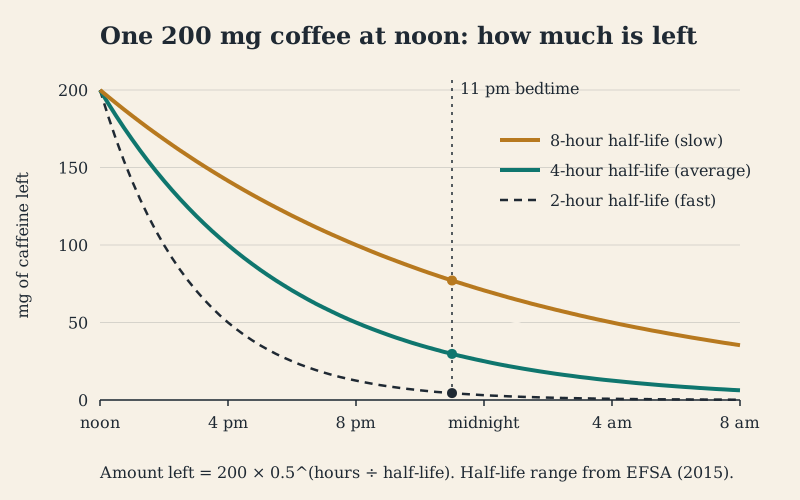
An 8-oz cup of brewed coffee has about 95 mg of caffeine, so 200 mg is a large coffee-shop cup or two regular ones. Drink it at noon with a four-hour half-life and you have 100 mg left at 4 p.m., 50 mg at 8 p.m., 25 mg at midnight and about 13 mg at 4 a.m.
At 10 p.m. about 35 mg is still circulating, roughly the caffeine in a can of cola.
The same coffee at four half-lives
This caffeine half life table shows the same 200 mg noon coffee at four speeds.
| Half-life | 4 p.m. | 8 p.m. | 11 p.m. | 4 a.m. |
|---|---|---|---|---|
| 2 hours (fast) | 50 mg | 13 mg | 4 mg | 1 mg |
| 4 hours (average) | 100 mg | 50 mg | 30 mg | 13 mg |
| 6 hours | 126 mg | 79 mg | 56 mg | 31 mg |
| 8 hours (slow end of normal) | 141 mg | 100 mg | 77 mg | 50 mg |
Quarter-life
A quarter-life is two half-lives, the point where 75% is gone. At the four-hour average that's about 8 hours, and at the slow end it's 16. Andrew Huberman uses a longer figure in his caffeine episode: "Caffeine has a quarter life of about 12 hours." That matches a six-hour half-life, and he calls it a broad stroke.
Two cups stack
The second cup lands on top of what's left of the first. With 200 mg at 8 a.m. and another 200 mg at noon, about 100 mg of the morning cup remains at noon, so you're at 300 mg. By 10 p.m. about 53 mg is still in you.
7 factors that change your caffeine half-life
EFSA names age, body weight, pregnancy, medication and liver health among the things that move the number.
The pill
The oestrogen and progestogen in the pill inhibit CYP1A2, the liver enzyme that clears most caffeine. In a 1980 study, women on the pill took 10.7 hours on average to clear half a dose, against 6.2 hours for women not on it. A 1985 study of low-dose pills found 7.9 hours against 5.4.
Pregnancy
In pregnancy, oestrogen and progestogen inhibit the same enzyme. The half-life lengthens as pregnancy goes on, up to about 16 hours, three to four times the usual, according to a presentation at EFSA's 2015 caffeine stakeholder meeting. In a 1981 study of 57 pregnant women it averaged 8.3 hours, with a range of 3 to 16, and for most it was back to normal within a month of giving birth. EFSA says up to 200 mg a day from all sources doesn't raise safety concerns for the foetus.
Medication
The antidepressant fluvoxamine strongly blocks CYP1A2. In eight volunteers it took caffeine's half-life from 5 to 31 hours, and the authors warned it may lead to caffeine intoxication. The antibiotic ciprofloxacin raised it from 5.2 to 8.2 hours in one study of 10 men, and from 4.5 to 9.7 hours in another of 12 volunteers. If a new prescription makes your usual coffee feel stronger, ask your pharmacist.
Smoking, and stopping
Smoking speeds the enzyme up. In a 1978 study, smokers had a half-life of 3.5 hours against 6.0 for non-smokers. When 12 heavy smokers quit, their caffeine clearance fell by 36%, and most of that drop came within four days, so the usual coffee leaves more caffeine in the blood.
Liver disease
In a small 1980 report, three healthy people averaged 5.7 hours, while two patients with alcoholic liver disease had half-lives of 60 and 168 hours.
Genes
CYP1A2 handles about 95% of the caffeine you drink, according to a 2018 review by Nehlig. One common variant in its gene (rs762551) affects how much smoking and caffeine intake speed the enzyme up, and a presentation at EFSA's 2015 stakeholder meeting said it isn't directly linked to fast or slow metabolism.
Age
Age matters most at the start of life. Newborns take 50 to 100 hours to clear half a dose. In a 1983 study, eight healthy men around 71 cleared caffeine at much the same rate as eight men around 20.
How caffeine actually damages your sleep (even when you fall asleep fine)
400 mg, six hours before bed
In a 2013 study by Drake and colleagues, 12 healthy sleepers took 400 mg of caffeine at bedtime, 3 hours before bed or 6 hours before bed, on separate nights at home. Even at six hours, a sleep monitor recorded more than an hour less sleep than on placebo, and deep sleep fell. REM didn't change.
The sleepers' diaries caught the disruption at bedtime and at three hours, but not at six, a gap the authors called an important finding. It's also a big dose, about four regular coffees.
Huberman's advice fits that finding. He says even people who can drink an espresso and fall straight asleep should keep caffeine out of the 12 hours before bed.
What 24 studies found
A 2023 meta-analysis by Gardiner and colleagues pooled 24 studies. Caffeine cut total sleep by 45 minutes and sleep efficiency by 7%. Falling asleep took 9 minutes longer, time awake in the night rose by 12 minutes, light sleep went up by about 6 minutes and deep sleep fell by about 11. For that stage, see these ways to get more deep sleep.
The crash and the loop
When caffeine wears off, the sleep pressure it was hiding is still there. A 2008 review by Roehrs and Roth links regular daily caffeine with disturbed sleep and daytime sleepiness, which may feed a loop of worse sleep and more afternoon coffee. The afternoon energy crash post covers that end of the day.
Cutting back has a cost. Withdrawal symptoms usually start 12 to 24 hours after your last dose, peak between about 20 and 51 hours and last 2 to 9 days, according to a 2004 review. The caffeine withdrawal guide covers what to expect and how to taper.
How to time caffeine for better sleep: 3 protocols
Once caffeine is in your blood, only time moves it.
Protocol 1: Count back 8.8 hours from bedtime
Gardiner's meta-analysis worked out how early caffeine has to stop to protect total sleep. For a 107 mg coffee that's at least 8.8 hours before bed, and for a 217.5 mg serve of pre-workout at least 13.2 hours.
| Bedtime | Last regular coffee | Last pre-workout-size dose |
|---|---|---|
| 10 p.m. | about 1 p.m. | about 8:45 a.m. |
| 11 p.m. | about 2 p.m. | about 9:45 a.m. |
| Midnight | about 3 p.m. | about 10:45 a.m. |
Drake's team said their results support the older sleep-hygiene advice of no substantial caffeine for at least 6 hours before bed, a looser cutoff than Gardiner's. Huberman advises 8 to 12 hours, and says he tries to keep his own caffeine before noon, with a 10 p.m. bedtime.
Protocol 2: Move it earlier if your half-life runs long
Gardiner's figure is pooled across studies and doesn't adjust for your half-life. On a four-hour half-life, 8.8 hours leaves about a fifth of the dose. On 10.7 hours, the pill average in the 1980 study, the same gap leaves more than half.
So if you're on the pill, pregnant, taking fluvoxamine or ciprofloxacin, or recently quit smoking, move your cutoff earlier and keep afternoon doses small. At an eight-hour half-life, 200 mg at 2 p.m. still leaves 100 mg at 10 p.m.
Protocol 3: Replace the afternoon cup
Huberman isn't a fan of the coffee-then-nap trick, partly because it puts caffeine into your afternoon. Without caffeine, the options are a short nap or a 10-minute NSDR session. In the only trial comparing them directly, a 2026 study of 60 active young adults, the nap group felt sleepier and less ready straight after waking, but 40 minutes later a 25-minute nap beat 10 minutes of NSDR on readiness to perform, and NSDR showed no effect. NSDR's advantage is that you don't wake up groggy, a spell that rarely lasts past 30 minutes without major sleep loss, according to a 2000 review. If you can nap and have about 40 minutes before you need to perform, nap. If you must be back at work straight away, NSDR skips the groggy spell. More in NSDR versus a nap.
Huberman also suggests waiting 90 to 120 minutes after waking for the first coffee, but a 2024 review found no evidence that delaying it prevents an afternoon crash. Doses and start times are in caffeine timing for focus.
Can you clear caffeine faster?
No. Cleveland Clinic says there's no proven method to flush caffeine out quickly, and its registered dietitian Beth Czerwony says "nothing's really going to help speed it up." Water and moving around may ease the side effects, but they don't clear caffeine faster. Huberman notes that many people take 100 mg of L-theanine with coffee to offset the jitters.
Caffeine content by source: know your actual intake
The half-life maths needs a starting dose.
Common sources
| Source | Serving | Caffeine |
|---|---|---|
| Brewed coffee | 8 oz | about 95 mg (coffee-shop servings run 58 to 259 mg) |
| Espresso | 1 oz shot | about 63 mg |
| Black tea | 8 oz | about 47 mg |
| Green tea | 8 oz | about 28 mg |
| Cola | 12 oz can | about 33 mg |
| Energy drinks | 8 oz | 40 to 250 mg |
| Pre-workout | 1 standard serve | about 218 mg |
| Dark chocolate (70-85%) | 1 oz | about 23 mg |
| Decaf coffee | 8 oz | about 2 mg |
Sources: USDA FoodData Central, the Antonio review (energy drinks, coffee-shop range) and Gardiner (pre-workout).
How much is too much
For most adults, the FDA cites 400 mg a day as an amount not generally associated with negative effects. Huberman's per-dose range is 1 to 3 mg per kg of body weight, or 70 to 210 mg for a 70 kg adult.
If you're pregnant, breastfeeding, take regular medication, or have a heart or liver condition, ask your doctor or pharmacist how much caffeine suits you.
If you change one thing, move your last coffee earlier. At a four-hour half-life, 200 mg at 8 a.m. is down to about 18 mg by 10 p.m., and the same cup at 3 p.m. leaves about 59 mg.
FAQ
How long does caffeine stay in your system?
Caffeine stays in your system for most of a day. With an average caffeine half life of four hours, about a fifth of a dose is left after 10 hours, and it takes roughly 20 hours to fall to a few percent. With an eight-hour half-life, double those times.
Is caffeine's half-life the same for everyone?
No, caffeine's half-life differs a lot from person to person. It runs from about 2 to 8 hours in healthy adults, longer on the pill, and much longer with pregnancy, fluvoxamine or liver disease. Smoking shortens it. The CYP1A2 enzyme does about 95% of the work, so anything that slows or speeds it changes your number.
How does pregnancy affect caffeine metabolism?
Pregnancy slows caffeine metabolism because its hormones hold back CYP1A2. The half-life can reach about 16 hours late in pregnancy, three to four times the usual, and returns to normal after birth. EFSA says up to 200 mg a day from all sources doesn't raise safety concerns for the foetus.
Does caffeine affect sleep quality even if I fall asleep?
Yes, caffeine can lower sleep quality even when you fall asleep easily. In one study, 400 mg six hours before bed cost more than an hour of sleep and cut deep sleep, and the sleepers' diaries didn't pick it up. Across 24 studies, caffeine cut total sleep by 45 minutes.
How can I get caffeine out of my system faster?
You can't get caffeine out of your system faster in any proven way. Water and moving around may ease the jitters, but your liver clears caffeine at its own pace. What works is an earlier last cup, at least 8.8 hours before bed for a regular coffee.
Sources
- European Food Safety Authority (2015). Caffeine: EFSA explains risk assessment. https://www.efsa.europa.eu/sites/default/files/corporate_publications/files/efsaexplainscaffeine150527.pdf
- European Food Safety Authority (2015). Scientific opinion on the safety of caffeine: pharmacokinetic and pharmacodynamic effects (stakeholder meeting presentation). https://efsa.europa.eu/sites/default/files/event/documentset/150305-p09.pdf
- Antonio J, Newmire DE, Stout JR, et al. (2024). Common questions and misconceptions about caffeine supplementation: what does the scientific evidence really show? Journal of the International Society of Sports Nutrition. https://pubmed.ncbi.nlm.nih.gov/38466174/
- Houston Methodist (2023). Caffeine & Sleep: How Long Does Caffeine Keep You Awake? https://www.houstonmethodist.org/blog/articles/2021/oct/caffeine-sleep-how-long-does-caffeine-keep-you-awake/
- Huberman A. Using Caffeine to Optimize Mental & Physical Performance. Huberman Lab podcast. https://www.hubermanlab.com/episode/using-caffeine-to-optimize-mental-and-physical-performance
- Patwardhan RV, Desmond PV, Johnson RF, Schenker S (1980). Impaired elimination of caffeine by oral contraceptive steroids. Journal of Laboratory and Clinical Medicine. https://pubmed.ncbi.nlm.nih.gov/7359014/
- Abernethy DR, Todd EL (1985). Impairment of caffeine clearance by chronic use of low-dose oestrogen-containing oral contraceptives. European Journal of Clinical Pharmacology. https://pubmed.ncbi.nlm.nih.gov/4029248/
- Knutti R, Rothweiler H, Schlatter C (1981). Effect of pregnancy on the pharmacokinetics of caffeine. European Journal of Clinical Pharmacology. https://pubmed.ncbi.nlm.nih.gov/7341280/
- Jeppesen U, Loft S, Poulsen HE, Brøsen K (1996). A fluvoxamine-caffeine interaction study. Pharmacogenetics. https://pubmed.ncbi.nlm.nih.gov/8807660/
- Healy DP, Polk RE, Kanawati L, Rock DT, Mooney ML (1989). Interaction between oral ciprofloxacin and caffeine in normal volunteers. Antimicrobial Agents and Chemotherapy. https://pubmed.ncbi.nlm.nih.gov/2729942/
- Mahr G, Sörgel F, Granneman GR, et al. (1992). Effects of temafloxacin and ciprofloxacin on the pharmacokinetics of caffeine. Clinical Pharmacokinetics. https://pubmed.ncbi.nlm.nih.gov/1319876/
- Parsons WD, Neims AH (1978). Effect of smoking on caffeine clearance. Clinical Pharmacology & Therapeutics. https://pubmed.ncbi.nlm.nih.gov/657717/
- Faber MS, Fuhr U (2004). Time response of cytochrome P450 1A2 activity on cessation of heavy smoking. Clinical Pharmacology & Therapeutics. https://pubmed.ncbi.nlm.nih.gov/15289794/
- Statland BE, Demas TJ (1980). Serum caffeine half-lives: healthy subjects vs. patients having alcoholic hepatic disease. American Journal of Clinical Pathology. https://pubmed.ncbi.nlm.nih.gov/7361718/
- Nehlig A (2018). Interindividual differences in caffeine metabolism and factors driving caffeine consumption. Pharmacological Reviews. https://pubmed.ncbi.nlm.nih.gov/29514871/
- Blanchard J, Sawers SJ (1983). Comparative pharmacokinetics of caffeine in young and elderly men. Journal of Pharmacokinetics and Biopharmaceutics. https://pubmed.ncbi.nlm.nih.gov/6886969/
- Drake C, Roehrs T, Shambroom J, Roth T (2013). Caffeine effects on sleep taken 0, 3, or 6 hours before going to bed. Journal of Clinical Sleep Medicine. https://pubmed.ncbi.nlm.nih.gov/24235903/
- Gardiner C, Weakley J, Burke LM, et al. (2023). The effect of caffeine on subsequent sleep: a systematic review and meta-analysis. Sleep Medicine Reviews. https://pubmed.ncbi.nlm.nih.gov/36870101/
- Roehrs T, Roth T (2008). Caffeine: sleep and daytime sleepiness. Sleep Medicine Reviews. https://pubmed.ncbi.nlm.nih.gov/17950009/
- Juliano LM, Griffiths RR (2004). A critical review of caffeine withdrawal: empirical validation of symptoms and signs, incidence, severity, and associated features. Psychopharmacology. https://pubmed.ncbi.nlm.nih.gov/15448977/
- Boukhris O, Suppiah H, Driller M (2026). Comparing the effects of a short nap and non-sleep deep rest on perceptual, cognitive, and physical performance in active adults. Clocks & Sleep. https://pubmed.ncbi.nlm.nih.gov/42783005/
- Tassi P, Muzet A (2000). Sleep inertia. Sleep Medicine Reviews. https://pubmed.ncbi.nlm.nih.gov/12531174/
- Cleveland Clinic. How To Get Caffeine Out of Your System. https://health.clevelandclinic.org/how-to-get-caffeine-out-of-your-system
- US Food and Drug Administration. Spilling the Beans: How Much Caffeine Is Too Much? https://www.fda.gov/consumers/consumer-updates/spilling-beans-how-much-caffeine-too-much
- US Department of Agriculture. FoodData Central (SR Legacy: brewed coffee, espresso, decaf coffee, black tea, green tea, cola, dark chocolate 70-85%). https://fdc.nal.usda.gov/