The optimal sleep temperature for most adults is around 65°F (18°C), give or take a few degrees. The Sleep Foundation says most doctors recommend 65 to 68°F, and Cleveland Clinic's sleep psychologist gives 60 to 67°F. A cool room helps because your core temperature falls as you drift off, and a warm room slows that down. Below is why, a one-week test to find your own number, and five ways to get your bedroom there. Temperature is one of the habits covered in how to sleep better.
TL;DR
- Start at about 65°F (18°C). The published ranges run from 60 to 68°F (15.6 to 20°C).
- Older adults may sleep better in a warmer room. In one study of 50 people at home, 68 to 77°F (20 to 25°C) worked best.
- In normal bedding, heat means more waking and less deep and REM sleep.
- A warm bath or shower 1 to 2 hours before bed, at 40 to 42.5°C (104 to 108.5°F), helped people fall asleep faster in a 2019 meta-analysis.
- Keep the room cool and use as many blankets as you need. Pushing a blanket off is easier than cooling a hot room.
- Run a 7-night test, stepping down from 68°F, to find the setting where you fall asleep fastest and wake up clearest.
Why temperature controls your sleep
Your core temperature has to fall
Your core temperature starts to drop about two hours before you usually fall asleep, at about the same time your body releases melatonin, according to the Sleep Foundation. It bottoms out in the early morning, and over the night it swings by about 2°F. Andrew Huberman puts the fall at one to three degrees in his Sleep Toolkit episode, without saying which unit.
The heat leaves through your hands and feet. Your body clock widens the blood vessels in the skin there, warm blood flows out to the surface, and heat escapes. A 2007 review by Kurt Kräuchi, a sleep researcher in Basel, concluded that heat loss through the hands and feet before lights out makes you sleepy and helps you fall asleep quickly. Sleep tends to start when core temperature is falling fastest.
A warm room makes that heat loss harder, and sleep starts later. A 2022 study used wristband data from more than 47,000 adults in 68 countries. Warmer nights shortened sleep, mostly because people fell asleep later, and older adults and women lost more. The journal publisher's press release puts the loss at just over 14 minutes on nights above 30°C (86°F) outside.
What heat does to deep and REM sleep
Temperature also changes the kind of sleep you get. A 2012 review of the thermal research found that in normal bedding and nightclothes, heat increases waking and cuts both slow-wave (deep) sleep and REM sleep. "Thermoregulation is very important for staying in restorative, slow-wave sleep stages," Dr. Michelle Drerup, a sleep psychologist, told Cleveland Clinic. If getting more deep sleep is your goal, heat is one of the first things to fix.
REM sleep is the more fragile of the two. During REM your body stops most sweating and shivering, so the room's temperature reaches you more directly. "Heat is a huge disruptor for REM sleep," Drerup says. REM periods get longer in the second half of the night, so that's when a warm bedroom has the most REM to interfere with. For the background, see what each sleep stage does.
Why cool is easier to fix than warm
If a room is too cold, you add a blanket. If it's too hot, there's little to do except throw the covers off. Huberman's advice in the Sleep Toolkit episode follows from that. Keep the room cool, get under as many blankets as you need to fall asleep, and through the night you'll push a hand or a foot out to cool off. His newsletter gives the reason. Tossing off a blanket is easier than cooling a room that's too hot.
Cool doesn't mean cold. The same 2012 review found that with enough bedding, cold didn't change sleep stages, but it did change how the heart was controlled during sleep. Drerup says cold makes blood vessels narrow and puts extra load on the cardiovascular system. Err cool, with enough cover that you never shiver.
The ideal range, and why one number doesn't fit everyone
What the guidelines say
The Sleep Foundation puts the best bedroom temperature at about 65°F (18.3°C) and says most doctors recommend 65 to 68°F (18 to 20°C). Cleveland Clinic's range is a little cooler, 60 to 67°F (15.6 to 19.4°C). It also gives a simple rule at each end. Above 70°F (21°C) is too hot, and below 60°F (15.6°C) is too cold.
Both ranges are expert guidance, and neither comes from a single trial. The right room temperature also depends on your duvet and what you wear to bed. Treat 65°F as the starting point, and expect your own optimal sleep temperature to sit a few degrees either side of it.
Why your number may be different
Age. A 2023 study tracked 50 older adults in their own homes for nearly 11,000 nights with wearable sleep monitors and bedroom sensors. They slept most efficiently and restfully at 68 to 77°F (20 to 25°C), and sleep efficiency fell by 5 to 10% as the room went from 25 to 30°C (77 to 86°F). The researchers also found large differences between individuals.
Sex. In a lab study of 28 women and 28 men with the same bedtimes, the women's body-temperature and melatonin rhythms ran earlier relative to their sleep. That's one plausible reason two people in one bed don't always want the same room.
Cold hands and feet. Women with chronically cold hands and feet (a condition called vasospastic syndrome) lose heat less easily and take longer to fall asleep, according to Kräuchi's review. If that's you, try a cool room with socks before you turn the heating up.
How to find your number: a 7-night self-experiment
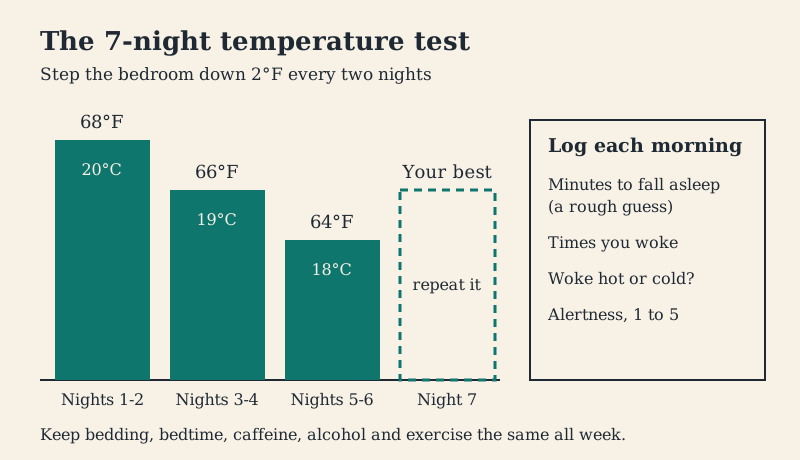
This is a simple self-test that no study has checked. It finds your optimal sleep temperature from your own data in place of a borrowed number.
- Nights 1 and 2: set the bedroom to 68°F (20°C).
- Nights 3 and 4: 66°F (19°C).
- Nights 5 and 6: 64°F (18°C).
- Night 7: go back to the setting that scored best. If you still woke warm at 64°F, try 62°F (17°C) for two more nights.
Each morning, write down four things: roughly how long it took to fall asleep, how many times you woke, whether you woke hot or cold, and how alert you feel on a scale of 1 to 5. Keep bedding, bedtime, caffeine, alcohol and exercise the same all week, so the room is the only thing that changes. One night is noisy, so judge each setting on both of its nights.
5 methods to optimize your sleep temperature
Method 1: free, adjust the room tonight
Turn the thermostat down for the night, or open a window or door for a cross-breeze. In summer, keep the blinds closed during the day so the room doesn't store heat. Take one layer off the bed. Then follow Huberman's blanket rule. Keep the room cool, use as many covers as you need, and let a hand or foot find its way out.
Socks depend on your feet. Huberman skips them because they cover the soles, which shed heat, but says they suit people whose cold feet wake them. In one small study, six young men in a 23°C (73°F) room fell asleep 7.5 minutes faster and slept 32 minutes longer wearing bed socks. If you wake up hot, leave them off.
Method 2: free, the warm bath or shower
This one sounds backwards, but it has the best evidence of anything here. A 2019 meta-analysis pooled 13 studies of warm baths and showers before bed. Water at 40 to 42.5°C (104 to 108.5°F) was linked to better-rated sleep and better sleep efficiency. When the bath or shower came 1 to 2 hours before bed and lasted as little as 10 minutes, people also fell asleep faster.
The authors think the warm water sends blood to the hands and feet, which then shed heat once you're out, so core temperature falls further. They also say the research is thin, especially on the best timing. A bath at 9pm for an 11pm bedtime sits inside the window, and the full warm-bath routine has the step-by-step version. If you have a heart or circulation condition, or you're pregnant, check with a doctor before very hot baths.
Method 3: low cost, bedding and sleepwear
The Sleep Foundation's list includes sheets, pyjamas and duvets chosen for temperature regulation. Swap to a lighter duvet in summer and add a blanket on top in a cold snap. If you wake up hot on your mattress, a breathable topper or cooler sheets cost far less than a new bed.
If you share a bed with someone who runs warmer or colder, try two single duvets on one bed, common in Scandinavia and Germany. Each person picks their own weight, and nobody fights over one cover.
Method 4: moderate cost, fans, thermostat schedules and humidity
A programmable thermostat can start cooling an hour or so before bed, hold through the night and warm the room slightly before your alarm. The Sleep Foundation notes that lowering the thermostat at night works with your body's own fall in temperature. Cleveland Clinic suggests keeping a fan in the room so you can cool down quickly if you wake warm.
Humidity matters too. The 2012 review found that humid heat adds further to the heat load on your body during sleep and affects sleep stages. For a target, the US Environmental Protection Agency's general indoor advice is 30 to 50% relative humidity, and below 60%. A cheap hygrometer will tell you where you are.
Method 5: high tech, cooling pads and mattresses
Water-based cooling pads sit on the mattress and pump temperature-controlled water under you, often with a setting for each side. Huberman says he uses one. There's some lab support for cooling during sleep: in a 2024 study of 72 people, a mattress built to draw heat away from the body added about 7.5 minutes of deep sleep over the night and lowered heart rate slightly. One of the authors works for the company that makes it.
A pad is worth the money mainly for couples who disagree on temperature, or in hot climates without air conditioning. Otherwise the free methods do most of the work.
What disrupts your body's cooling process
Exercise timing
Evening exercise is fine for most people. A 2019 meta-analysis of 23 studies found that a single evening workout slightly increased slow-wave sleep, by 1.3 percentage points. The exception is vigorous exercise that ends within about an hour of bed, which may make it harder to fall asleep. If you train late, finish the hard part earlier and keep the last stretch easy.
Caffeine, alcohol and late meals
Caffeine can keep you warm. In one lab study, about 200 mg of caffeine taken five hours before sleep raised core temperature, held heat back from the hands and feet, and made sleep take longer to come. The volunteers were sleep-deprived and sleeping during the day, so it isn't clear how closely this matches a normal night.
Alcohol works the other way at first. A 2013 review found that it shortens the time to fall asleep and steadies the first half of the night, then disrupts the second half, and at moderate and higher doses it cuts REM.
Cleveland Clinic suggests avoiding caffeine and sugary food before bed, saying sugar can raise body temperature. If you're looking at supplements, glycine has a temperature link. In rats, it lowered core temperature by sending more blood to the feet. Most of the researchers worked for Ajinomoto, a company that makes glycine.
A wired mind
A perfect thermostat setting won't help much if your mind is still racing at midnight. Give yourself a wind-down away from bright screens. Dim the lights and read, or play a guided NSDR track in bed. NSDR (non-sleep deep rest) is 10 to 30 minutes of guided, awake rest. A voice moves your attention through your body and slows your breathing. Three of the four trials that use the NSDR name tested a single 10-minute session, and none of them measured night-time sleep, so treat it as a way to wind down rather than a sleep treatment. See NSDR for sleep for how to use one.
If you sleep badly most nights for weeks despite a cool room, talk to a doctor. A thermostat can't fix insomnia or sleep apnoea.
FAQ
Is 72 degrees too hot to sleep?
For most adults, yes, 72°F (22°C) is warmer than the optimal sleep temperature. It's above the Sleep Foundation's 65 to 68°F range, and Cleveland Clinic says "If your bedroom temperature is above 70° F, it's too hot." Older adults are the exception. In a study of 50 people at home, they slept most efficiently at 68 to 77°F.
What temperature is too cold to sleep in?
Cleveland Clinic draws the line at 60°F (15.6°C). With enough bedding, a cold room changes sleep stages less than a hot one, but cold makes blood vessels narrow and puts extra load on the heart. If you shiver or wake up cold under your usual covers, the room is too cold for you.
Does room temperature affect REM sleep?
Yes, and heat is the main problem. During REM your body stops most sweating and shivering, so the room's temperature reaches you more directly. A 2012 review found that heat in normal bedding cuts REM and deep sleep, and Drerup calls heat "a huge disruptor for REM sleep." REM periods get longer late in the night.
Should I wear socks to bed for better sleep?
Socks help if your feet run cold and are worth skipping if you wake up hot. In one small study, six young men in a cool room fell asleep 7.5 minutes faster with bed socks. Huberman doesn't wear them, because the soles of the feet are one of the main places the body sheds heat.
How does humidity affect sleep temperature?
High humidity makes a warm room harder to sleep in. Sweat evaporates more slowly, and a 2012 review found that humid heat adds further to the body's heat load during sleep and affects sleep stages. The US EPA's general indoor target is 30 to 50% relative humidity, and a dehumidifier helps in a humid climate.
Sources
- Sleep Foundation. Best Temperature for Sleep (updated 11 Jul 2025). https://www.sleepfoundation.org/bedroom-environment/best-temperature-for-sleep
- Sleep Foundation. Stages of Sleep. https://www.sleepfoundation.org/how-sleep-works/stages-of-sleep
- Cleveland Clinic Health Essentials. What Is the Ideal Sleeping Temperature for My Bedroom? (with Dr. Michelle Drerup). https://health.clevelandclinic.org/what-is-the-ideal-sleeping-temperature-for-my-bedroom
- Okamoto-Mizuno K, Mizuno K (2012). Effects of thermal environment on sleep and circadian rhythm. Journal of Physiological Anthropology. https://pubmed.ncbi.nlm.nih.gov/22738673/
- Kräuchi K (2007). The thermophysiological cascade leading to sleep initiation in relation to phase of entrainment. Sleep Medicine Reviews. https://pubmed.ncbi.nlm.nih.gov/17764994/
- Harding EC, Franks NP, Wisden W (2019). The temperature dependence of sleep. Frontiers in Neuroscience. https://pubmed.ncbi.nlm.nih.gov/31105512/
- Minor K, Bjerre-Nielsen A, Jonasdottir SS, Lehmann S, Obradovich N (2022). Rising temperatures erode human sleep globally. One Earth. https://doi.org/10.1016/j.oneear.2022.04.008
- ScienceDaily (20 May 2022). Rising temperatures erode human sleep globally (Cell Press release on Minor 2022). https://www.sciencedaily.com/releases/2022/05/220520132837.htm
- Baniassadi A, Manor B, Yu W, Travison T, Lipsitz L (2023). Nighttime ambient temperature and sleep in community-dwelling older adults. Science of the Total Environment. https://pubmed.ncbi.nlm.nih.gov/37474050/
- Cain SW et al. (2010). Sex differences in phase angle of entrainment and melatonin amplitude in humans. Journal of Biological Rhythms. https://pubmed.ncbi.nlm.nih.gov/20679498/
- Haghayegh S, Khoshnevis S, Smolensky MH, Diller KR, Castriotta RJ (2019). Before-bedtime passive body heating by warm shower or bath to improve sleep: a systematic review and meta-analysis. Sleep Medicine Reviews. https://pubmed.ncbi.nlm.nih.gov/31102877/
- Ko Y, Lee JY (2018). Effects of feet warming using bed socks on sleep quality and thermoregulatory responses in a cool environment. Journal of Physiological Anthropology. https://pubmed.ncbi.nlm.nih.gov/29699592/
- Herberger S et al. (2024). Enhanced conductive body heat loss during sleep increases slow-wave sleep and calms the heart. Scientific Reports. https://pubmed.ncbi.nlm.nih.gov/38409133/
- McHill AW, Smith BJ, Wright KP (2014). Effects of caffeine on skin and core temperatures, alertness, and recovery sleep during circadian misalignment. Journal of Biological Rhythms. https://pubmed.ncbi.nlm.nih.gov/24682207/
- Ebrahim IO, Shapiro CM, Williams AJ, Fenwick PB (2013). Alcohol and sleep I: effects on normal sleep. Alcoholism: Clinical and Experimental Research. https://pubmed.ncbi.nlm.nih.gov/23347102/
- Stutz J, Eiholzer R, Spengler CM (2019). Effects of evening exercise on sleep in healthy participants: a systematic review and meta-analysis. Sports Medicine. https://pubmed.ncbi.nlm.nih.gov/30374942/
- Boukhris O, Suppiah H, Halson S, Russell S, Clarke A, Geneau MC, et al. (2024). The acute effects of nonsleep deep rest on perceptual responses, physical, and cognitive performance in physically active participants. Applied Psychology: Health and Well-Being. https://pubmed.ncbi.nlm.nih.gov/38953770/
- Wrzeciono A, Cieślik B, Kiper P, Szczepańska-Gieracha J, Gajda R (2024). Non-sleep deep rest relaxation and virtual reality therapy for psychological outcomes in patients with coronary artery disease: a pilot randomized controlled trial. Journal of Clinical Medicine. https://pubmed.ncbi.nlm.nih.gov/39685636/
- Boukhris O, Suppiah H, Kerkeni M, Holt A, Driller M (2026). Time course of perceptual, cognitive, physical and physiological responses to a single non-sleep deep rest session in physically active young adults. Applied Psychology: Health and Well-Being. https://pubmed.ncbi.nlm.nih.gov/42383502/
- Boukhris O, Suppiah H, Driller M (2026). Comparing the effects of a short nap and non-sleep deep rest on perceptual, cognitive, and physical performance in active adults. Clocks & Sleep. https://pubmed.ncbi.nlm.nih.gov/42783005/
- Kawai N et al. (2015). The sleep-promoting and hypothermic effects of glycine are mediated by NMDA receptors in the suprachiasmatic nucleus. Neuropsychopharmacology. https://pubmed.ncbi.nlm.nih.gov/25533534/
- US Environmental Protection Agency. A Brief Guide to Mold, Moisture and Your Home. https://www.epa.gov/mold/brief-guide-mold-moisture-and-your-home
- Huberman A (2022). Sleep Toolkit: Tools for Optimizing Sleep & Sleep-Wake Timing. Huberman Lab podcast. https://www.youtube.com/watch?v=h2aWYjSA1Jc
- Huberman A (2021). Toolkit for Sleep. Huberman Lab newsletter. https://www.hubermanlab.com/newsletter/toolkit-for-sleep