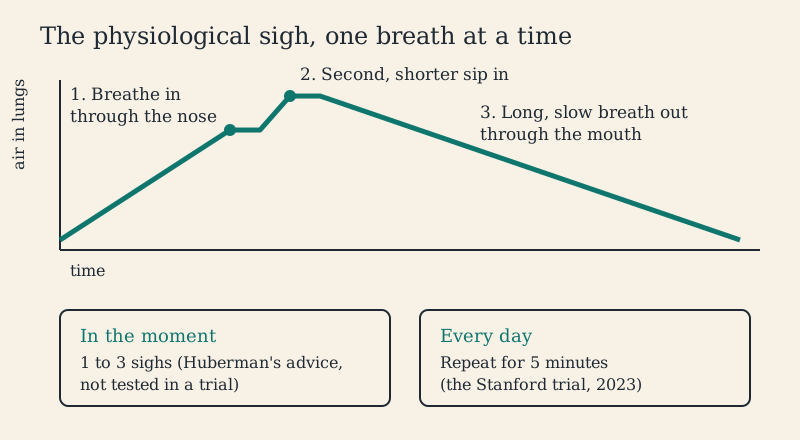
A physiological sigh is two breaths in through the nose, the second one shorter, then one long breath out through the mouth. Your body already does this on its own every few minutes. As a deliberate tool, Andrew Huberman recommends one to three sighs to calm down fast. The main trial tested a 5-minute daily version, and in 108 adults it improved mood and slowed resting breathing more than mindfulness meditation did.
What is the physiological sigh?
Jack Feldman, a UCLA neurobiologist whose lab identified the brainstem area that sets the rhythm of breathing, describes the natural version this way: "It starts out as a normal breath, but before you exhale, you take a second breath on top of it."
The sigh your body already does
You sigh about once every five minutes, roughly 12 times an hour. Each sigh brings in about twice the volume of a normal breath. In 2016, Feldman and Stanford colleagues mapped the brain circuit that turns a normal breath into a sigh. In mice, it comes down to about 200 neurons in the breathing centre.
Sighs also track mood. In three lab experiments, people sighed more during relief, when a loud noise ended or they learned none was coming, than during the stress itself.
Physiological sigh vs cyclic sighing
They're the same breath at different doses. "Physiological sigh" usually means one to three of them in a stressful moment. "Cyclic sighing" is what the Stanford trial called repeating the breath for 5 minutes. That month-long daily routine is the best-tested version. Smaller trials have since tried shorter doses, including one minute of cyclic sighing, which, like box breathing, lowered anxiety more than a control condition in 47 university students during real-life stressful moments. The Stanford trial also tested cyclic hyperventilation, which flips the pattern to long inhales and short exhales.
How does the physiological sigh work?
The double inhale reopens tiny air sacs in your lungs, and the long exhale slows your heart. Which of the two does the calming hasn't been tested.
Your breath is half automatic
Breathing runs on its own, but you can take it over at any moment. Researchers describe it as controlled through both autonomic and voluntary routes. Stanford psychiatrist David Spiegel, a senior author of the trial, put it plainly: "What's interesting about the breath is that it's right on the edge of conscious control."
Reopening collapsed air sacs
Your lungs hold about 480 million alveoli, the tiny sacs where oxygen goes in and carbon dioxide comes out. Laid flat, their lining would cover about 70 square metres, roughly a third of a tennis court.
A collapsed alveolus stops trading gas. Without a sigh every five minutes or so, Feldman said in 2016, "the alveoli will slowly collapse, causing lung failure." A normal breath isn't big enough to pop them open again. A deep breath is, and a sigh is the deep breath your body takes on its own.
Huberman's explanation goes further. He says the second inhale reinflates collapsed sacs, so the long exhale that follows clears more carbon dioxide, and that is what relaxes you. The trial didn't measure carbon dioxide, so treat this as a plausible explanation that hasn't been tested.
The long exhale slows your heart
Your heart speeds up a little when you breathe in and slows when you breathe out. Huberman's account is that the diaphragm changes the space around the heart, and the brainstem answers with a signal to speed up or slow down. His rule: "if you want to calm down quickly, you need to make your exhales longer and or more vigorous than your inhales." Slowing the heart is the job of the parasympathetic nervous system.
A small lab study backs the exhale part. When 30 people breathed with a longer exhale than inhale, they felt more relaxed and less stressed. At 6 breaths a minute, the long exhale also raised the high-frequency part of heart rate variability.
Why "calm down" doesn't work
Telling yourself to calm down rarely helps. Huberman goes further: "In fact, that tends to just exacerbate stress." His argument is that the stress system is generic, the same alarm for a deadline or a near miss on the road, and the quickest ways to turn it down have a direct line to the body. Breathing is one of those. He calls it a real-time tool because it needs no training and works in the moment.
How to do the physiological sigh, step by step
These steps follow the instructions the Stanford participants were given.
- Sit or lie down.
- Breathe in slowly through your nose. A comfortable, full breath. Don't strain.
- At the top, sip in a second, shorter breath through your nose. It will be smaller than the first. That's normal.
- Breathe out slowly through your mouth until your lungs feel empty.
- Pick your dose. One to three sighs in a stressful moment, or repeat for 5 minutes with a timer as daily practice.
If breathing out through your mouth feels odd, do the whole thing through your nose. The trial allowed that. To follow along with a pacer, use the guided physiological sigh.
What the Stanford study found (and didn't)
The key study is Balban and colleagues, published in Cell Reports Medicine in 2023, with Spiegel and Huberman as senior authors. It was a remote, randomised trial of "three different daily 5-min breathwork exercises compared with an equivalent period of mindfulness meditation over 1 month." Of the 108 adults enrolled, 30 did cyclic sighing, 21 box breathing, 33 cyclic hyperventilation and 24 mindfulness meditation.
What it found:
- Mood. People rated their positive mood before and after each session. It rose by 1.89 points per session on average with cyclic sighing, 1.91 across all three breathing groups and 1.22 with meditation (the meditation change didn't reach significance, p = 0.06). In the abstract's words, "breathwork, especially the exhale-focused cyclic sighing, produces greater improvement in mood (p < 0.05) and reduction in respiratory rate (p < 0.05) compared with mindfulness meditation."
- It built up. Cyclic sighing's mood benefit grew the more days people practised. The other groups didn't show that.
- Breathing rate. Resting breathing rate, measured by a wrist wearable, fell more with cyclic sighing than with meditation. Spiegel: "They were breathing more slowly not just during the exercise, but throughout the day."
What it didn't find:
- Anxiety. State anxiety and negative mood fell in every group, with no difference between breathing and meditation.
- Heart rate variability and resting heart rate. No differences between any groups.
The study has real limits. The authors call it exploratory, and it wasn't pre-registered. Participants managed about 20 of the 28 days on average. The wearable was a WHOOP strap, and Huberman became a WHOOP adviser in June 2022. The trial screened out people with heart disease, glaucoma, seizures, pregnancy or serious psychiatric conditions, and 10% of participants reported a negative experience with the exercises.
Physiological sigh vs box breathing
Box breathing is a count, with the breath in, a hold, the breath out and a second hold all the same length. The Stanford trial is the only comparison of the two as a month-long daily routine. Daily mood gains were almost identical (1.89 points for cyclic sighing, 1.84 for box breathing). Only cyclic sighing lowered resting breathing rate more than meditation, and only its benefit grew with practice.
One sigh takes a few seconds and passes for an ordinary breath in a meeting. Box breathing needs a count you have to keep track of, so it suits a quiet break. If you'll only learn one, learn the sigh. For both, there's a guided box breathing pacer, and more options in breathing exercises for stress.
When to use the physiological sigh
In the moment: one to three sighs
Use it before a talk or after bad news. Huberman's advice is that "the physiological sigh done just one to three times ... will bring down your level of stress very, very fast." The trial he co-led tested 5 minutes a day, not one to three sighs, so this part rests on his judgement.
Feldman makes a similar point about deep breaths in general. Before a big talk or the first tee, "a deep breath, or a few deep breaths are tremendously effective in calming one down." He adds that it doesn't make a permanent change.
Every day: 5 minutes
For the routine that was tested, set a timer for 5 minutes once a day and keep sighing at an easy pace. A fixed time of day makes it easier to keep up, and the benefit grew with practice.
When to check first
If you have a heart condition, glaucoma, a seizure history, are pregnant, or have a serious psychiatric condition, talk to your GP before a daily practice, since the trial left those groups out. If a breathing drill sets off panic, stop and breathe normally.
Common mistakes
- Rushing the exhale. The long, slow breath out is the part the researchers emphasise. Let it run.
- Worrying the second inhale is too small. A short top-up is how it's meant to feel.
- Forcing it. The sigh should feel easy. If you feel dizzy or tingly, stop and breathe normally, then try again more gently.
- Expecting three sighs to do a 5-minute job. The trial's mood results came from 5 minutes a day for a month.
How the physiological sigh fits into nervous system regulation
The sigh is the quick tool. "We know that people who are breathing very rapidly feel more anxious, such as during a panic attack," Spiegel said of the trial. "Controlled breathwork seems to be a straightforward way to do the opposite: lower physiologic arousal and regulate your mood."
For longer recovery, NSDR (non-sleep deep rest) is a guided practice where you lie still and stay awake for 10 to 30 minutes. In a 2026 trial of 102 active young adults, one 10-minute NSDR session cut sleepiness, fatigue and stress more than a control session did. Heart rate fell more too, but HRV didn't differ. NSDR.co sessions are free.
A practical split is to sigh before the meeting and do a 10-minute session at lunch. For a full plan, see how to reset your nervous system, and for quick tools ranked by speed, how to calm down fast. If anxiety is the main issue, natural anxiety remedies covers breathing alongside exercise, sleep and more.
FAQ
How many times should you do a physiological sigh?
Do a physiological sigh one to three times in a stressful moment, which is Huberman's advice, or repeat it for 5 minutes as a daily practice, which is what the Stanford trial tested.
Does the physiological sigh really work?
The physiological sigh has one month-long randomised trial behind it, plus a few smaller, shorter studies. In 108 adults, 5 minutes of cyclic sighing a day for a month lifted mood and slowed resting breathing more than meditation. Anxiety fell about equally in every group, HRV didn't change, and the study was exploratory. No trial has tested Huberman's one-to-three-sigh version.
What is the difference between cyclic sighing and physiological sigh?
Cyclic sighing is the physiological sigh repeated for 5 minutes. The breath is the same: two inhales through the nose, one long exhale through the mouth. "Physiological sigh" usually means one to three of them in the moment.
Can you do the physiological sigh anywhere?
Yes, you can do it anywhere you can breathe slowly. One sigh takes a few seconds and looks like a normal breath, so it works in a meeting or before a presentation. Save the 5-minute version for somewhere you can sit or lie down.
Why do we naturally sigh every 5 minutes?
We sigh about every 5 minutes to reopen alveoli, the tiny air sacs in the lungs, which slowly collapse. A normal breath can't reopen them; a sigh, at about twice the normal volume, can. Feldman's 2016 research mapped the brain circuit that triggers it, in mice.
Sources
- Balban MY, Neri E, Kogon MM, et al. (2023). Brief structured respiration practices enhance mood and reduce physiological arousal. Cell Reports Medicine. https://pubmed.ncbi.nlm.nih.gov/36630953/ (full text: https://pmc.ncbi.nlm.nih.gov/articles/PMC9873947/)
- Li P, Janczewski WA, Yackle K, et al. (2016). The peptidergic control circuit for sighing. Nature. https://pubmed.ncbi.nlm.nih.gov/26855425/
- Smith JC, Ellenberger HH, Ballanyi K, Richter DW, Feldman JL (1991). Pre-Bötzinger complex: a brainstem region that may generate respiratory rhythm in mammals. Science. https://pubmed.ncbi.nlm.nih.gov/1683005/
- Severs LJ, Vlemincx E, Ramirez JM (2022). The psychophysiology of the sigh: I: The sigh from the physiological perspective. Biological Psychology. https://pubmed.ncbi.nlm.nih.gov/35288214/
- Vlemincx E, Van Diest I, De Peuter S, et al. (2009). Why do you sigh? Sigh rate during induced stress and relief. Psychophysiology. https://pubmed.ncbi.nlm.nih.gov/19497009/
- Riedl EM, Bracklo T, Wimmer K, et al. (2026). Simply breathing anxiety away? A pilot, just-in-time ecological momentary intervention study of one-minute cyclic sighing versus box breathing as tools for acute anxiety reduction and attention promotion in real life. Anxiety, Stress, & Coping. https://pubmed.ncbi.nlm.nih.gov/42002307/
- Ochs M, Nyengaard JR, Jung A, et al. (2004). The number of alveoli in the human lung. American Journal of Respiratory and Critical Care Medicine. https://pubmed.ncbi.nlm.nih.gov/14512270/
- Van Diest I, Verstappen K, Aubert AE, et al. (2014). Inhalation/Exhalation ratio modulates the effect of slow breathing on heart rate variability and relaxation. Applied Psychophysiology and Biofeedback. https://pubmed.ncbi.nlm.nih.gov/25156003/
- Boukhris O et al. (2026). Time course of perceptual, cognitive, physical and physiological responses to a single non-sleep deep rest session in physically active young adults. Applied Psychology: Health and Well-Being. https://pubmed.ncbi.nlm.nih.gov/42383502/
- Stanford Medicine (2023). 'Cyclic sighing' can help breathe away anxiety. https://med.stanford.edu/news/insights/2023/02/cyclic-sighing-can-help-breathe-away-anxiety.html
- MacDonald F, ScienceAlert (2016). Sighing Is Actually a Life-Saving Reflex, And Scientists Have Found The Switch That Controls It (reporting UCLA's release on Li et al.). https://www.sciencealert.com/scientists-discover-that-sighing-is-actually-a-life-saving-biological-function
- Huberman Lab (2021). Tools for Managing Stress & Anxiety. https://www.hubermanlab.com/episode/tools-for-managing-stress-and-anxiety
- Huberman Lab. Dr. Jack Feldman: Breathing for Mental & Physical Health & Performance. https://www.hubermanlab.com/episode/dr-jack-feldman-breathing-for-mental-physical-health-and-performance