Nervous system dysregulation is an everyday name for a stress response that won't settle. It stays switched on after the stress has passed, or it drops into a flat, shut-down state. It isn't a medical diagnosis. The signs are real, though, and several overlap with conditions a GP can test for.
What is nervous system dysregulation?
Your autonomic nervous system runs the things you don't think about, such as heart rate and digestion. It has two branches: a stress branch, the sympathetic, and a rest branch, the parasympathetic. They aren't two ends of one dial, and each can rise or fall independently. When the stress branch turns up, your heart beats faster, blood pressure rises and gut movement slows. The rest branch brings digestion back.
The stress response is built to switch on and then off again. The stress researcher Bruce McEwen described three ways that goes wrong. It switches on too often. It fails to switch off after the stress is over. Or it responds too weakly, and other systems overcompensate.
A description, not a diagnosis
You won't find nervous system dysregulation listed as a condition in the DSM-5.
Stuck on, or shut down
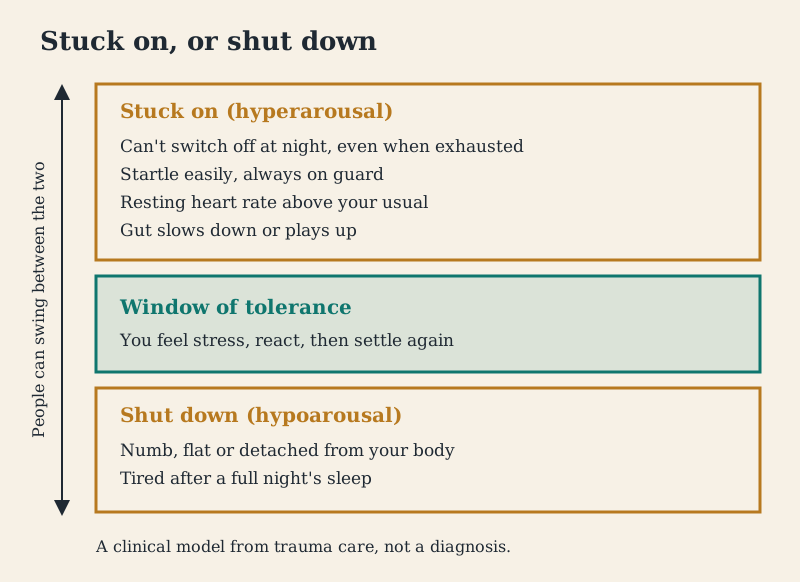
Therapists who work with trauma talk about a window of tolerance, a range of arousal that's "not too high and not too low". Above it, you're stuck on (hyperarousal). Below it, you shut down (hypoarousal). People who've been through trauma can move easily from one state to the other.
Fight, flight and freeze
Researchers describe a longer sequence than fight or flight, called the defence cascade. Arousal comes first, then fight or flight. Freezing is fight or flight "put on hold". When escape seems impossible, the body can drop into tonic or collapsed immobility, where people describe numbness, coldness and feeling detached or unreal.
Freezing looks like stillness, but it isn't rest. Both branches fire at once, the stress branch primed for action while the rest branch puts a brake on the heart. Studies of freezing in people measure it by a slower heart rate and reduced movement. Outside research, "freeze" is often used for the numb, collapsed state too.
You'll often see these states explained with Stephen Porges's polyvagal theory, which is popular in therapy. In 2026, 39 experts in vagus nerve physiology and evolution co-authored a paper concluding the theory is "untenable". The signs below don't depend on it.
8 signs of a dysregulated nervous system
The signs split into a stuck-on group, a shut-down group and a mixed group. None of them proves dysregulation on its own, and several have medical causes worth ruling out first.
Hyperarousal signs
1. You can't fall asleep, even though you're exhausted. Studies of insomnia find raised arousal by night and by day.
2. Your resting heart rate sits above your usual. No cut-off marks dysregulation. A normal adult resting rate is 60 to 100 beats per minute, so compare against your own trend over weeks. Most trackers also report heart rate variability; see what HRV is and how to read it.
3. You startle easily. A "heightened startle reaction" and "hypervigilance" are both listed PTSD symptoms.
4. Your gut plays up for no clear reason. The stress branch slows gut movement. Get gut symptoms checked first, since stress can add to a gut problem without being its only cause.
Hypoarousal signs
5. You feel numb or disconnected. You feel emotionally flat or detached from your body. This matches the shut-down end of the defence cascade.
6. You're tired after a full night's sleep. "Persistent fatigue, even after adequate rest" appears on published symptom lists. An overactive thyroid and PoTS can both cause tiredness too, so see a GP before you put it down to stress.
Mixed signs
7. Your mood swings between extremes. You're anxious one hour and flat the next. One trauma review proposes that a dopamine imbalance in the brain may drive "rapid fluctuations in level of arousal and in the associated mood".
8. You can't concentrate. Difficulty concentrating is on the PTSD arousal list.
One or two of these after a hard week is normal.
What causes nervous system dysregulation?
Usually several things at once, building over time.
Chronic stress
A review of 37 studies on stress and heart rate variability states that "during chronic stress, the sympathetic nervous system is hyperactivated".
Sleep loss
After one night on call, 15 young doctors showed a shift toward the stress branch on heart rate variability. In another study, 13 healthy men who slept under 5 hours a night for 5 nights had higher sympathetic activity and more noradrenaline in their blood. Raised arousal then makes sleep harder, so each problem worsens the other.
Trauma
In the window-of-tolerance model, severe trauma leaves a system that reminders of the event can tip into extreme states. Stephen Porges put it this way in a 2022 interview: "our nervous system is always trying to figure out a way for us to survive, meaning to be safe." Some nervous systems, he says, are "re-tuned to threat" by experiences many people wouldn't see as threatening.
Lifestyle factors
- Caffeine. In a study of 15 volunteers, caffeine raised sympathetic nerve activity within an hour, and 400 mg taken 6 hours before bed still disrupted sleep in another.
- Screens in bed. In a lab study, reading on a light-emitting e-reader before bed made people take longer to fall asleep than reading a printed book.
- Too little movement. Exercise training gives sedentary adults a small rise in heart rate variability, a marker of the rest branch.
Medical conditions
Some conditions produce the same symptoms. An overactive thyroid can cause anxiety, poor sleep, tiredness and a fast or irregular heartbeat. PoTS, a rise in heart rate when you get up, can cause dizziness and palpitations on standing, gut problems, fatigue and brain fog. Autonomic problems, especially PoTS, are an important subset of long COVID, and an NIH trial, RECOVER-AUTONOMIC, is testing three treatments for it.
When to see a doctor
See a GP if your symptoms are new, severe or getting worse, or if they affect work, sleep or relationships. Ask whether a thyroid problem or PoTS could explain them before you settle on stress.
Call 999 or go to A&E if you have palpitations that don't go away, or palpitations with chest pain, shortness of breath, feeling faint or fainting.
If trauma sits behind it, see someone trained in trauma care. For adults with PTSD, NICE recommends trauma-focused CBT, and EMDR after non-combat trauma. Somatic experiencing has only preliminary evidence, from studies of mixed quality. This guide is general information, not a diagnosis.
How to regulate a dysregulated nervous system
The goal is to come back down faster after stress. The full method, one habit at a time, is in the 5-step reset plan. In short:
- Slow breathing with a longer exhale. Across 223 studies, slow breathing raised heart rate variability during a session and straight after it. In a one-month Stanford trial of 108 people, 5 minutes a day of cyclic sighing improved daily mood more than mindfulness meditation did. HRV didn't differ.
- Vagus nerve techniques. About 75% of parasympathetic fibres travel in the vagus nerve, according to a 2007 physiology review. Humming on the out-breath raised HRV in a pilot of 16 adults, about as much as plain slow breathing. More in vagus nerve techniques.
- Movement, starting gently. Harder sessions push HRV lower during exercise and slow its recovery afterwards. That's normal, but if you're run down, walk.
Calming down takes minutes. No study gives a timeline for changing your baseline, which shifts with repeated practice.
How to calm your nervous system right now
- Take a few physiological sighs. Breathe in through the nose, add a second short breath on top, then breathe out slowly through the mouth.
- For a few minutes, breathe out for longer than you breathe in, say 4 seconds in and 6 out. In a small lab study, a long exhale felt more relaxing than a short one.
- If you need more, hold something ice-cold to your face for up to a minute. In 10 healthy volunteers, an ice-cold face compress slowed heart rate, most likely through the vagus nerve. Blood pressure rose too, so skip this if you have a heart condition.
For more quick tools, see how to calm down fast.
NSDR for nervous system regulation
NSDR (non-sleep deep rest) is a short guided practice built on slow breathing and a step-by-step body scan. You lie down, stay awake and follow a voice. See what NSDR is for the background.
The research is early. In a 2026 trial, 102 physically active young adults did one 10-minute NSDR session or a control session. Sleepiness, fatigue, stress and heart rate fell more with NSDR. HRV didn't differ, and the authors call the physiological findings modest.
No study has compared a guided session with breathing alone. A voice can be easier to follow than counting breaths when your mind is racing.
If a guided voice suits you better than counting, NSDR.co's sessions are free, and there will always be a free plan.
FAQ
Is nervous system dysregulation a medical diagnosis?
No, nervous system dysregulation is a descriptive term, not a medical diagnosis, and the DSM-5 doesn't list it. If your symptoms are new, severe or lasting, a GP can check for conditions that look similar, such as an overactive thyroid or PoTS.
How long does it take to regulate a dysregulated nervous system?
Nobody knows how long it takes to regulate a dysregulated nervous system, because no study has measured it. Calming down in the moment takes minutes. Judge progress by how you sleep and feel over weeks.
Can you measure nervous system dysregulation?
You can measure parts of nervous system dysregulation, but no single test confirms it. Heart rate variability is the most practical home measure. A review of 37 studies found low rest-branch activity was the HRV change most often linked to stress, and it notes there's no accepted standard for measuring stress. Higher HRV isn't always better either, so watch your own trend over several days.
What's the difference between dysregulation and anxiety?
Anxiety can be diagnosed, as in generalised anxiety disorder, while dysregulation is a broader description, not a diagnosis. The two overlap, since anxiety has physical symptoms too, such as a faster heartbeat and stomach cramps. Its shut-down end can show up as numbness and feeling detached.
Can exercise make dysregulation worse?
There's no direct evidence that exercise makes dysregulation worse. Hard exercise lowers HRV while you do it and slows its recovery afterwards, which is the body's normal response to effort. If you're run down, start with walking or easy cycling and build up.
What is the freeze response?
The freeze response is fight or flight "put on hold". You go still while both branches of the nervous system fire at once. In everyday use, "freeze" also covers the numb, collapsed state that can follow when escape feels impossible.
Sources
- Berntson GG, Cacioppo JT, Quigley KS (1991). Autonomic determinism: the modes of autonomic control, the doctrine of autonomic space, and the laws of autonomic constraint. Psychological Review. https://pubmed.ncbi.nlm.nih.gov/1660159/
- Waxenbaum JA, Reddy V, Das JM (2025). Anatomy, Autonomic Nervous System. StatPearls. https://pubmed.ncbi.nlm.nih.gov/30969667/
- McEwen BS (1998). Stress, adaptation, and disease. Allostasis and allostatic load. Annals of the New York Academy of Sciences. https://pubmed.ncbi.nlm.nih.gov/9629234/
- Corrigan FM, Fisher JJ, Nutt DJ (2011). Autonomic dysregulation and the Window of Tolerance model of the effects of complex emotional trauma. Journal of Psychopharmacology. https://pubmed.ncbi.nlm.nih.gov/20093318/
- Kozlowska K, Walker P, McLean L, Carrive P (2015). Fear and the Defense Cascade: Clinical Implications and Management. Harvard Review of Psychiatry. https://pubmed.ncbi.nlm.nih.gov/26062169/
- Hagenaars MA, Oitzl M, Roelofs K (2014). Updating freeze: aligning animal and human research. Neuroscience and Biobehavioral Reviews. https://pubmed.ncbi.nlm.nih.gov/25108035/
- Grossman P et al. (2026). Why The Polyvagal Theory Is Untenable: An international expert evaluation of the polyvagal theory. Clinical Neuropsychiatry. https://pubmed.ncbi.nlm.nih.gov/41768017/
- Riemann D et al. (2010). The hyperarousal model of insomnia: a review of the concept and its evidence. Sleep Medicine Reviews. https://pubmed.ncbi.nlm.nih.gov/19481481/
- British Heart Foundation. What is a normal pulse rate? https://www.bhf.org.uk/informationsupport/heart-matters-magazine/medical/ask-the-experts/pulse-rate
- US Department of Veterans Affairs, National Center for PTSD. PTSD and DSM-5. https://www.ptsd.va.gov/professional/treat/essentials/dsm5_ptsd.asp
- Howard A (2025). Nervous System Dysregulation: Signs, Causes, Treatment. Healthline (medically reviewed by Heidi Moawad, MD). https://www.healthline.com/health/anxiety/what-is-nervous-system-dysregulation
- Kim HG et al. (2018). Stress and Heart Rate Variability: A Meta-Analysis and Review of the Literature. Psychiatry Investigation. https://pubmed.ncbi.nlm.nih.gov/29486547/
- Tobaldini E et al. (2013). One night on-call: sleep deprivation affects cardiac autonomic control and inflammation in physicians. European Journal of Internal Medicine. https://pubmed.ncbi.nlm.nih.gov/23601527/
- Dettoni JL et al. (2012). Cardiovascular effects of partial sleep deprivation in healthy volunteers. Journal of Applied Physiology. https://pubmed.ncbi.nlm.nih.gov/22539169/
- Kseib K (2022). 'Our nervous system is always trying to figure out a way for us to survive, to be safe' (interview with Stephen Porges). The Psychologist, British Psychological Society. https://bps.org.uk/psychologist/our-nervous-system-always-trying-figure-out-way-us-survive-be-safe
- Corti R et al. (2002). Coffee acutely increases sympathetic nerve activity and blood pressure independently of caffeine content: role of habitual versus nonhabitual drinking. Circulation. https://pubmed.ncbi.nlm.nih.gov/12460875/
- Drake C et al. (2013). Caffeine effects on sleep taken 0, 3, or 6 hours before going to bed. Journal of Clinical Sleep Medicine. https://pubmed.ncbi.nlm.nih.gov/24235903/
- Chang AM et al. (2015). Evening use of light-emitting eReaders negatively affects sleep, circadian timing, and next-morning alertness. PNAS. https://pubmed.ncbi.nlm.nih.gov/25535358/
- Casanova-Lizón A et al. (2022). Does Exercise Training Improve Cardiac-Parasympathetic Nervous System Activity in Sedentary People? A Systematic Review with Meta-Analysis. International Journal of Environmental Research and Public Health. https://pubmed.ncbi.nlm.nih.gov/36360777/
- NHS. Overactive thyroid (hyperthyroidism): symptoms. https://www.nhs.uk/conditions/overactive-thyroid-hyperthyroidism/symptoms/
- NHS. Postural tachycardia syndrome (PoTS). https://www.nhs.uk/conditions/postural-tachycardia-syndrome/
- Fudim M et al. (2026). Design and rationale of RECOVER-AUTONOMIC: A randomized platform trial evaluating interventions for Long COVID postural orthostatic tachycardia syndrome. American Heart Journal. https://pubmed.ncbi.nlm.nih.gov/41720282/
- NHS. Heart palpitations. https://www.nhs.uk/conditions/heart-palpitations/
- NICE (2018). Post-traumatic stress disorder (NG116): Recommendations. https://www.nice.org.uk/guidance/ng116/chapter/Recommendations
- NHS. Anxiety, fear and panic. https://www.nhs.uk/mental-health/feelings-symptoms-behaviours/feelings-and-symptoms/anxiety-fear-panic/
- Laborde S et al. (2022). Effects of voluntary slow breathing on heart rate and heart rate variability: A systematic review and a meta-analysis. Neuroscience and Biobehavioral Reviews. https://pubmed.ncbi.nlm.nih.gov/35623448/
- Balban MY et al. (2023). Brief structured respiration practices enhance mood and reduce physiological arousal. Cell Reports Medicine. https://pubmed.ncbi.nlm.nih.gov/36630953/
- McCorry LK (2007). Physiology of the autonomic nervous system. American Journal of Pharmaceutical Education. https://pubmed.ncbi.nlm.nih.gov/17786266/
- Woo M et al. (2025). Effects of slow-paced breathing and humming breathing on heart rate variability and affect: a pilot investigation. Physiology & Behavior. https://pubmed.ncbi.nlm.nih.gov/40482984/
- Michael S, Graham KS, Davis GM (2017). Cardiac Autonomic Responses during Exercise and Post-exercise Recovery Using Heart Rate Variability and Systolic Time Intervals: A Review. Frontiers in Physiology. https://pubmed.ncbi.nlm.nih.gov/28611675/
- Kuhfuß M et al. (2021). Somatic experiencing: effectiveness and key factors of a body-oriented trauma therapy: a scoping literature review. European Journal of Psychotraumatology. https://pubmed.ncbi.nlm.nih.gov/34290845/
- Van Diest I et al. (2014). Inhalation/Exhalation ratio modulates the effect of slow breathing on heart rate variability and relaxation. Applied Psychophysiology and Biofeedback. https://pubmed.ncbi.nlm.nih.gov/25156003/
- Stemper B et al. (2002). Evaluation of cold face test bradycardia by means of spectral analysis. Clinical Autonomic Research. https://pubmed.ncbi.nlm.nih.gov/12102454/
- Boukhris O et al. (2026). Time course of perceptual, cognitive, physical and physiological responses to a single non-sleep deep rest session in physically active young adults. Applied Psychology: Health and Well-Being. https://pubmed.ncbi.nlm.nih.gov/42383502/
- Shaffer F, Ginsberg JP (2017). An Overview of Heart Rate Variability Metrics and Norms. Frontiers in Public Health. https://pubmed.ncbi.nlm.nih.gov/29034226/