Is rain white noise? Strictly, no. White noise is a defined signal with the same energy at every pitch, so it sounds like an even hiss. Rain is a natural sound whose pitch range shifts with how hard it falls and what it lands on, so it has no single colour. In practice people probably call rain white noise because it does a similar job: a steady sound that covers other noises.
Below: what white noise actually is, what's known about the sound of rain, and whether the difference matters for sleep.
What counts as white noise?
White noise has the same energy at every frequency, so its spectrum is flat. To the ear it's a steady hiss. The other "colours" describe how that energy tilts:
- Pink noise loses about 3 dB of power for each octave you go up, so every octave carries the same total energy. It sits between white and brown.
- Brown noise drops about 6 dB per octave, so the low end dominates. Wikipedia describes it as a low roar, like a waterfall, heavy rain or distant thunder.
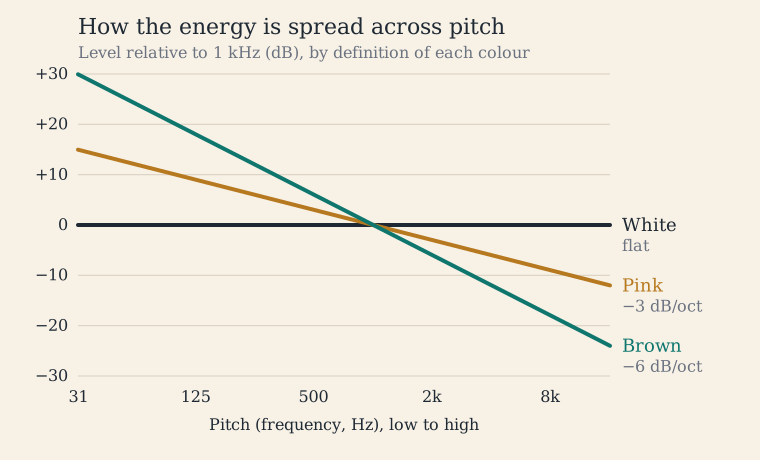
These are definitions, not recordings. A noise generator follows the slope by design. For how white and brown compare in use, see brown noise vs white noise.
So what colour is rain?
Rain isn't made to a slope, and its sound changes with conditions. The clearest measurement we found of how rain sounds comes from a 2024 study on a rooftop in Seoul, where engineers recorded raindrops hitting a waterproof plastic enclosure around a microphone. With no rain, the microphone picked up sound only below 2,500 Hz. Rain at 5 mm an hour added sound between 2,500 and 5,000 Hz, and the heaviest rain in the study (58 mm an hour) added a lot above 5,000 Hz. The harder it rained, the higher the pitches it added. That was one device design, and it recorded the plastic enclosure as much as the rain, so it shows a pattern rather than a rule for all rain.
The surface matters too. Lab work cited in the same paper looked at drops landing on deep water, a thin film of water on aluminium, dry aluminium and brick. Dry aluminium gave a sound spread fairly evenly across the whole range, though noticeably weaker.
So a light shower and a downpour on a hard roof make different sounds, and neither needs to follow a clean slope of any one colour.
| Sound | How the energy is spread | How it sounds |
|---|---|---|
| White noise | Equal at every pitch (flat) | Even hiss |
| Pink noise | Falls about 3 dB per octave | Between white and brown |
| Brown noise | Falls about 6 dB per octave | Low roar |
| Rain | Changes with how hard it falls and what it hits; heavier rain adds higher pitches | Depends on the rain and the surface |
Why do people call rain white noise?
Probably because it does the same job. In the introduction to their 2026 sleep study, the Penn team describe one idea behind broadband noise (the family that includes white noise): it can mask other sounds coming into the bedroom. They count rain sounds as broadband noise. Rain gets played for the same reason.
The labels help the mix-up along. Even in acoustics, "white noise" gets used loosely for any sound with a similar hiss. And playlists file rain under it: one of the top Google results for "is rain white noise" (19 Oct 2026) is a Spotify rain album by an artist called White Noise Relaxation. Our rain guide covers what rain sounds can and can't do for sleep.
Does the colour matter for sleep?
We found no adult trial that tested rain recordings on their own as a sleep aid (PubMed title and abstract search, 21 Oct 2026). Small trials of mixed nature sounds exist, but none that we found separates out rain, so the evidence doesn't tell us whether rain does anything for sleep.
Colour is unsettled too. A 2026 Penn lab study of one colour found a downside. In 25 healthy adults, a night of pink noise alone at 50 dB cut REM sleep by about 19 minutes. It tested pink noise, not rain or white noise. The authors say more research is needed on the best colour and level of broadband noise and on long-term use, and they caution against using it widely without thought.
So the evidence we found doesn't pick a best colour of noise for sleep, or a most calming sound. The practical answer is to pick the sound you find easiest to ignore, keep it quiet and put it on a timer. There's more on the evidence in white noise for sleep, pink noise and our comparison of sleep sounds, and the full picture for rain is in the research on rain sounds.
How loud and how long
Think of 50 dB as a ceiling, not a target. That's the level that cut REM in the Penn study, and the team's release says it is often compared to moderate rainfall. Lower isn't proven safe: with traffic noise in the background, pink noise at 40 dB also led to less REM than the traffic noise alone, and the team says the best level still needs research. So keep it as quiet as you can at your pillow, and never above 50 dB. A free sound-meter app is only a very rough guide.
Then set a timer. Basner's own advice, as reported by NBC News: if a sound machine helps, play it at a low volume and set a timer so it isn't on all night. We found no study of the best timer length.
This is general information, not medical advice. NSDR is not a treatment for any condition.
FAQ
Is rain pink noise?
Rain isn't pink noise either, in the strict sense. Pink noise is a generated signal that loses about 3 dB per octave. Rain's spectrum changes with how hard it falls and what it lands on, and heavier rain adds more high-pitched sound, so no single colour fits all rain.
Is rain white noise or brown noise?
Rain is neither white noise nor brown noise in the strict sense. Brown noise is a generated signal that drops about 6 dB per octave, and Wikipedia says it resembles heavy rainfall. Real rain doesn't hold that slope: its sound changes with how hard it falls and what it hits, and heavier rain adds more high-pitched sound.
Is ocean white noise?
By the strict definition, ocean sound isn't white noise. White noise is a generated signal with equal energy at every pitch, and waves are a natural sound that no generator made to a slope.
Can I play rain all night?
You can play rain all night, but you don't need to. A 2026 lab study found a night of pink noise at 50 dB cut REM sleep by about 19 minutes, and its authors caution against widespread, indiscriminate use of this kind of noise. Nothing tests rain, so less and quieter is the cautious choice. Keep it quiet, never above 50 dB at the pillow, and use a timer.
Is rain or white noise better for sleep?
We found no adult trial that compares them, and none that tested rain recordings on their own as a sleep aid. The Penn team behind the 2026 study says more research is needed on the best colour and level of noise. Choose the one you find easier to ignore, and play it quietly on a timer.
Sources
- Wikipedia. White noise. https://en.wikipedia.org/wiki/White_noise
- Wikipedia. Pink noise. https://en.wikipedia.org/wiki/Pink_noise
- Wikipedia. Colors of noise. https://en.wikipedia.org/wiki/Colors_of_noise
- Wikipedia. Brownian noise. https://en.wikipedia.org/wiki/Brownian_noise
- Hwang S, Jun C, De Michele C, Kim HJ, Lee J (2024). Rainfall observation leveraging raindrop sounds acquired using waterproof enclosure: exploring optimal length of sounds for frequency analysis. Sensors 24(13):4281. https://pubmed.ncbi.nlm.nih.gov/39001060/
- Basner M, Smith MG, Cordoza M, et al. (2026). Efficacy of pink noise and earplugs for mitigating the effects of intermittent environmental noise exposure on sleep. Sleep 49(5):zsag001. https://pubmed.ncbi.nlm.nih.gov/41627391/
- Penn Medicine via ScienceDaily (2026). Sound machines might be making your sleep worse. https://www.sciencedaily.com/releases/2026/02/260203030529.htm
- NBC News (2026). Pink noise may be bad for sleep quality, new research finds. https://www.nbcnews.com/health/health-news/pink-noise-worse-sleep-quality-study-rem-rcna257099