Pink noise is steady sound with more energy in the low frequencies than white noise, so it sounds like steady rain instead of a hiss. For sleep, the evidence splits in two. Short bursts of pink noise timed to a sleeping brain's slow waves boosted deep-sleep activity and memory in small lab studies. A track playing all night is a different thing. In a February 2026 Penn study, a night of pink noise at 50 dB came with about 19 fewer minutes of REM sleep. For focus, it may help a little if you have ADHD.
TL;DR
- Pink noise is deeper and less hissy than white noise.
- The deep-sleep and memory results came from clicks timed to brain waves in a lab.
- An all-night track at 50 dB cut REM by about 19 minutes in a 2026 lab study.
- For focus, white and pink noise gave a small boost to people with ADHD and a small drop to people without it.
- Keep it low, treat 50 dB as a ceiling, and set a timer. To block noise, try earplugs first.
What is pink noise?
Pink noise contains every frequency you can hear, but the low end is louder than the high end. Its power falls by about 3 dB with each octave up, so every octave carries the same total energy. That's why it's also called 1/f noise.
White noise is equal at every frequency, which is where its hiss comes from. Pink noise turns that hiss down and is often likened to steady rain. Brown noise drops faster still, about 6 dB per octave, and sounds more like a waterfall. More on the flat version in white noise for sleep.
The name comes from light. Light with the same spectrum would look pink. Sound engineers use it to test and tune loudspeakers.
Is it nicer to listen to? In a small 2020 study, 22 college students in Taiwan scored pink and red (brown) noise better than white on comfort questionnaires. That's one small study, and nobody was asleep.
How pink noise affects sleep
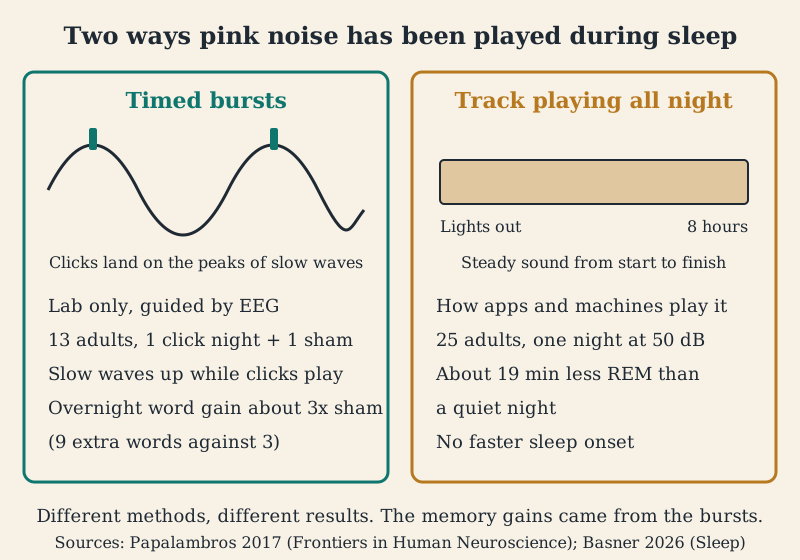
Two different things get called "pink noise for sleep": a lab method that plays short clicks at exact moments, and a track running from lights out to morning. Their results differ.
Timed bursts: the deep-sleep and memory studies
In Papalambros 2017, from Phyllis Zee's lab at Northwestern University, 13 adults aged 60 to 84 slept two nights in the lab: one with stimulation, one with sham. Electrodes tracked their slow brain waves, and software played five short pulses of pink noise timed to the peak of each wave, then paused.
While the pulses played, slow-wave activity and sleep spindles went up. Across the whole night, slow-wave activity was no different from the sham night. On a word-pair memory test, the overnight gain was about three times bigger after stimulation: 9 extra words against 3.
A 2019 follow-up tried it in 9 people with amnestic mild cognitive impairment, an early memory problem. Slow waves rose by more than 10% during stimulation. Recall improved in only 5 of the 9.
Why timing matters
In a 2013 German study, clicks played in step with the slow waves boosted them and improved memory. The same clicks played out of step did nothing. Timing is the active ingredient, and a speaker on your nightstand has no idea what your brain waves are doing.
Steady noise all night
A 2012 study from Peking University played steady pink noise to 40 people for a night and found more "stable sleep". The researchers estimated that from heart signals rather than brain-wave sleep staging.
Steady sound may help you drop off faster, though the clearest study used white noise. In a 2017 study at Brigham and Women's Hospital in Boston, 18 healthy adults went to bed 90 minutes early to mimic a bad night. With filtered white noise at about 46 dB, they reached stage 2 sleep a median 38% faster.
A 2021 review of 38 studies of continuous white or similar noise rated the evidence that it improves sleep "very low".
The REM problem: what the 2026 study found
In February 2026, Dr Mathias Basner's team at the University of Pennsylvania published a sleep-lab study in Sleep. Twenty-five healthy adults with a mean age of 28.5 spent seven nights in the lab. After one quiet night to settle in, they had six conditions in random order: quiet, recorded traffic and aircraft noise, pink noise alone at 50 dB, that noise plus pink noise at 40 or 50 dB, and that noise with earplugs.
What they found:
- On the night with pink noise alone at 50 dB, people got about 19 fewer minutes of REM than on the quiet night, swapped for lighter sleep. Nothing else changed. They didn't fall asleep faster or sleep longer.
- The traffic and aircraft noise night cost about 23 minutes of deep (N3) sleep.
- Pink noise layered on that noise added about 15 minutes awake compared with the quiet night, which neither sound did on its own.
- Earplugs blocked nearly all the traffic and aircraft noise effects, though they started to fail against the loudest, 65 dB events.
Basner, in the Penn Medicine release: "REM sleep is important for memory consolidation, emotional regulation and brain development, so our findings suggest that playing pink noise and other types of broadband noise during sleep could be harmful, especially for children whose brains are still developing and who spend much more time in REM sleep than adults."
It was one night per condition. Stanford sleep physician Dr Rafael Pelayo told NBC News the findings might not apply to the average person at home. Whether the REM loss holds over weeks of nightly use hasn't been tested.
Pink noise for focus and ADHD
The ADHD connection
The focus evidence is firmer than the sleep evidence, but only for people with ADHD, on lab tasks, and mostly with white noise.
A 2024 meta-analysis from Oregon Health & Science University pooled 13 small studies of 335 children and young adults with ADHD or ADHD symptoms. Noise gave a small boost on lab attention tasks (g = 0.25). Twelve of the 13 studies used white noise, one used pink and none used brown.
In people without ADHD, the same noise slightly hurt performance (g = -0.21).
One idea is that people with ADHD run under-aroused, and steady noise nudges arousal up to a better level for focus. Some researchers think a process called stochastic resonance is involved, where random noise helps a weak signal get through. The authors say the mechanism is still unproven.
Without ADHD
Silence has the better evidence. If unpredictable noise is what breaks your concentration, a steady sound may make it stand out less, the same masking logic as at night. Nobody has tested that for focus, so try it on a few work blocks and compare.
Pink noise vs white noise vs brown noise
| Noise | How its energy is spread | Sounds like | Likely best at covering* | Sleep research | ADHD focus studies (2024 review) |
|---|---|---|---|---|---|
| White | Equal at every frequency | Static | Voices and sharp sounds | 38 studies of white and similar noise, rated very low quality | 12 |
| Pink | Falls about 3 dB per octave | Steady rain | A bit of both | Timed bursts boosted deep-sleep waves in small lab studies; an all-night track cut REM (2026) | 1 |
| Brown | Falls about 6 dB per octave | Waterfall, deep rumble | Low rumble like traffic or HVAC | Almost none | 0 |
*Inferred from each sound's spectrum. No study has compared them for masking during sleep.
Choose pink noise if white sounds harsh to you. Choose white if voices or sharp sounds wake you, and see white noise for sleep. If you want something deeper, read brown noise for sleep.
Green noise has no standard definition. It's usually sold as steady sound with a boosted middle, and no study has tested it on people. For music, rain and the rest, see every sleep sound compared.
Is pink noise safe? The risks to know
Volume
The Penn team played pink noise at 50 dB, roughly the loudness of moderate rain. That's quieter than normal conversation, which is about 60 dB, and it still cost REM. So treat 50 dB as a ceiling, not a target.
Measure the level at your pillow with a sound meter app. Don't trust a talk-over test. By the CDC's rule of thumb, having to raise your voice to be heard at arm's length means the noise is likely above 85 dB.
Children and infants
REM makes up about half of a newborn's sleep and falls to about a fifth by age 3. Basner's team says their results caution against broadband noise for newborns and toddlers, though no children were in the study.
Volume is the other worry. A 2014 University of Toronto study in Pediatrics tested 14 infant sleep machines at full volume. At 30 cm, every one topped 50 dB, the recommended limit for hospital nurseries. Three went past 85 dB, which over 8 hours would exceed adult workplace limits and risk hearing loss.
The Toronto authors' advice, as reported by Medical News Today, is to place the machine as far from the cot as you can, never in it or on the rail, play it low and play it for a short time.
Long-term use
No study has followed people who sleep with pink noise for months or years. A 2021 review from Basner's Penn group warned that continuous noise "may also negatively affect sleep and hearing".
How to use pink noise the right way
For sleep
- Try earplugs first if blocking noise is the goal. They beat pink noise in the Penn study and add no sound of their own. It was one lab study, though.
- Use the lowest level that covers the noise. Treat 50 dB at your pillow as the ceiling.
- Set a timer. Basner told NBC News to play it low and set a timer so it isn't on all night. In his study it ran all 8 hours. No one has tested the best length, so start with roughly the time it takes you to fall asleep.
- Put the speaker across the room. Sound level falls with distance, and earbuds put it right at your ear.
- Pick a long track that doesn't loop, so you don't start noticing the repeat.
For focus
- Test it if you have ADHD or ADHD traits. That's where the small benefit showed up.
- Keep it low. Joel Nigg, who led the 2024 review, told the AP to take "plenty of breaks for the ears to rest".
- Play it for one work block, such as one of these 90-minute focus blocks, then switch it off.
- Compare. Without ADHD, the pooled result went the other way, so try a few blocks with it and a few without.
For stress
Pink noise hasn't been tested for stress on its own. A 2025 review of 34 sound studies found the clearest stress effects for music. For non-musical sounds it called the research limited, and some studies found sound raised stress.
When the problem isn't the noise
If a busy mind keeps you up, pink noise has nothing to work on. Masking only covers sounds.
NSDR is guided rest built on yoga nidra-style body scanning and slow breathing. A 2026 meta-analysis of 73 yoga nidra studies with 5,201 participants reported less stress and anxiety, though the studies were low quality and the effects likely inflated. See NSDR for sleep. NSDR.co is free.
This is general information, not medical advice. If poor sleep lasts for weeks, see a doctor, and ask a paediatrician before using a sound machine for a baby.
FAQ
Is pink noise better than white noise for sleep?
Pink noise isn't proven better than white noise for sleep, or worse. White noise has more studies, rated very low quality, and pink noise's deep-sleep gains came from timed lab bursts. Pick the one you find easier to ignore.
Can pink noise help with tinnitus?
Pink noise hasn't been tested for tinnitus on its own. Some people use steady sound to make the ringing less noticeable, but the evidence for sound therapy is weak. A 2018 Cochrane review of 8 trials with 590 people found no evidence that sound generators or hearing aids beat no device, and rated the evidence low quality. An audiologist can help.
Is it safe to play pink noise all night?
All-night pink noise is the pattern that cost REM, so a timer is the safer choice. In the Penn study, one night of pink noise alone at 50 dB meant about 19 fewer minutes of REM, and nobody has tested months of nightly use.
What volume should pink noise be?
Pink noise should be as quiet as still does the job. Treat 50 dB, about moderate rain, as a ceiling, not a target, and check it at your pillow. For a baby, the hospital-nursery limit of 50 dB is a sensible ceiling at the cot.
Does pink noise improve memory?
Pink noise improved memory only when it was timed to slow brain waves in a lab. In the 2017 Northwestern study of 13 older adults, the overnight word gain was about three times bigger than after a sham night. A speaker playing all night hasn't been shown to do this.
Sources
- Basner M, Smith MG, Cordoza M, Kayser MS, Carlin M, Ecker AJ, et al. (2026). Efficacy of pink noise and earplugs for mitigating the effects of intermittent environmental noise exposure on sleep. Sleep 49(5):zsag001. https://pubmed.ncbi.nlm.nih.gov/41627391/
- Penn Medicine (2026). News release on the pink noise and earplugs study, Feb 2026 (via ScienceDaily). https://www.sciencedaily.com/releases/2026/02/260203030529.htm
- NBC News (2026). Pink noise may be bad for sleep quality, new research finds. https://www.nbcnews.com/health/health-news/pink-noise-worse-sleep-quality-study-rem-rcna257099
- Papalambros NA, Santostasi G, Malkani RG, Braun R, Weintraub S, Paller KA, Zee PC (2017). Acoustic enhancement of sleep slow oscillations and concomitant memory improvement in older adults. Frontiers in Human Neuroscience 11:109. https://pubmed.ncbi.nlm.nih.gov/28337134/
- Northwestern University (2017). News release on pink noise and deep sleep in older adults. https://news.northwestern.edu/stories/2017/april/pink-noise-sound-enhance-deep-sleep-memory
- Papalambros NA, Weintraub S, Chen T, Grimaldi D, Santostasi G, Paller KA, Zee PC, Malkani RG (2019). Acoustic enhancement of sleep slow oscillations in mild cognitive impairment. Annals of Clinical and Translational Neurology 6(7):1191-1201. https://pubmed.ncbi.nlm.nih.gov/31353857/
- Ngo HV, Martinetz T, Born J, Mölle M (2013). Auditory closed-loop stimulation of the sleep slow oscillation enhances memory. Neuron 78(3):545-553. https://pubmed.ncbi.nlm.nih.gov/23583623/
- Zhou J, Liu D, Li X, Ma J, Zhang J, Fang J (2012). Pink noise: effect on complexity synchronization of brain activity and sleep consolidation. Journal of Theoretical Biology 306:68-72. https://pubmed.ncbi.nlm.nih.gov/22726808/
- Messineo L, Taranto-Montemurro L, Sands SA, Oliveira Marques MD, Azabarzin A, Wellman DA (2017). Broadband sound administration improves sleep onset latency in healthy subjects in a model of transient insomnia. Frontiers in Neurology 8:718. https://pubmed.ncbi.nlm.nih.gov/29312136/
- Riedy SM, Smith MG, Rocha S, Basner M (2021). Noise as a sleep aid: a systematic review. Sleep Medicine Reviews 55:101385. https://pubmed.ncbi.nlm.nih.gov/33007706/
- Nigg JT, Bruton A, Kozlowski MB, Johnstone JM, Karalunas SL (2024). Systematic review and meta-analysis: do white noise or pink noise help with task performance in youth with attention-deficit/hyperactivity disorder or with elevated attention problems? Journal of the American Academy of Child and Adolescent Psychiatry 63(8):778-788. https://pubmed.ncbi.nlm.nih.gov/38428577/
- Johnson CK, Associated Press (2024). Can pink noise enhance sleep and memory? Early research drives a color noise buzz (quotes from Joel Nigg). https://www.nbcnewyork.com/news/national-international/pink-noise-enhance-sleep-memory/5433098/
- Lu SY, Huang YH, Lin KY (2020). Spectral content (colour) of noise exposure affects work efficiency. Noise and Health 22(104):19-27. https://pubmed.ncbi.nlm.nih.gov/33243964/
- Hugh SC, Wolter NE, Propst EJ, Gordon KA, Cushing SL, Papsin BC (2014). Infant sleep machines and hazardous sound pressure levels. Pediatrics 133(4):677-681. https://pubmed.ncbi.nlm.nih.gov/24590753/
- Medical News Today (2014). Report on infant sleep machine recommendations. https://www.medicalnewstoday.com/articles/273468
- Saskovets M, Saponkova I, Liang Z (2025). Effects of sound interventions on the mental stress response in adults: scoping review. JMIR Mental Health 12:e69120. https://pubmed.ncbi.nlm.nih.gov/40127440/
- Sereda M, Xia J, El Refaie A, Hall DA, Hoare DJ (2018). Sound therapy (using amplification devices and/or sound generators) for tinnitus. Cochrane Database of Systematic Reviews 12:CD013094. https://pubmed.ncbi.nlm.nih.gov/30589445/
- Ghai S, Odyniec P, Ghai I (2026). Effects of yoga nidra on stress, anxiety, and depression: a systematic review and meta-analysis. Annals of the New York Academy of Sciences 1556(1):e70149. https://pubmed.ncbi.nlm.nih.gov/41327816/
- Centers for Disease Control and Prevention (archived 2023). What noises cause hearing loss? https://web.archive.org/web/2023/https://www.cdc.gov/nceh/hearing_loss/what_noises_cause_hearing_loss.html
- Wikipedia. Pink noise (definition, name origin, use in audio testing). https://en.wikipedia.org/wiki/Pink_noise