Green noise is steady background sound with the middle frequencies turned up, usually said to centre near 500 Hz. It's sold as a softer white noise that sounds like a stream or distant surf. It has no agreed definition, and PubMed lists no study of it in people (searched October 2026). Like any steady sound it can cover sudden noises, so the rules for white and pink noise apply, including a 2026 lab finding that a night of pink noise at 50 dB cost about 19 minutes of REM sleep.
TL;DR
- Green noise boosts the middle of the frequency range, often said to be near 500 Hz.
- No study has tested it on people. The research quoted for it is about nature recordings or white and pink noise.
- It can cover sudden noises. White noise probably covers high-pitched sounds and hiss better (untested).
- Treat 50 dB at your pillow as a ceiling, not a target, and set a timer. If blocking noise is the goal, try earplugs.
What is green noise?
Green noise is broadband sound, a steady wash shaped so the middle of the hearing range is louder than the top and bottom. The Sleep Foundation explains that white noise has every audible frequency at equal volume, while green noise "amplifies the frequencies in the middle of that range." Most descriptions liken it to a stream, distant waves or wind in trees.
Sleep physician Dr. Abhinav Singh, on the same page: "Different frequency concentrations are grouped as colors. White has a hissing tone to it, while green has more middle range, and brown has more low bass ranges."
Why there's no agreed definition
White, pink and brown noise have exact shapes. White is flat across the spectrum. Pink loses about 3 dB of energy with each octave you go up, and brown loses about 6 dB. Green noise has no slope like that.
Producers of ambient recordings market it as "the background noise of the world", something like pink noise with extra energy near 500 Hz. Engineers use the same name for something unrelated, a mid-frequency dot pattern in halftone printing. PubMed's 12 "green noise" papers cover printing, imaging, physics, engineering and neuron modelling. None involves people.
Sleep sites give anything from "around 500 Hz" to "500 to 5,000 Hz", so two green noise tracks can sound quite different. Listen before you settle on one.
Green noise vs other noise colors
| Noise | Spectrum | Sounds like | Sleep evidence |
|---|---|---|---|
| White | Flat: equal energy at every frequency | Static, a fan | Most studied: 38 studies of white or similar noise, rated very low quality |
| Pink | Falls about 3 dB per octave | Steady rain | A few small studies; an all-night track cut REM in 2026 |
| Brown | Falls about 6 dB per octave | A waterfall | No sleep or ADHD studies found |
| Green | Boosted middle, often said near 500 Hz | A stream, distant surf | No studies on people |
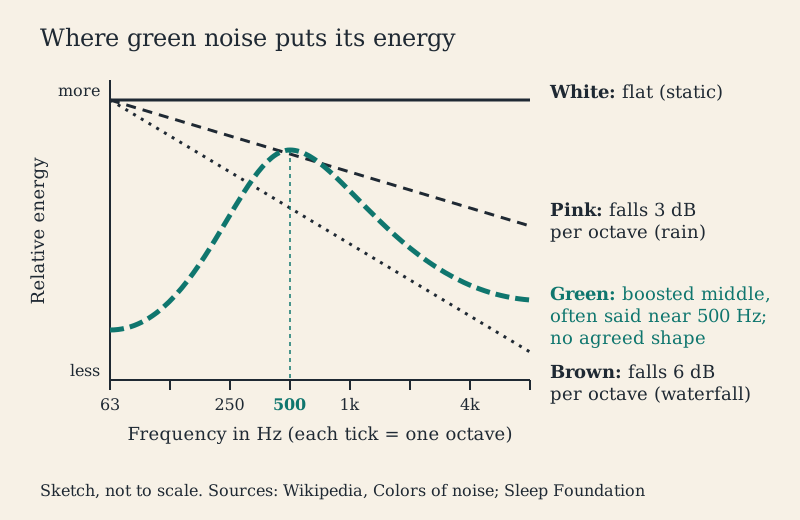
Green sits between the hiss of white noise and the rumble of brown noise. Pink is its closest relative; see pink noise for sleep and focus.
Does green noise help with sleep?
What the research says, and what it doesn't
Nobody knows. The Sleep Foundation says "there is limited data on how green noise can benefit sleepers", and on PubMed the count is zero.
The wider evidence on steady noise is weak too. A 2021 review from Mathias Basner's group at Penn found 38 studies of white or similar noise, with results ranging from better sleep to worse, and rated the evidence "very low" quality.
The nature-sound studies often credited to green noise played recordings of real places. Nobody has tested a generated green noise track.
How it could help
What wakes you is usually the jump in sound, more than the loudness. In a sleep-lab study of 4 to 5 people, the gap between background and peak decided whether recorded hospital noise caused an arousal. White noise narrowed the gap, and arousals fell to near normal.
A 2017 Brigham and Women's Hospital study put 18 healthy adults to bed 90 minutes early to mimic a bad night. Steady broadband sound at about 46 dB cut the time it took them to fall asleep by 38%.
Green noise should mask the same way, though with less high-frequency energy it probably lets more high-pitched sound through than white noise does (untested).
The 2026 study that applies to every noise color
In a February 2026 Penn study, 25 healthy young adults spent seven nights in a sleep lab, one to settle in and then six conditions in random order. Pink noise alone at 50 dB, about the loudness of moderate rain, came with about 19 fewer minutes of REM than the quiet night. Played over recorded traffic noise, pink noise at 40 or 50 dB left less deep and REM sleep. Earplugs blocked nearly all traffic noise effects but started failing at 65 dB.
The study tested only pink noise. Basner still warned, in the Penn release, that "playing pink noise and other types of broadband noise during sleep could be harmful". Green noise is broadband noise. More in sleep sounds compared.
Green noise vs white noise
White noise spreads its energy evenly across the range of human hearing, which gives it a bright hiss. Green noise turns down the top and bottom.
White noise has the studies, even if they're mixed. A 2025 meta-analysis of 12 trials (1,301 people, many in intensive care) found it improved self-rated sleep quality in adults and older adults, though study quality varied. In a 2021 study of 10 New Yorkers kept up by city noise, a week of white noise cut their time awake at night. Green noise has nothing comparable, and white noise probably masks more because it covers the full range.
To choose:
- Your room is noisy and the hiss doesn't bother you. Use white noise. More in white noise for sleep.
- White noise sounds harsh to you. Try green or pink, and accept a little less masking at the top end.
- Your room is already quiet. You may not need either. In the Penn study, pink noise in a quiet room didn't help people sleep, and it cost them REM.
Does green noise help with focus?
No study has tested green noise for focus. For white and pink noise, it depends on who's listening. A 2024 meta-analysis found a small benefit on lab attention tasks for young people with ADHD or ADHD symptoms, from 12 white-noise studies, 1 pink and 0 brown. In people without ADHD, the noise slightly hurt performance.
A 2014 brain-scan study found white noise, though not a plain tone, slightly improved memory for pictures and raised activity in dopamine-producing midbrain areas during learning. Green noise wasn't in it.
Without ADHD, quiet may serve you better. Compare a noise day with a quiet day on the same kind of task.
Green noise for stress and anxiety
Nature recordings have a little evidence here. In a 2017 study of 17 adults in a brain scanner, sounds recorded in natural places shifted heart-rate measures toward rest-and-digest, compared with recordings of man-made places. People who started out stressed relaxed the most, and people who were already relaxed got slightly more stressed, according to the university's release.
In a 2010 study of 40 people, skin conductance, a sweat-gland marker of stress, tended to settle a little faster after a hard maths task with nature sounds than with recordings of noisy environments, though heart-rate variability didn't change. A 2025 review still called the research on nature sounds and stress limited.
None of these studies played green noise or measured cortisol. The Sleep Foundation suggests a steady sound might give a racing mind something to focus on instead, an untested idea. Green noise can't treat anxiety, so see a doctor if anxiety keeps you up most nights.
How to use green noise
- Measure the volume at your pillow. Use a free decibel app. Treat 50 dB as a ceiling, not a target, and go as low as still covers the noise.
- Set a timer. Basner told NBC News to play it low on a timer so it isn't on all night. His study played pink noise for the whole 8 hours. No study has tested how long a timer should run.
- Put the speaker across the room. Distance lowers the level at your ears.
- Pick a long, steady track. Jumps in sound wake people, so avoid an audible loop point or sudden changes.
- Give it a week. The New York white-noise study ran each phase for a week.
- Try earplugs if blocking noise is the goal. In the Penn study they protected sleep from traffic noise better than pink noise did.
| Level | Roughly | For sleep |
|---|---|---|
| 30 dB | A whisper | Fine |
| 50 dB | Moderate rain; the Penn pink noise | The ceiling |
| 60 dB | Normal conversation | Too loud |
| 85 dB | You have to raise your voice to be heard | Can damage hearing over time |
Levels from the CDC and the Penn release.
Where to find green noise
Streaming services, YouTube and most sleep apps carry green noise tracks. A steady stream or rain recording is a close cousin; see rain sounds for sleep. Nature recordings can include bird calls or gusts, so pick one without sudden changes.
When sound isn't the problem
Sound changes the room. It does nothing for a mind that's still racing at lights-out.
NSDR is guided rest based on yoga nidra. A voice takes you through a body scan and slower breathing while you stay awake. A 2026 meta-analysis of 73 yoga nidra studies (5,201 participants) reported less stress and anxiety, though the authors called the studies low quality and the effects likely inflated. Try a 10-minute session at lights-out, with green noise low behind it if you like. NSDR for sleep covers how, and NSDR.co is free.
This is general information, not medical advice. If poor sleep, anxiety or tinnitus lasts for weeks, see a doctor.
FAQ
Is green noise scientifically proven to help sleep?
No, green noise has no sleep studies at all. PubMed lists none (searched October 2026). The evidence people cite is about nature recordings or white and pink noise.
Is green noise better than white noise?
Green noise has less hiss, but white noise has the evidence and probably covers high-pitched sounds better (untested). If the hiss bothers you, try green.
Can I play green noise all night?
Playing green noise all night is the riskier choice. A night of pink noise at 50 dB cost about 19 minutes of REM in the Penn study, and long-term use is unstudied. Basner advises a timer.
How loud should green noise be for sleep?
Green noise should be as quiet as still covers the noise, and no more than 50 dB at your pillow. Measure it with an app. A talk-over test can't tell you. By the CDC's rule of thumb, needing to raise your voice means about 85 dB.
Is green noise safe for babies?
Green noise hasn't been tested on babies, and sound machines can get loud. A 2014 Pediatrics study of 14 infant machines at full volume found all were above 50 dB at 30 cm, the hospital-nursery limit, and three went above 85 dB. The authors advise placing it as far from the baby as you can, never in the cot or on the rail, at low volume, for a short time (Medical News Today). Basner's team cautions against broadband noise for newborns and toddlers, who need a lot of REM. In a 2003 Science study, rat pups raised in continuous moderate noise were slow to develop an orderly hearing cortex. Ask your paediatrician.
Does green noise help with ADHD?
Green noise hasn't been tested for ADHD. In the 2024 meta-analysis, white and pink noise helped young people with ADHD a little on lab tasks and slightly hurt those without it.
Does green noise help with tinnitus?
There's no evidence green noise helps tinnitus, though some people use background sound to make the ringing less noticeable. A 2018 Cochrane review of 8 trials found no trial showing that sound generators or hearing aids beat having no device, and rated the evidence low quality. See an audiologist.
What's the difference between green noise and nature sounds?
Green noise is a generated signal that never changes. A nature recording is a real place, with the odd bird call or gust. The relaxation studies used recordings.
Why is it called "green" noise?
The name is probably a nod to nature. Ambient-recording producers sell it as "the background noise of the world". In engineering, "green noise" means an unrelated dot pattern used in halftone printing.
Can you become dependent on green noise to sleep?
Nobody has studied whether people become dependent on green noise or other sleep sounds, or what years of nightly use do. That's one more reason to run it on a timer.
Sources
- Basner M, Smith MG, Cordoza M, et al. (2026). Efficacy of pink noise and earplugs for mitigating the effects of intermittent environmental noise exposure on sleep. Sleep 49(5):zsag001. https://pubmed.ncbi.nlm.nih.gov/41627391/
- Penn Medicine (2026). News release on the pink noise and earplugs study, 4 Feb 2026 (via ScienceDaily). https://www.sciencedaily.com/releases/2026/02/260203030529.htm
- NBC News (2026). Report on the Penn pink noise study, 4 Feb 2026. https://www.nbcnews.com/health/health-news/pink-noise-worse-sleep-quality-study-rem-rcna257099
- Riedy SM, Smith MG, Rocha S, Basner M (2021). Noise as a sleep aid: a systematic review. Sleep Medicine Reviews 55:101385. https://pubmed.ncbi.nlm.nih.gov/33007706/
- Ding Y, Sun X, Yin J, et al. (2025). Impact of white noise on sleep quality across age groups and in critically ill/non-critically ill patients: a systematic review and meta-analysis of randomized controlled trials. Sleep Medicine 136:106869. https://pubmed.ncbi.nlm.nih.gov/41151421/
- Ebben MR, Yan P, Krieger AC (2021). The effects of white noise on sleep and duration in individuals living in a high noise environment in New York City. Sleep Medicine 83:256-259. https://pubmed.ncbi.nlm.nih.gov/34049045/
- Stanchina ML, Abu-Hijleh M, Chaudhry BK, et al. (2005). The influence of white noise on sleep in subjects exposed to ICU noise. Sleep Medicine 6(5):423-428. https://pubmed.ncbi.nlm.nih.gov/16139772/
- Messineo L, Taranto-Montemurro L, Sands SA, et al. (2017). Broadband sound administration improves sleep onset latency in healthy subjects in a model of transient insomnia. Frontiers in Neurology 8:718. https://pubmed.ncbi.nlm.nih.gov/29312136/
- Gould van Praag CD, Garfinkel SN, Sparasci O, et al. (2017). Mind-wandering and alterations to default mode network connectivity when listening to naturalistic versus artificial sounds. Scientific Reports 7:45273. https://pubmed.ncbi.nlm.nih.gov/28345604/
- Brighton and Sussex Medical School (2017). The sound of nature helps us relax (news release). https://www.bsms.ac.uk/about/news/2017/03-31-the-sound-of-nature-helps-us-relax.aspx
- Alvarsson JJ, Wiens S, Nilsson ME (2010). Stress recovery during exposure to nature sound and environmental noise. International Journal of Environmental Research and Public Health 7(3):1036-1046. https://pubmed.ncbi.nlm.nih.gov/20617017/
- Saskovets M, Saponkova I, Liang Z (2025). Effects of sound interventions on the mental stress response in adults: scoping review. JMIR Mental Health 12:e69120. https://pubmed.ncbi.nlm.nih.gov/40127440/
- Nigg JT, Bruton A, Kozlowski MB, et al. (2024). Systematic review and meta-analysis: do white noise or pink noise help with task performance in youth with attention-deficit/hyperactivity disorder or with elevated attention problems? Journal of the American Academy of Child and Adolescent Psychiatry 63(8):778-788. https://pubmed.ncbi.nlm.nih.gov/38428577/
- Rausch VH, Bauch EM, Bunzeck N (2014). White noise improves learning by modulating activity in dopaminergic midbrain regions and right superior temporal sulcus. Journal of Cognitive Neuroscience 26(7):1469-1480. https://pubmed.ncbi.nlm.nih.gov/24345178/
- Hugh SC, Wolter NE, Propst EJ, et al. (2014). Infant sleep machines and hazardous sound pressure levels. Pediatrics 133(4):677-681. https://pubmed.ncbi.nlm.nih.gov/24590753/
- Medical News Today (2014). Report on infant sleep machine recommendations. https://www.medicalnewstoday.com/articles/273468
- Chang EF, Merzenich MM (2003). Environmental noise retards auditory cortical development. Science 300(5618):498-502. https://pubmed.ncbi.nlm.nih.gov/12702879/
- Sereda M, Xia J, El Refaie A, et al. (2018). Sound therapy (using amplification devices and/or sound generators) for tinnitus. Cochrane Database of Systematic Reviews 12:CD013094. https://pubmed.ncbi.nlm.nih.gov/30589445/
- Ghai S, Odyniec P, Ghai I (2026). Effects of yoga nidra on stress, anxiety, and depression: a systematic review and meta-analysis. Annals of the New York Academy of Sciences 1556(1):e70149. https://pubmed.ncbi.nlm.nih.gov/41327816/
- Centers for Disease Control and Prevention (archived 2023). What noises cause hearing loss? https://web.archive.org/web/2023/https://www.cdc.gov/nceh/hearing_loss/what_noises_cause_hearing_loss.html
- Sleep Foundation (2025). What is green noise and how can it help you sleep? (Summer JV, medically reviewed by Singh A; updated 29 Jul 2025). https://www.sleepfoundation.org/noise-and-sleep/what-is-green-noise
- Wikipedia. Colors of noise (green noise, white, pink and brown noise definitions). https://en.wikipedia.org/wiki/Colors_of_noise
- Lau DL, Khan AM, Arce GR (2002). Minimizing stochastic moiré in frequency-modulated halftones by means of green-noise masks. Journal of the Optical Society of America A 19(11):2203-2217. https://pubmed.ncbi.nlm.nih.gov/12413121/