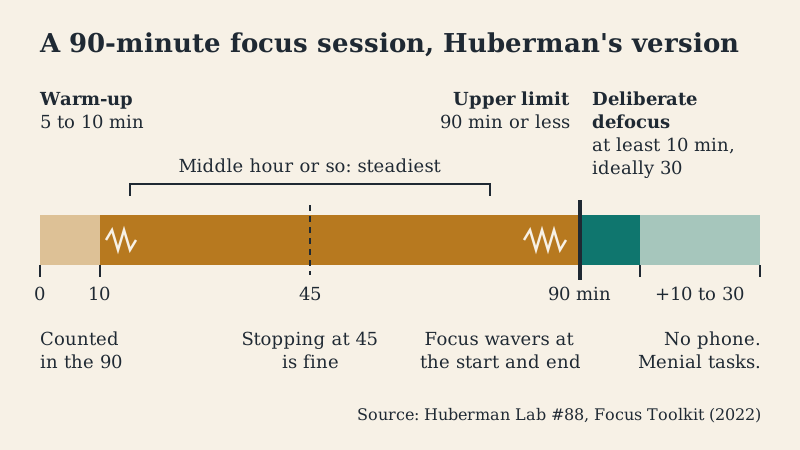
The ideal focus session length, by Andrew Huberman's account, is 90 minutes or less. In his Focus Toolkit episode (Huberman Lab #88) he counts the first 5 to 10 minutes as a warm-up inside those 90, then takes 10 to 30 minutes of deliberate defocus before the next session. The 90 comes from sleep's roughly 90-minute cycles, and the evidence for a matching rhythm while you're awake is weak and mixed.
The 90-minute focus protocol at a glance
- Cap sessions at 90 minutes. Huberman says 45 counts too.
- The first 5 to 10 minutes are a restless warm-up, counted in the 90.
- The middle hour or so is steadiest, and focus wavers at either end.
- Then take 10 to 30 minutes of deliberate defocus, phone-free.
- Two, maybe three, a day; start with one daily for about four weeks.
- Ninety is Huberman's cap, not a proven rhythm. A 1995 study of 60 people found no 90-minute rhythm in waking performance.
Why 90 minutes? What ultradian rhythms do and don't show
Where Huberman's 90 minutes comes from
Huberman bases the 90 minutes on ultradian rhythms, the roughly 90-minute cycles seen in sleep (how the sleep cycle works). He keeps the number loose. "We can reliably say 90 minutes or less," he says, and "it doesn't have to be the full 90 minutes." So he sets a 90-minute timer as the upper limit, not a target. A session you end at 45 minutes still counts.
What the research on waking cycles shows
He argues that pushing for two or three hours of focus is possible but "not really in line with what we know about the underlying biology."
The biology is shakier. Nathaniel Kleitman proposed a "basic rest-activity cycle" of about 1.5 hours that runs while we're awake. Yet a 1995 study testing 60 people every 10 minutes for nine hours found no 90-minute rhythm in performance (Neubauer & Freudenthaler). Waking cycles of about 1.5 hours have been reported, but they're small and easily masked (Lavie, 1989).
Ninety minutes is a sensible cap borrowed from sleep, not a measured limit on waking focus.
The chemistry Huberman links to focus
His model pairs epinephrine with alertness, acetylcholine with an attention spotlight, and dopamine with concentration and focus. He puts tiredness at 90 minutes, or even 45, down to the effort of refocusing.
What happens during a 90-minute focus session
The warm-up: the first 5 to 10 minutes
A restless start is normal; if it feels hard, you're probably doing it right. Huberman calls the first 5 to 10 minutes "a transition time" and counts that warm-up inside the 90. Open with the easiest part of the task. Keep the timer running.
The middle stretch
The middle hour or so is the steadiest, though attention still drifts. "A big part of being able to focus is to go back to focusing," he says. Put your phone in another room, turn notifications off and work on one task. In one field study, information workers switched tasks about every three minutes (González & Mark, 2004). See ways to sharpen focus before and during a session.
The last stretch, and stopping early
Focus wavers near the end, so finish the thought you're on. Stopping at 45 minutes is fine too.
Deliberate defocus: the recovery protocol
What deliberate defocus means
Deliberate defocus is Huberman's term for the break. Take at least 10 minutes, ideally 30, and spend them on "somewhat menial tasks" that need little concentration.
What counts and what doesn't
| Do | Don't |
|---|---|
| Walk | Check your phone |
| Look at the sky | Read anything demanding |
| Stretch | Scroll in the hallway |
| Make tea | Phone in the restroom |
| Simple chores | Start a new task |
Walking, looking at the sky, and skipping reading and the phone are Huberman's own examples.
Why the break matters
Huberman calls that idle period "essential for your ability to focus," much as rest between sets of resistance training lets you perform during the sets.
Decompressing lets you refocus later, he argues, and harder work needs longer rest. Read more about recovering from mental fatigue.
NSDR between focus sessions
What NSDR is
In the same episode Huberman recommends NSDR, guided deep relaxation he equates with yoga nidra. In focus meditation you keep bringing your attention back. In NSDR you try to defocus, and most people stay awake. One small imaging study measured more striatal dopamine release during yoga nidra, equal to a 65% increase (Kjaer et al., 2002). The scans were taken during the practice itself. The study doesn't show what happens after a session, or between two focus blocks.
When and how long
Huberman uses 10 to 30 minutes and adds an afternoon session mainly when he's short on sleep. Slot it between sessions or after lunch.
Where to find a session
Huberman Lab Clips has free 10-minute and 20-minute recordings. NSDR.co is free, with 50+ sessions and always a free plan. A 10-minute track is an easy start. See NSDR session options by goal and length.
The focus supplement stack (optional)
Health note: these are doses Huberman describes on his podcast, not medical advice. Check with a doctor before taking any of them, especially if you take medication, are pregnant, or have a heart, blood-pressure or mental-health condition.
Huberman puts behaviour first, food second and supplements last. He calls their effect modest, far smaller than that of prescription drugs. The table gives the doses he describes, with his own caveats.
| Supplement | Dose Huberman gives | Timing | His caveat |
|---|---|---|---|
| L-tyrosine | 500-1,000 mg (he takes 500) | dopamine starts to peak 30-45 min after | once or twice a week; crash afterwards; not with schizophrenia, psychosis, bipolar or anxiety |
| Alpha-GPC | 300-600 mg (300 suits him) | 10-20 min before | about four days a week; stroke-risk study |
| Caffeine | 100-200 mg | 90-120 min after waking | a 2024 review found no evidence the delay prevents a crash |
L-tyrosine
L-tyrosine is a dopamine and norepinephrine precursor. A review found it seems to help cognitive performance, mainly in short, stressful or mentally demanding situations (Jongkees et al., 2015). In Controlling Your Dopamine he warns that it "will not be good for you" if you have a dopamine-related condition such as schizophrenia, psychosis, bipolar disorder or anxiety. Crash depth varies.
Alpha-GPC
Huberman raises one worry himself. He cites a recent study suggesting that taking alpha-GPC for many years could raise stroke risk. He reads the data as not very conclusive but a reason for concern. He takes it about four days a week, not daily.
Caffeine
Huberman's reason for waiting 90 to 120 minutes is adenosine, the sleep-pressure molecule. A 2024 review questioned that reasoning and found no evidence that the delay prevents an afternoon crash (Antonio et al.), so treat it as optional.
His timing rule covers the whole stack. Take it early in the day, never after 2 or 3 p.m., to protect sleep, and combine two or three focus tools at most. Read more about caffeine timing for focus.
Your daily focus schedule
An example two-session day
| Block | How long | Note |
|---|---|---|
| Focus session 1 | 90 min or less | warm-up included |
| Deliberate defocus | 10-30 min | no phone |
| Shallow work | as needed | email, meetings, admin |
| Lunch | don't overeat | |
| NSDR (optional) | 10-30 min | |
| Focus session 2 | 90 min or less | |
| Deliberate defocus | 10-30 min |
How many sessions a day
Huberman recommends about two, maybe three, sessions a day. He can do three 90-minute bouts himself, "but that's about it," and some people may manage four. How many you can do depends, in his view, on how well you've slept and eaten and how well trained your focus is. Start with one a day, weekends included. After about four weeks, if you can stay concentrated through the restless start, he'd consider adding another. Better training doesn't mean more sessions, though. The more deeply you can concentrate, he says, the fewer deep bouts you can do each day and the more defocus you need.
How much deep work a day adds up to
Two or three full 90-minute sessions add up to 3 to 4.5 hours of hard focus. That figure is plain arithmetic. Deliberate-practice research found little extra benefit beyond about 4 hours a day (Ericsson et al., 1993). Huberman is clear that he means the hard mental work, not the whole working day. The author Cal Newport, on Huberman's podcast, said he's "good for 4, 4.5, good hours a day" of producing good work.
90 minutes vs Pomodoro: which is better?
What the studies found
Pomodoro is usually 25 minutes on, 5 off. Three small student trials have compared it, or a close variant, with self-chosen breaks. In Biwer 2023 (87 students, one study day), scheduled breaks, including a 24/6 "Pomodoro" schedule, gave better moods than self-chosen breaks and appeared to get the same work done in less time. In Smits 2025 (94 students, 2 hours), Pomodoro fatigue rose faster, with no overall difference in productivity or flow. Göksu 2026 (176 students) found no significant performance difference, and self-chosen breaks gave better moods, so the trials disagree on mood. None tested 90-minute blocks, so no trial has settled the ideal focus session length.
Side by side
| Factor | 90-minute block | Pomodoro |
|---|---|---|
| Session | 90 min or less | 25 min |
| Break | 10-30 min | 5 min |
| Warm-up | 5-10 min per start | same, paid more often |
| Based on | ultradian cycles (Huberman) | a fixed 25/5 timer |
| Evidence | no trial tested it | small trials: similar to self-chosen breaks |
When to use each
Long blocks make you pay the warm-up less often, so use them for writing, coding and learning. Pomodoro suits admin, email and tasks you've been avoiding, because a short timer makes starting easier. Some people pair Pomodoro with binaural beats. For work that needs your full concentration, use one long block of up to 90 minutes, then take a real break.
FAQ
What's the ideal focus session length for beginners?
For beginners, the ideal focus session length is the same 90 minutes or less, and 45 minutes counts. Huberman suggests starting with one session a day. After about four weeks, if you can stay with it through the restless start, consider adding a second.
Can you train yourself to focus longer than 90 minutes?
Yes, focusing for longer than 90 minutes is possible, Huberman says, but he doesn't think it fits the biology, and the harder the work, the more rest you need afterwards. He also notes a paradox. The better trained your focus, the more defocus you need and the fewer deep bouts you can manage. The 90-minute cap itself comes from sleep cycles, and the evidence for a matching cycle in waking focus is weak and mixed.
How long should a break be after a 90-minute focus session?
Huberman's break after a 90-minute session is at least 10 minutes, ideally 30, with no phone. After a 45-minute bout, he allows "maybe five, 10, maybe even 30 minutes".
Does the 90-minute rule apply to workouts and practice?
Yes, in Huberman's view. He applies the same 90-minute cap to workouts, motor skill learning and music practice.
What's the difference between ultradian and circadian rhythms?
A circadian rhythm runs about 24 hours, and light is the main cue that sets the body's central clock. An ultradian rhythm is any cycle shorter than a day. Sleep's roughly 90-minute cycle is one; cortisol pulses are another. Whether a 90-minute cycle also governs focus while you're awake is disputed.
Sources
- Huberman A (2022). Focus Toolkit: Tools to Improve Your Focus & Concentration. Huberman Lab podcast #88. https://www.hubermanlab.com/episode/focus-toolkit-tools-to-improve-your-focus-and-concentration
- Huberman Lab Essentials (2024). How to Focus to Change Your Brain. YouTube. https://youtube.com/watch?v=4AwyVTHEU3s
- Huberman A (2021). Controlling Your Dopamine For Motivation, Focus & Satisfaction. Huberman Lab podcast. https://www.hubermanlab.com/episode/controlling-your-dopamine-for-motivation-focus-and-satisfaction
- Huberman A, Newport C (2024). Dr. Cal Newport: How to Enhance Focus and Improve Productivity. Huberman Lab podcast. https://www.hubermanlab.com/episode/dr-cal-newport-how-to-enhance-focus-and-improve-productivity
- Neubauer AC, Freudenthaler HH (1995). Ultradian rhythms in cognitive performance: no evidence for a 1.5-h rhythm. Biological Psychology. https://pubmed.ncbi.nlm.nih.gov/7669837/
- Lavie P (1989). Ultradian rhythms in arousal: the problem of masking. Chronobiology International. https://pubmed.ncbi.nlm.nih.gov/2706701/
- Al-Farsi HY, Al-Fahdi EY, Al-Balushi MA, et al. (2025). Sleep disturbances associated with different systems of the body: underlying mechanisms involved and consequences. Current Medicinal Chemistry. https://pubmed.ncbi.nlm.nih.gov/40277067/
- Gjerstad JK, Lightman SL, Spiga F (2018). Role of glucocorticoid negative feedback in the regulation of HPA axis pulsatility. Stress. https://pubmed.ncbi.nlm.nih.gov/29764284/
- Potter GDM, Wood TR (2020). The future of shift work: circadian biology meets personalised medicine and behavioural science. Frontiers in Nutrition. https://pubmed.ncbi.nlm.nih.gov/32850937/
- Ericsson KA, Krampe RT, Tesch-Römer C (1993). The role of deliberate practice in the acquisition of expert performance. Psychological Review. https://doi.org/10.1037/0033-295X.100.3.363
- González VM, Mark G (2004). "Constant, constant, multi-tasking craziness": managing multiple working spheres. Proceedings of CHI 2004. https://www.ics.uci.edu/~gmark/CHI2004.pdf
- Kjaer TW, Bertelsen C, Piccini P, et al. (2002). Increased dopamine tone during meditation-induced change of consciousness. Brain Research: Cognitive Brain Research. https://pubmed.ncbi.nlm.nih.gov/11958969/
- Jongkees BJ, Hommel B, Kühn S, Colzato LS (2015). Effect of tyrosine supplementation on clinical and healthy populations under stress or cognitive demands: a review. Journal of Psychiatric Research. https://pubmed.ncbi.nlm.nih.gov/26424423/
- Antonio J, Newmire DE, Stout JR, et al. (2024). Common questions and misconceptions about caffeine supplementation: what does the scientific evidence really show? Journal of the International Society of Sports Nutrition. https://pubmed.ncbi.nlm.nih.gov/38466174/
- Biwer F, Wiradhany W, Oude Egbrink MGA, de Bruin ABH (2023). Understanding effort regulation: comparing 'Pomodoro' breaks and self-regulated breaks. British Journal of Educational Psychology. https://pubmed.ncbi.nlm.nih.gov/36859717/
- Smits EJC, Wenzel N, de Bruin A (2025). Investigating the effectiveness of self-regulated, Pomodoro, and Flowtime break-taking techniques among students. Behavioral Sciences. https://pubmed.ncbi.nlm.nih.gov/40723645/
- Göksu A, Wiradhany W, de Bruin ABH (2026). When to take a break: comparing effects of systematic short (Pomodoro) and self-regulated breaks on subjective experience and actual learning. Behavioral Sciences. https://pubmed.ncbi.nlm.nih.gov/42510279/
- Huberman Lab Clips. 10 Minute Non-Sleep Deep Rest (NSDR) to Restore Mental & Physical Energy. YouTube. https://youtube.com/watch?v=KHIbgSN2qAU
- Huberman Lab Clips. 20 Minute Non-Sleep Deep Rest (NSDR). YouTube. https://youtube.com/watch?v=hEypv90GzDE