On brown noise vs white noise, the research doesn't show that either one beats the other for sleep or focus. Brown noise is a deep, soft rumble that some people find easier to listen to. White noise is a brighter hiss. In theory, brown covers low sounds like traffic better and white covers higher sounds like voices better, but that's physics, not a tested result.
| Brown noise | White noise | |
|---|---|---|
| Sound | Low roar, like a waterfall or heavy rain | Even hiss, like an untuned radio |
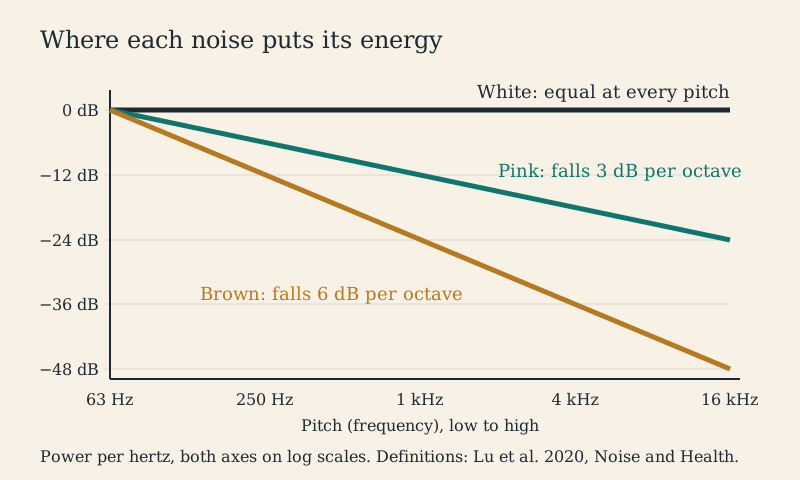
| Energy | Falls about 6 dB per octave as pitch rises | Equal at every frequency |
| Should mask best (in theory) | Low sounds, like traffic rumble | A wider range, including higher sounds like voices |
| Sleep evidence | Almost none | Small adult studies of broadband sound, with mixed results |
| Comfort in one small study (22 college students) | Rated better than white | Rated worse than brown or pink |
| Try first if | You find hiss harsh, or the noise is a low rumble | The noise is voices or sharp sounds |
What's the difference between brown and white noise?
White noise has equal power at every frequency you can hear. It sounds like static: a flat, bright hiss. The name borrows from white light, which mixes every colour.
Brown noise loses about 6 dB of power for every octave you go up, so the low frequencies dominate. It sounds like a low roar: a waterfall, heavy rain or distant thunder. It's also called red noise. The name "brown" comes from Robert Brown, the botanist who documented Brownian motion, not from the colour. Pink noise sits between the two, falling about 3 dB per octave.
For more on each, see what brown noise is and white noise for sleep.
Which is better for sleep?
The idea behind both is masking. A steady sound makes sudden ones, like a door or a car, stand out less. Whether that improves sleep is less certain, and the adult studies we found are small.
Some results are encouraging. In a 2017 Harvard lab study, 18 healthy adults went to bed 90 minutes before their usual time. Broadband sound at about 46 dB cut the time it took them to fall asleep by a median 38%. It was broadband sound tuned to the room, so it isn't a clean test of brown or white noise.
Brown noise has almost no sleep research. The only sleep study we found that used it involved 54 patients in an Indian hospital unit. It played white noise on day one, pink on day two and brown on day three, and patients rated their sleep better than a control group on each day. Because each colour got its own day, it can't tell you which is better.
Volume is the other thing to watch. In a 2026 Penn sleep-lab study, 25 adults spent seven nights in the lab. On the night with pink noise alone at 50 dB, playing all night, they got about 19 fewer minutes of REM sleep than on a quiet night. Brown and white noise weren't tested, so treat 50 dB as a ceiling, not a target.
So for sleep, the brown noise vs white noise choice comes down to the noise you need to cover, and keeping it quiet. Brown noise for sleep covers timers and speaker placement.
Which is better for focus?
We found no solid evidence that either colour sharpens focus in adults. Brown noise has no ADHD trials that we found, and nothing we found compares the two colours for focus. What exists is small. In a 2020 Taiwanese study of 22 healthy college students, comfort ratings came out better for brown and pink noise than for white (Lu 2020). When UCL researchers tracked pupil size, a marker of arousal, in 31 people, it didn't differ between white, pink and brown noise, though each noise played for 10 seconds, a short test (Erfanian 2025).
So for focus, pick the one you find easier to listen to, keep the volume low, and judge by how you get on. For music options, see focus music for ADHD.
Is a fan white noise or brown noise?
Neither, strictly. A fan makes broadband sound, the same broad family as the noise colours and as rain, but its exact sound depends on the fan and its speed. We found no study that measured household fans against the noise colours. If a fan covers the noise that wakes you, that's what counts.
What about pink and green noise?
Pink noise is the middle ground. It falls about 3 dB per octave and sounds like rain. The 2026 REM finding came from pink noise.
Green noise has no agreed definition. It's usually described as a boost in the middle frequencies, and no study has tested it on people.
How to choose, and how loud to play it
Most of the brown noise vs white noise decision is about pitch. A sound masks best at a similar pitch. Brown noise puts its energy low, so it suits a low rumble, like traffic or the bass from next door. White noise has far more high-frequency energy, so it should cover voices and sharper sounds better. That's the physics. We found no study that tests the two head to head on real bedroom noise.
A simple rule, from that physics:
- If the noise you want to cover is a low rumble, start with brown.
- If it's voices or sharp sounds, start with white.
- If hiss bothers you, try brown or pink.
Sleep scientist Matthew Walker, quoted in GQ, suggests trying a noise for several nights and noticing how easily you fall asleep, how often you wake and how you feel in the morning. Give each colour a few nights before you decide.
Then keep it quiet. For sleep, keep it below 50 dB, the level that cost REM sleep in the Penn study. For long listening at a desk, stay well under 70 dBA. Long or repeated exposure at or above 85 dBA can damage hearing, while 70 dBA and below is unlikely to (NIDCD). Normal conversation is about 60 to 70 dBA. The ear is less sensitive to bass, so brown noise can seem quieter than it is. Check it with a meter app. NBC News reports advice from Penn's Mathias Basner, who led the REM study: if a sound machine helps, play it at a low volume and set a timer so it isn't on all night.
This is general information, not medical advice. NSDR is not a treatment for any condition. If you're struggling, talk to your GP. UK: Samaritans 116 123. US: 988.
FAQ
Is brown noise better than white noise?
Brown noise isn't better than white noise in general. It's softer, it should cover low rumble better, and some people find it easier to listen to. White noise should cover voices and higher sounds better. So the brown noise vs white noise choice depends on the noise you need to cover.
Is brown noise good for ADHD?
Brown noise is untested for ADHD: we found no trial of it. A UCL study found no difference in a body marker of arousal between white, pink and brown noise, and a small study of college students found brown noise more comfortable than white. Neither says it helps focus. If ADHD is getting in the way of your days, talk to your GP.
What colour noise is good for anxiety?
We found no study in adults showing that one colour of noise eases anxiety more than another. A UCL study found no difference in a body marker of arousal between white, pink and brown noise. A 2025 review of 34 studies on sound and stress found the research on non-musical sounds limited, and noted that sound can raise stress as well as lower it. If anxiety is getting in the way of your days, talk to your GP.
Can you sleep with noise on all night?
You can, but researchers suggest a timer. In the 2026 Penn study, on the night pink noise played at 50 dB from lights out, REM sleep fell by about 19 minutes. For ongoing sleep problems, CBT-I (cognitive behavioural therapy for insomnia) is the recommended first treatment. Ask your GP.
Sources
- Messineo L, Taranto-Montemurro L, Sands SA, Oliveira Marques MD, Azabarzin A, Wellman DA (2017). Broadband sound administration improves sleep onset latency in healthy subjects in a model of transient insomnia. Frontiers in Neurology 8:718. https://pubmed.ncbi.nlm.nih.gov/29312136/
- Warjri E, Dsilva F, Sanal TS, Kumar A (2022). Impact of a white noise app on sleep quality among critically ill patients. Nursing in Critical Care 27(6):815-823. https://pubmed.ncbi.nlm.nih.gov/34931413/
- Basner M, Smith MG, Cordoza M, Kayser MS, Carlin M, Ecker AJ, et al. (2026). Efficacy of pink noise and earplugs for mitigating the effects of intermittent environmental noise exposure on sleep. Sleep 49(5):zsag001. https://pubmed.ncbi.nlm.nih.gov/41627391/
- Lu SY, Huang YH, Lin KY (2020). Spectral content (colour) of noise exposure affects work efficiency. Noise and Health 22(104):19-27. https://pubmed.ncbi.nlm.nih.gov/33243964/
- Erfanian M, Chait M, Kang J (2025). Pupil-linked arousal does not differ between "white", "pink" and "brown" noises. International Journal of Psychophysiology 218:113271. https://pubmed.ncbi.nlm.nih.gov/41110471/
- Saskovets M, Saponkova I, Liang Z (2025). Effects of sound interventions on the mental stress response in adults: scoping review. JMIR Mental Health 12:e69120. https://pubmed.ncbi.nlm.nih.gov/40127440/
- National Institute on Deafness and Other Communication Disorders (NIH). Noise-induced hearing loss. https://www.nidcd.nih.gov/health/noise-induced-hearing-loss
- Sardinha EL (2025). Brown noise vs. white noise: how to figure out which one will have you sleeping like a rock. GQ. https://www.gq.com/story/best-for-sleep-brown-pink-white-noise
- NBC News (2026). Pink noise may be bad for sleep quality, new research finds. https://www.nbcnews.com/health/health-news/pink-noise-worse-sleep-quality-study-rem-rcna257099
- Wikipedia. Brownian noise; White noise; Auditory masking (definitions, names, masking by frequency). https://en.wikipedia.org/wiki/Brownian_noise