Many people use brown noise for sleep and say it helps them drift off, probably because they like the sound and because it covers low, steady noise like traffic rumble or an air conditioner kicking on. Neither reason has been tested during sleep, and brown noise has almost no sleep research of its own. A PubMed search finds one hospital study that played it for a single day. A February 2026 Penn study of another broadband sound, pink noise, found that a night of it on its own at 50 dB came with about 19 fewer minutes of REM sleep. Below is what that means for brown noise, plus 6 rules for volume, timing and placement.
TL;DR
- Brown noise is bass-heavy. Its power falls about 6 dB per octave, so it rumbles instead of hissing.
- It has almost no sleep research, and evidence that continuous noise helps sleep is rated "very low".
- It likely covers low, steady noise like traffic or HVAC best. White or pink noise probably covers voices better, though that's untested.
- In a 2026 lab study, all-night pink noise on its own at 50 dB cut REM by about 19 minutes. Brown noise wasn't tested, so treat 50 dB as a ceiling.
- Set a timer so it isn't playing all night, and keep the speaker across the room.
- To block noise, earplugs did better than pink noise in that same study.
What is brown noise?
How it differs from white and pink noise
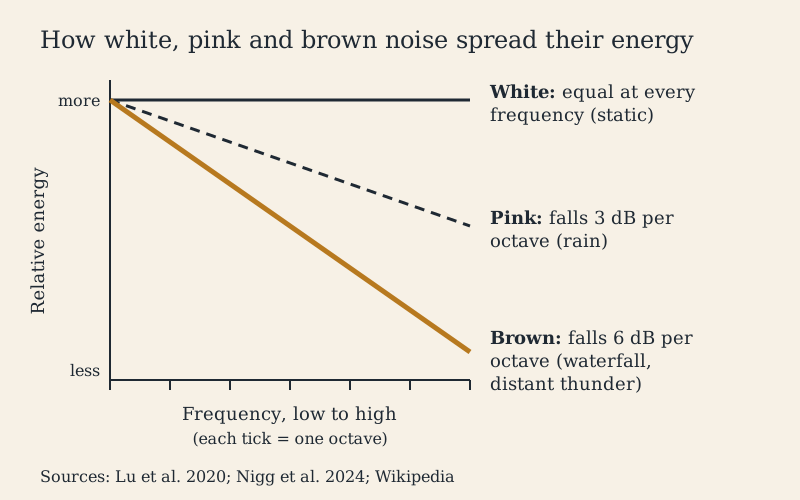
Brown noise, also called Brownian or red noise, keeps most of its energy in the low frequencies. Its power falls with 1/f squared, about 6 dB per octave. Pink noise falls about 3 dB per octave (Lu 2020), and white noise is equal at every frequency.
The waveform moves like a random walk, where each moment is a small random step from the last. That is why its energy sits in the low frequencies. The name comes from Robert Brown, the Scottish botanist who documented Brownian motion (Wikipedia), not the colour.
What it sounds like
A low roar, like a waterfall, heavy rain or distant thunder. With so little high-frequency energy, it has almost none of white noise's hiss.
Why some people love it and others don't
In one small 2020 study, students rated brown and pink noise as more comfortable than white. In an office study cited by the same authors, workers who heard brown noise through earphones rejected it as irritating.
More on what brown noise is and how it's used for focus.
Why people say brown noise helps sleep
It's pleasant to fall asleep to
The likeliest reason is that people find it pleasant, and a sound you like is easier to fall asleep to than one that grates. That's a reasonable guess. Nobody has measured it. UCL researchers tracked pupil size, a marker of arousal, in people hearing 10-second clips while awake. Pupil size didn't differ between white, pink and brown noise (Erfanian 2025). Most claims about brown noise for sleep come from social media, not studies.
It covers low, steady noise
Its energy sits where traffic rumble, HVAC hum and overhead planes sit, so in principle it covers those best. Nobody has tested this during sleep. Northwestern Medicine singles it out for a furnace or air conditioner starting and stopping.
Brown noise puts less energy in the range of voices and sharp sounds, so white or pink noise is probably the better cover for those.
The ADHD connection
The trend is tied to the ADHD community, where people say it helps them focus. A 2024 meta-analysis from Oregon Health & Science University pooled 13 small studies of 335 children and young adults with ADHD or ADHD symptoms (Nigg 2024). White noise, plus one pink-noise study, gave a small boost on lab attention tasks (g = 0.25). Without ADHD, noise slightly hurt performance (g = -0.21).
No study used brown noise. For attention, the authors say the effect "may well extend to brown noise". One idea is that people with ADHD are under-aroused and steady noise raises arousal, possibly through stochastic resonance. The mechanism is unproven.
Whether this carries over to sleep is unknown. If noise works by raising arousal, that may help focus, but it isn't obviously what you want at bedtime.
What the research shows (and doesn't)
Almost no sleep studies of brown noise
A PubMed search in October 2026 for brown or Brownian noise and sleep returns 4 hits, with one human sleep study and no randomised trial. Rain recordings have the same gap; see the evidence on rain sounds.
That 2022 study, in an Indian intensive care unit, played white, pink and brown noise through earphones on days 1, 2 and 3, with sleep rated on a 4-point scale. Brown noise got day 3 only, so its effect can't be isolated.
The closest evidence is about other sounds
A 2021 systematic review of 38 studies of continuous white or similar noise rated the evidence that it improves sleep "very low" (Riedy 2021). Results ranged from better sleep to worse.
The 2020 lab study of 22 Taiwanese students found brown noise at about 47 dB lifted several cognitive scores versus quiet. So did pink and white. Nobody was asleep.
What nobody has measured yet
No one has measured how brown noise affects REM, or what years of nightly use do. Any sleep benefit is inferred from other sounds, whose own evidence is rated very low.
The 2026 Basner study: what it means for brown noise
What the study tested
In a 2026 Penn Medicine sleep-lab study led by Dr Mathias Basner, 25 healthy adults with a mean age of 28.5 each spent seven nights under different sound conditions, some with continuous pink noise at 40 or 50 dB from lights out.
What it found
On the night with pink noise alone at 50 dB, they got about 19 fewer minutes of REM sleep than on a quiet night. REM matters for memory consolidation, emotional regulation and brain development.
Pink noise layered on traffic and aircraft noise added about 15 minutes awake; neither alone did. Earplugs blocked nearly all the traffic and aircraft effects, though they started to fail at 65 dB. Morning tests were unaffected, but people rated their sleep, alertness and mood worse.
What it means for brown noise
Brown noise is broadband too, and the paper names it as untested. Until it is, treat it with the same caution.
Basner, in the Penn Medicine release: "Overall, our results caution against the use of broadband noise, especially for newborns and toddlers, and indicate that we need more research in vulnerable populations, on long-term use, on the different colors of broadband noise, and on safe broadband noise levels in relation to sleep."
Stanford's Dr Rafael Pelayo told NBC News that lab findings might not apply to the average person at home.
Brown noise vs other noise colors for sleep
| Noise | How its energy is spread | Sounds like | Likely best at covering* | Sleep research |
|---|---|---|---|---|
| Brown | Falls about 6 dB per octave, mostly low end | Waterfall, heavy rain, distant thunder | Low rumble: traffic, HVAC | Almost none |
| White | Equal at every frequency | Static | Hiss-range and sharp sounds | Most studied, but evidence rated very low |
| Pink | Falls about 3 dB per octave | Rain, ocean waves | A bit of both | Some: timed bursts boosted deep-sleep brain waves in a lab study; a continuous track cut REM in 2026 |
| Green | No standard definition | Varies | Unclear | None |
*Inferred from each sound's spectrum. No study has compared them for masking during sleep.
Choose brown noise if: white and pink sound too harsh, or your main noise is a low rumble like traffic, HVAC or a furnace cycling.
Choose something else if: voices or sharp sounds wake you, so try white or pink noise; bass-heavy sound feels oppressive; or you want the most-researched option, white noise for sleep, though even that evidence is rated very low.
Or see every sleep sound compared.
How to use brown noise for sleep safely
1. Keep the volume low, and measure it
Use the lowest volume that still does the job. Pink noise alone at 50 dB, roughly moderate rain, cut REM in the Penn study, so treat 50 dB as a ceiling, not a target. That's below conversation, at 60 to 70 dBA, and far below the 85 dBA where long exposure risks hearing (NIDCD).
Measure the level at pillow height with a meter app, so you can compare it with the study's 50 dB. Northwestern sleep physician Dr Roneil G. Malkani: "When using continuous background noise, it is important to keep the volume just low enough to be audible, but not so high that it would cause arousal from sleep."
2. Set a timer
Basner advises a timer so the sound isn't playing all night. No one has tested the best duration.
3. Put the speaker across the room
Sound level falls with distance. A 2014 study of 14 infant sleep machines measured them at 30, 100 and 200 cm (Hugh 2014). Never put it under the pillow. Bass passes through walls more easily than higher sounds (NRC), so it may reach a partner or neighbours.
4. Skip headphones
Headphones put the sound right at your ear, can be uncomfortable if you sleep on your side, and can stop you hearing an alarm.
5. Pick a long, non-looping track
A long track or generator app means you won't start noticing a repeat.
6. Use earplugs if blocking noise is the only goal
In the Penn study, earplugs blocked nearly all the effects of traffic and aircraft noise on sleep. Pink noise didn't. It was one lab study of 25 people, but if quiet is the goal, start there.
When background sound isn't enough
Many brown noise fans online say it quiets a busy, wired mind. If that's your reason, the underlying problem may be stress rather than noise.
NSDR is guided rest built on yoga nidra-style body scanning and slow breathing. A 2026 meta-analysis of 73 yoga nidra studies with 5,201 participants reported less stress and anxiety, though the studies were low quality and the effects likely inflated (Ghai 2026). See NSDR for sleep. NSDR.co is free.
This is general information, not medical advice. If poor sleep lasts for weeks, see a doctor.
FAQ
Is it okay to play brown noise all night?
A timer is the safer choice, since all-night use hasn't been tested. There's no long-term data on nightly use. In the Penn study, one night of pink noise alone at 50 dB cost about 19 minutes of REM. Basner advises low volume and a timer.
Is brown noise better than white noise for sleep?
It depends on what's keeping you up, so neither is better for everyone. Brown noise has no high-pitched hiss, which many people prefer, and its bass suits traffic and HVAC. White noise probably covers voices and sharp sounds better. Neither has been shown to improve sleep in good-quality trials.
Does brown noise help with ADHD sleep problems?
Nobody knows, because no study has tested it for sleep in people with ADHD. The closest evidence is daytime focus: white noise gave a small boost on attention tasks in children and young adults with ADHD, and the review's authors think brown noise may work similarly. If you try brown noise for sleep, keep it low and on a timer.
Is brown noise safe for babies?
Brown noise hasn't been tested for safety in babies. The Penn paper says its findings "caution against its indiscriminate use, especially in newborns and toddlers for whom REM sleep is critical for neurodevelopment." REM is about half of a newborn's sleep. In the 2014 Pediatrics study, all 14 machines on full volume topped 50 dB at 30 cm, the recommended limit for hospital nurseries. Use the lowest volume, across the room, not all night, and ask your paediatrician.
Why is brown noise so popular on TikTok?
Its TikTok popularity is tied to ADHD, with people saying it helps them focus. A 2024 review of noise for ADHD pointed to tens of millions of social media views on the topic. The research is still thin.
Can you become dependent on brown noise for sleep?
It's more likely to become a habit than a dependency, though nobody has studied it. Your brain links the sound with sleep, like any bedtime routine. If that worries you, try some nights without it.
Sources
- Basner M, Smith MG, Cordoza M, Kayser MS, Carlin M, Ecker AJ, et al. (2026). Efficacy of pink noise and earplugs for mitigating the effects of intermittent environmental noise exposure on sleep. Sleep 49(5):zsag001. https://pubmed.ncbi.nlm.nih.gov/41627391/
- Penn Medicine (2026). News release on the pink noise and earplugs study, Feb 2026 (via ScienceDaily). https://www.sciencedaily.com/releases/2026/02/260203030529.htm
- NBC News (2026). Report on the Penn pink noise study, Feb 2026. https://www.nbcnews.com/health/health-news/pink-noise-worse-sleep-quality-study-rem-rcna257099
- Riedy SM, Smith MG, Rocha S, Basner M (2021). Noise as a sleep aid: a systematic review. Sleep Medicine Reviews 55:101385. https://pubmed.ncbi.nlm.nih.gov/33007706/
- Nigg JT, Bruton A, Kozlowski MB, Johnstone JM, Karalunas SL (2024). Systematic review and meta-analysis: do white noise or pink noise help with task performance in youth with attention-deficit/hyperactivity disorder or with elevated attention problems? Journal of the American Academy of Child and Adolescent Psychiatry 63(8):778-788. https://pubmed.ncbi.nlm.nih.gov/38428577/
- Lu SY, Huang YH, Lin KY (2020). Spectral content (colour) of noise exposure affects work efficiency. Noise and Health 22(104):19-27. https://pubmed.ncbi.nlm.nih.gov/33243964/
- Erfanian M, Chait M, Kang J (2025). Pupil-linked arousal does not differ between "white", "pink" and "brown" noises. International Journal of Psychophysiology 218:113271. https://pubmed.ncbi.nlm.nih.gov/41110471/
- Warjri E, Dsilva F, Sanal TS, Kumar A (2022). Impact of a white noise app on sleep quality among critically ill patients. Nursing in Critical Care 27(6):815-823. https://pubmed.ncbi.nlm.nih.gov/34931413/
- Ngo HV, Martinetz T, Born J, Mölle M (2013). Auditory closed-loop stimulation of the sleep slow oscillation enhances memory. Neuron 78(3):545-553. https://pubmed.ncbi.nlm.nih.gov/23583623/
- Hugh SC, Wolter NE, Propst EJ, Gordon KA, Cushing SL, Papsin BC (2014). Infant sleep machines and hazardous sound pressure levels. Pediatrics 133(4):677-681. https://pubmed.ncbi.nlm.nih.gov/24590753/
- Ghai S, Odyniec P, Ghai I (2026). Effects of yoga nidra on stress, anxiety, and depression: a systematic review and meta-analysis. Annals of the New York Academy of Sciences 1556(1):e70149. https://pubmed.ncbi.nlm.nih.gov/41327816/
- Northwestern Medicine (2025). What noise color is best for sleep? HealthBeat (quotes from Roneil G. Malkani, MD). https://www.nm.org/healthbeat/healthy-tips/what-noise-color-is-best-for-sleep
- National Institute on Deafness and Other Communication Disorders (NIH). Noise-induced hearing loss. https://www.nidcd.nih.gov/health/noise-induced-hearing-loss
- Wikipedia. Brownian noise (name origin and spectrum). https://en.wikipedia.org/wiki/Brownian_noise
- National Research Council Canada. Canadian Building Digest 239 (sound transmission). https://web.mit.edu/parmstr/Public/NRCan/CanBldgDigests/cbd239_e.html