Sleep sounds can help you fall asleep when noise is the problem, mostly by covering sudden sounds like traffic or a neighbour's door. The evidence is thinner than their popularity suggests. A 2021 review of 38 studies rated the case for continuous noise as a sleep aid "very low" quality, and a February 2026 Penn lab study found a night of pink noise at 50 dB came with about 19 fewer minutes of REM sleep. This guide ranks 8 types of sleep sound by sleep evidence and adds a comparison table and a rule for choosing.
TL;DR
- Sleep sounds help mainly by masking sudden noise. In a quiet room, pink noise at 50 dB didn't help sleep in a 2026 lab study, and it cut REM.
- Music has the best evidence: a 2022 Cochrane review of 13 trials found moderate-certainty gains in self-rated sleep for adults with insomnia.
- The evidence for continuous white and similar noise is rated "very low". A PubMed search found no sleep trials of brown or green noise.
- If noise wakes you, try earplugs first. They protected sleep from traffic noise better than pink noise in the 2026 study.
- Whatever you play, treat 50 dB as a ceiling, not a target. Keep it as low as still covers the noise, set a timer, and put the speaker across the room.
Why sleep sounds work (and when they don't)
Steady sound hides sudden noise
Fans, white and pink noise, and rain all count as broadband sound. In a sleep-lab study of only 4 to 5 people, the jump from background to peak, more than how loud the peak was, decided whether recorded ICU noise caused an arousal. White noise shrank that jump and cut arousals back to near-normal.
In a 2021 study of 10 New Yorkers from a sleep clinic, who slept badly and reported a lot of noise where they slept, a week of white noise cut time spent awake at night, measured with a wrist actigraph. The drop in awakenings didn't reach significance.
In a quiet room, sound may cost you REM
In the Penn study, pink noise alone at 50 dB, roughly the loudness of moderate rain, didn't help people fall asleep faster or sleep longer in a quiet room. It swapped about 19 minutes of REM for lighter sleep.
The relaxation effect
A 2017 Brighton and Sussex Medical School brain-scan study of 17 healthy young adults compared natural soundscapes with recordings of man-made places. Natural sounds shifted heart-rate measures toward rest-and-digest, mostly in people who started out stressed. Synthetic noise like white or pink noise wasn't tested.
The overall evidence is rated "very low"
That 2021 review, from Mathias Basner's group at Penn, rated the evidence that continuous noise improves sleep as "very low" quality. Its 38 studies had mixed results, and the authors warned continuous noise "may also negatively affect sleep and hearing".
Every sleep sound type, ranked by evidence
The order reflects how much sleep research exists for each, not which will suit you.
1. Music
A 2022 Cochrane review of 13 trials in adults with insomnia found moderate-certainty evidence that music improves self-rated sleep quality. The 3 studies with objective measures, covering 136 people, showed it may not improve sleep onset or total sleep. So music may help you feel you slept better, though lab measures may not show a change. A 2021 meta-analysis of 5 trials found older adults rated their sleep better with it, especially sedative music for at least four weeks. A 2014 Singapore trial of 60 older adults used soft, slow instrumental music without lyrics, at about 60 to 80 beats per minute and 40 minutes long, over 6 weeks. It may suit anyone lying awake with a busy head.
2. White noise
White noise sounds like static, with all frequencies at equal intensity. The 2021 Penn review found 38 studies of white or similar steady noise and sleep, and rated the evidence very low quality. Hospital trials are small. In a 2026 trial of 58 intensive-care patients, three nights of white noise may have improved how well they rated their sleep. In a 1990 trial, 16 of 20 newborns fell asleep within five minutes with white noise, against 5 of 20 without. Read the baby FAQ before using a machine.
With the most high-frequency energy of the colours, it may cover voices or electronics best, though no study has compared colours head to head. Some find the hiss harsh. More in white noise for sleep.
3. Pink noise
Pink noise has more energy in the low frequencies and less in the high, and is often compared to rain or ocean waves. In a 2017 Northwestern study, 13 adults aged 60 to 84 had one night of pink-noise stimulation and one sham night. A computer timed pink-noise clicks to their slow brain waves. The clicks boosted deep-sleep activity while they played, though not across the whole night, and the overnight word-recall gain was about three times bigger than on the sham night, 9 extra words against 3. Penn tested a continuous track through a speaker, and it cut REM.
By day, a 2024 meta-analysis (13 studies, 335 people) found white and pink noise gave young people with ADHD or ADHD symptoms a small benefit on lab attention tasks. More in pink noise for sleep and focus.
4. Rain and nature sounds
This group covers rain, streams and birdsong. Steady rain counts as broadband sound, like white and pink noise, but sounds natural. Whether it relaxes you more than white noise is untested. PubMed lists no trials of rain recordings as a sleep aid (searched October 2026). A 2021 PNAS meta-analysis found water sounds had the biggest effect on health and positive mood of the three sound types it compared, but none of its outcomes was sleep.
Jumps in sound caused arousals in the ICU-noise study, so steady rain is likely a safer pick than thunder, though that is untested. Choose a long recording so you don't notice the loop. More in rain sounds for sleep.
5. Binaural beats
Two slightly different tones, one in each ear, create the sense of a third tone at the difference, so you need earbuds. A 3 Hz beat lengthened deep sleep in a 2018 study of 24 people. A 2024 study of 12 people found 0.25 Hz beats shortened the time to deep sleep in afternoon naps. Brain waves didn't sync to the beat, though, and a company that has filed a patent funded it. A 2023 review counted 5 studies supporting brain-wave entrainment, 8 against and 1 mixed. They suit people happy to sleep in earbuds who want to experiment.
6. ASMR
ASMR sounds include whispering and tapping. In a 2015 survey of 475 self-selected ASMR users, 82% used it to help them sleep. A 2022 randomised pilot trial in 76 stressed adults saw insomnia scores fall over three weeks of ASMR, just as much as with binaural beats, with no no-sound group. It seems to suit people who get the tingles, and even then it depends on taste. In a 2023 brain-scan study of 30 ASMR fans, emotion-related areas responded only to videos they liked. If you don't get the tingles, it may just be irritating.
7. Brown noise
Brown noise is a deep rumble like a waterfall, with even less high-frequency energy than pink. The authors of the 2024 ADHD meta-analysis say public interest in brown, white and pink noise for ADHD has "mushroomed", yet they found no brown-noise studies at all. A PubMed search in October 2026 found no controlled sleep trial of it either. It probably covers voices less well than white noise, though that is untested. More in brown noise for sleep.
8. Green noise
The Sleep Foundation describes green noise as a variant of white noise that boosts the middle frequencies, likened to a stream, and says research on it and sleep is limited. PubMed lists no sleep studies of green noise (searched October 2026). Test it like any steady sound: low, on a timer, for a week. More in green noise for sleep.
Sleep sounds compared: the table
| Sound | Sounds like | Sleep evidence | Watch out for |
|---|---|---|---|
| Music | Slow instrumental, about 60 to 80 BPM in a 2014 trial | Moderate certainty for self-rated sleep in insomnia (Cochrane 2022); no clear effect on objective measures | Songs with lyrics, which that trial avoided |
| White noise | Static | 38 studies of white and similar noise; rated very low quality | Hiss can feel harsh |
| Pink noise | Steady rain, ocean waves | Timed lab bursts briefly boosted deep-sleep activity; an all-night track cut REM (2026) | All-night playback |
| Rain and nature | Rain, streams, birdsong | Small waking studies; no trials of rain recordings as a sleep aid | Thunder, short loops |
| Binaural beats | A pulsing tone in earbuds | Two small studies; inconsistent results | You have to sleep in earbuds |
| ASMR | Whispering, tapping | One pilot trial with no no-sound group | Irritating if you don't get the tingles |
| Brown noise | A waterfall, a deep rumble | No sleep trials found | May cover voices less well (untested) |
| Green noise | Boosted mid-range, likened to a stream | No sleep trials found | Little data of any kind |
| Earplugs (no sound) | Quiet | Promising: beat pink noise in one 2026 lab study | Fit; started failing at 65 dB |
No study has compared these sleep sounds head to head. The order shows how much evidence exists, and says nothing about which will suit you.
The 2026 Penn REM study: what it means for sleep sounds
What they tested
Basner's team put 25 healthy young adults (mean age 28.5) through seven nights in a sleep lab. After a quiet first night to settle in, they had six conditions in random order: quiet, recorded traffic and aircraft noise, pink noise alone at 50 dB, that noise plus pink noise at 40 or 50 dB, and that noise with earplugs. It appeared in Sleep in February 2026.
What they found
Pink noise alone at 50 dB came with about 19 fewer minutes of REM than the quiet night (99.5 against 118.1 minutes). Played over traffic and aircraft noise, it added about 15 minutes awake, which neither did alone. Earplugs blocked nearly all of the traffic and aircraft noise effects but started failing at 65 dB. People rated their sleep worse after noise nights, though morning cognition was unaffected.
Basner, in the Penn Medicine release: "REM sleep is important for memory consolidation, emotional regulation and brain development, so our findings suggest that playing pink noise and other types of broadband noise during sleep could be harmful, especially for children whose brains are still developing and who spend much more time in REM sleep than adults."
What it doesn't tell you
Only pink noise was tested. Basner thinks white, brown or rain-like sounds could have the same effect and says each colour still needs testing. Stanford sleep physician Dr Rafael Pelayo told NBC News that because participants were in a lab, the findings might not apply to the average person at home.
What it means in practice
- Set a timer. Basner told NBC News that if a sound machine helps, play it low on a timer so it isn't on all night. No study has tested how long.
- Keep it low and measure it. Pink noise at 40 dB over traffic noise still left less deep and REM sleep than the quiet night. Treat 50 dB as a ceiling, not a target. Play it as low as still covers the noise, check with a decibel app at your pillow, and put the speaker across the room.
- Be careful with babies and toddlers. They spend far more of the night in REM, and Basner's team cautions against noise machines for them, though the study didn't include children. See the FAQ.
- Consider earplugs. They beat pink noise here, though the Penn authors note hospital meta-analyses found no convincing earplug benefit.
How to pick the right sleep sound for you
If noise wakes you, try earplugs first. If you can't sleep in them, pick the steady sound you notice least, play it as low as still covers the noise, and set a timer. If your room is already quiet, you may not need sound at all. If a busy mind is what keeps you up, sound won't fix it.
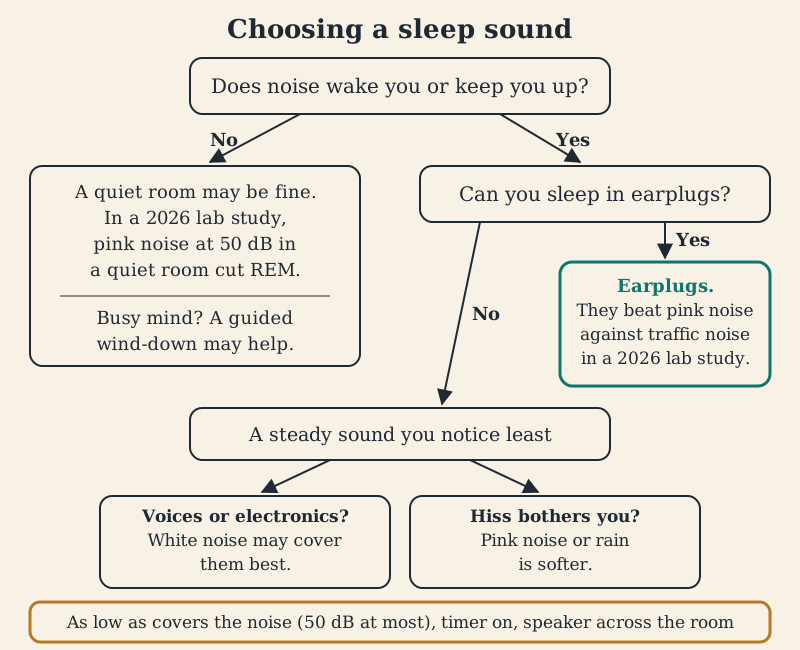
If noise wakes you
If earplugs don't suit you, white noise may cover voices or electronics best, and pink noise or rain is softer if the hiss bothers you. Brown noise probably covers voices less well (untested). Green noise has no data.
If your room is already quiet
Silence is a fine choice. In a quiet room, pink noise at 50 dB didn't help people sleep faster or longer, and it cost them REM.
If a racing mind keeps you up
A guided wind-down may help more than sound (see below).
If you have ADHD
White or pink noise gave young people with ADHD or its symptoms a small boost on lab attention tasks by day. There's no ADHD-specific sleep evidence, so the timer and low-volume rules still apply at night.
Give it a week
The New York study ran each phase for a week, so a week is a fair test. If nothing changes, noise probably isn't the problem. Screens, late caffeine and an irregular schedule are common culprits.
Beyond sound: calming your nervous system before bed
Sound changes the room. How wound up you are at lights-out is a separate problem.
NSDR is guided rest based on yoga nidra: body scans, slow breathing, deliberate relaxation. A 2026 meta-analysis of 73 yoga nidra studies (5,201 participants) reported less stress and anxiety, though the authors called the studies low quality and the effects likely inflated. Try a 10-minute session at lights-out, before any sleep sound goes on. It may help you wind down. NSDR for sleep covers how, and NSDR.co is free.
This is general information, not medical advice. If poor sleep lasts for weeks, see a doctor.
FAQ
What color noise is best for sleep?
No color of noise has been shown to be best for sleep. No study has compared them head to head. White and similar steady noise have 38 studies behind them, rated very low quality, and a PubMed search found no sleep trials of brown or green. Pick the one you notice least.
Should I play sleep sounds all night?
The cautious choice is not to play sleep sounds all night. One night of pink noise at 50 dB cost about 19 minutes of REM in the Penn study, and long-term use is unstudied. Basner advises a timer.
How loud should sleep sounds be?
Sleep sounds should be as loud as it takes to cover the noise, and no louder. Treat 50 dB as an upper limit and check it with a meter app at your pillow. Don't rely on a talk-over test. By the CDC's rule of thumb, needing to raise your voice to be heard at arm's length means the noise is likely above 85 dB.
Are sleep sounds safe for babies?
Sleep sounds aren't proven safe for babies, and the machines can get loud. A 2014 study in Pediatrics tested 14 infant machines at full volume. At 30 cm, all topped 50 dB, the hospital-nursery limit, and three went above 85 dB. The authors advise placing it as far from the cot as you can, never in it or on the rail, at a low volume, for a short time (Medical News Today). Basner cautions against broadband noise for newborns and toddlers, so ask your paediatrician.
Can sleep sounds help with insomnia?
For insomnia, sound is a tool at best. The AASM's 2021 guideline strongly recommends CBT-I for chronic insomnia, and music has moderate-certainty evidence for better self-rated sleep. If insomnia persists, see a doctor.
How long do sleep sounds take to work?
There's no tested timeline for how long they take to work. A week, the length of each phase in the New York study, is a fair trial.
Sources
- Basner M, Smith MG, Cordoza M, et al. (2026). Efficacy of pink noise and earplugs for mitigating the effects of intermittent environmental noise exposure on sleep. Sleep 49(5):zsag001. https://pubmed.ncbi.nlm.nih.gov/41627391/
- Penn Medicine (2026). News release on the pink noise and earplugs study, 3 Feb 2026 (via ScienceDaily). https://www.sciencedaily.com/releases/2026/02/260203030529.htm
- NBC News (2026). Report on the Penn pink noise study, 4 Feb 2026. https://www.nbcnews.com/health/health-news/pink-noise-worse-sleep-quality-study-rem-rcna257099
- Riedy SM, Smith MG, Rocha S, Basner M (2021). Noise as a sleep aid: a systematic review. Sleep Medicine Reviews 55:101385. https://pubmed.ncbi.nlm.nih.gov/33007706/
- Stanchina ML, Abu-Hijleh M, Chaudhry BK, et al. (2005). The influence of white noise on sleep in subjects exposed to ICU noise. Sleep Medicine 6(5):423-428. https://pubmed.ncbi.nlm.nih.gov/16139772/
- Ebben MR, Yan P, Krieger AC (2021). The effects of white noise on sleep and duration in individuals living in a high noise environment in New York City. Sleep Medicine 83:256-259. https://pubmed.ncbi.nlm.nih.gov/34049045/
- Gould van Praag CD, Garfinkel SN, Sparasci O, et al. (2017). Mind-wandering and alterations to default mode network connectivity when listening to naturalistic versus artificial sounds. Scientific Reports 7:45273. https://pubmed.ncbi.nlm.nih.gov/28345604/
- Brighton and Sussex Medical School (2017). The sound of nature helps us relax (news release). https://www.bsms.ac.uk/about/news/2017/03-31-the-sound-of-nature-helps-us-relax.aspx
- Shum A, Taylor BJ, Thayala J, et al. (2014). The effects of sedative music on sleep quality of older community-dwelling adults in Singapore. Complementary Therapies in Medicine 22(1):49-56. https://pubmed.ncbi.nlm.nih.gov/24559816/
- Jespersen KV, Pando-Naude V, Koenig J, et al. (2022). Listening to music for insomnia in adults. Cochrane Database of Systematic Reviews 8:CD010459. https://pubmed.ncbi.nlm.nih.gov/36000763/
- Chen CT, Tung HH, Fang CJ, et al. (2021). Effect of music therapy on improving sleep quality in older adults: a systematic review and meta-analysis. Journal of the American Geriatrics Society 69(7):1925-1932. https://pubmed.ncbi.nlm.nih.gov/33880759/
- Nien YC, Weng SF, Chou PL (2026). The effectiveness of white noise for sleep quality in patients admitted to the intensive care unit: a randomized controlled trial. Intensive and Critical Care Nursing 93:104239. https://pubmed.ncbi.nlm.nih.gov/41761732/
- Spencer JA, Moran DJ, Lee A, et al. (1990). White noise and sleep induction. Archives of Disease in Childhood 65(1):135-137. https://pubmed.ncbi.nlm.nih.gov/2405784/
- Papalambros NA, Santostasi G, Malkani RG, et al. (2017). Acoustic enhancement of sleep slow oscillations and concomitant memory improvement in older adults. Frontiers in Human Neuroscience 11:109. https://pubmed.ncbi.nlm.nih.gov/28337134/
- Nigg JT, Bruton A, Kozlowski MB, et al. (2024). Systematic review and meta-analysis: do white noise or pink noise help with task performance in youth with attention-deficit/hyperactivity disorder or with elevated attention problems? Journal of the American Academy of Child and Adolescent Psychiatry 63(8):778-788. https://pubmed.ncbi.nlm.nih.gov/38428577/
- Buxton RT, Pearson AL, Allou C, et al. (2021). A synthesis of health benefits of natural sounds and their distribution in national parks. PNAS 118(14):e2013097118. https://pubmed.ncbi.nlm.nih.gov/33753555/
- Jirakittayakorn N, Wongsawat Y (2018). A novel insight of effects of a 3-Hz binaural beat on sleep stages during sleep. Frontiers in Human Neuroscience 12:387. https://pubmed.ncbi.nlm.nih.gov/30319382/
- Fan Z, Zhu Y, Suzuki C, et al. (2024). Binaural beats at 0.25 Hz shorten the latency to slow-wave sleep during daytime naps. Scientific Reports 14:26062. https://pubmed.ncbi.nlm.nih.gov/39478090/
- Ingendoh RM, Posny ES, Heine A (2023). Binaural beats to entrain the brain? A systematic review of the effects of binaural beat stimulation on brain oscillatory activity, and the implications for psychological research and intervention. PLoS One 18(5):e0286023. https://pubmed.ncbi.nlm.nih.gov/37205669/
- Barratt EL, Davis NJ (2015). Autonomous Sensory Meridian Response (ASMR): a flow-like mental state. PeerJ 3:e851. https://pubmed.ncbi.nlm.nih.gov/25834771/
- Lee M, Lee HJ, Ahn J, et al. (2022). Comparison of autonomous sensory meridian response and binaural auditory beats effects on stress reduction: a pilot study. Scientific Reports 12:19521. https://pubmed.ncbi.nlm.nih.gov/36376468/
- Sakurai N, Nagasaka K, Sasaki K, et al. (2023). The relaxation effect of autonomous sensory meridian response depends on personal preference. Frontiers in Human Neuroscience 17:1249176. https://pubmed.ncbi.nlm.nih.gov/38116234/
- Sleep Foundation (2025). What is green noise and how can it help you sleep? (Summer JV, medically reviewed by Singh A; updated 29 Jul 2025). https://www.sleepfoundation.org/noise-and-sleep/what-is-green-noise
- Ghai S, Odyniec P, Ghai I (2026). Effects of yoga nidra on stress, anxiety, and depression: a systematic review and meta-analysis. Annals of the New York Academy of Sciences 1556(1):e70149. https://pubmed.ncbi.nlm.nih.gov/41327816/
- Centers for Disease Control and Prevention (archived 2023). What noises cause hearing loss? https://web.archive.org/web/2023/https://www.cdc.gov/nceh/hearing_loss/what_noises_cause_hearing_loss.html
- Hugh SC, Wolter NE, Propst EJ, et al. (2014). Infant sleep machines and hazardous sound pressure levels. Pediatrics 133(4):677-681. https://pubmed.ncbi.nlm.nih.gov/24590753/
- Medical News Today (2014). Report on infant sleep machine recommendations. https://www.medicalnewstoday.com/articles/273468
- Edinger JD, Arnedt JT, Bertisch SM, et al. (2021). Behavioral and psychological treatments for chronic insomnia disorder in adults: an American Academy of Sleep Medicine clinical practice guideline. Journal of Clinical Sleep Medicine 17(2):255-262. https://pubmed.ncbi.nlm.nih.gov/33164742/