White noise for sleep works best as cover. If traffic, a neighbour's door or a snoring partner wakes you, a steady hiss makes those sudden sounds stand out less. Past that, the evidence is thin. A 2021 review of 38 studies rated the case for continuous noise as a sleep aid "very low" quality, and a February 2026 Penn study found a night of pink noise, white noise's deeper cousin, at 50 dB came with about 19 fewer minutes of REM sleep. White noise itself wasn't tested. Below: when it helps, the baby rules, and a safe routine.
TL;DR
- White noise helps mainly by masking sudden noise, so a quiet room gives it little to do.
- The evidence that steady noise improves sleep is rated "very low", with results running from better sleep to worse.
- In a 2026 lab study, all-night pink noise at 50 dB cut REM by about 19 minutes. White noise wasn't tested, so treat 50 dB as a ceiling, not a target.
- If blocking noise is the goal, try earplugs first. They beat pink noise in that study.
- Otherwise use the lowest level that covers the noise, measure it at your pillow, set a timer, and keep the speaker across the room.
What is white noise?
White noise plays every frequency at the same intensity, across roughly the 20 to 20,000 Hz range of human hearing. It sounds like the static of an untuned radio. The name is borrowed from white light.
Equal intensity at every frequency means the high end is as strong as the low end, and that's where the hiss comes from. Pink noise and brown noise turn the high frequencies down, so they sound deeper, more like rain or a waterfall.
All that high-frequency energy may make white noise better than the deeper colours at covering voices and sharp sounds. That's inferred from the spectrum, since no study has compared colours head to head.
How white noise helps you sleep
Sound masking
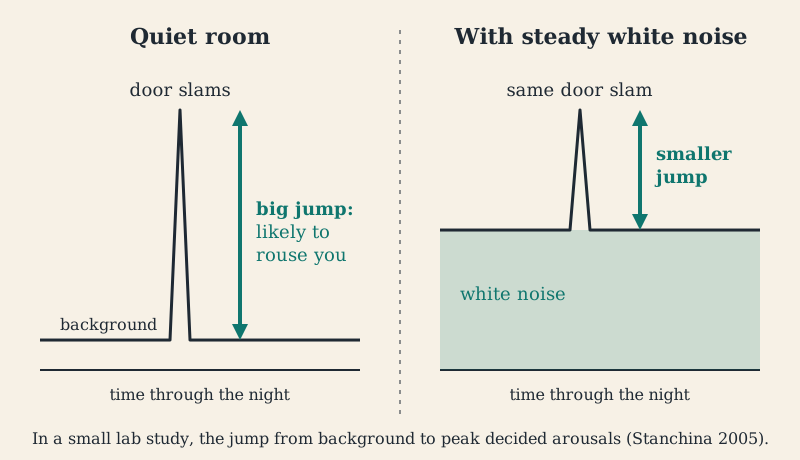
A sudden noise can cause a brief arousal that breaks up your sleep even if you don't remember waking.
What triggers that arousal is the jump in sound, more than how loud the noise is. In a 2005 sleep-lab study, healthy volunteers slept through recordings of intensive care unit noise. The change from background to peak decided whether they were roused, more than the peak level itself. Adding white noise raised the background, shrank that jump, and brought arousals back close to a normal night: about 16 an hour, against 48 with the ICU noise alone and 13 in quiet. Only four people completed all three nights, so treat it as a demonstration of the mechanism.
Real-world studies are small too. In a 2021 study of 10 New Yorkers from a sleep clinic who slept badly and reported a lot of noise where they slept, a week with a white noise machine shortened how long they said it took to fall asleep and cut time spent awake in the night, measured with a wrist actigraph. The drop in the number of awakenings didn't reach significance. In a 2026 trial of 58 intensive care patients, three nights of white noise at 40 to 50 dB may have improved how well they rated their sleep.
So the case for white noise is a case about covering noise. In a quiet room, the 2026 Penn study found pink noise at 50 dB didn't help people fall asleep faster or sleep longer, and it cost them REM.
When white noise works best
Worth trying if:
- you live near a busy road, a railway or a flight path
- a partner's snoring wakes you
- you hear neighbours through thin walls
- you sleep in the day, when the world outside is loud
Probably won't help if:
- your room is already quiet
- a racing mind keeps you up, which masking can't touch
- you find the hiss irritating
The research that complicates the picture
The 2026 Penn Medicine study
In February 2026, Dr Mathias Basner's team at the University of Pennsylvania published a sleep-lab study in Sleep. Twenty-five healthy adults with a mean age of 28.5 spent seven nights in the lab. After one quiet night to settle in, they had six conditions in random order: quiet, recorded traffic and aircraft noise, pink noise alone at 50 dB, that noise plus pink noise at 40 or 50 dB, and that noise with earplugs.
What they found:
- On the night with pink noise alone at 50 dB, people got about 19 fewer minutes of REM than on the quiet night, swapped for lighter sleep.
- The night of traffic and aircraft noise cost about 23 minutes of deep (N3) sleep.
- Pink noise layered on that noise added about 15 minutes awake. Neither alone did that.
- Earplugs blocked nearly all of the traffic and aircraft noise effects, though they started to fail against the loudest, 65 dB events.
- Morning cognitive tests didn't change, but people rated their sleep, alertness and mood worse after the traffic and aircraft noise nights.
The team chose pink noise over white because an earlier review suggested pink may be better for sleep. So white noise wasn't tested. Basner, in the Penn Medicine release: "REM sleep is important for memory consolidation, emotional regulation and brain development, so our findings suggest that playing pink noise and other types of broadband noise during sleep could be harmful, especially for children whose brains are still developing and who spend much more time in REM sleep than adults."
White noise is broadband too. Basner says each colour still needs testing, so assume it could do the same until it has been. Stanford sleep physician Dr Rafael Pelayo told NBC News that because the participants slept in a lab, the findings might not apply to the average person at home.
The systematic review
The 2021 review, also from Basner's group, pulled together 38 studies of continuous white or similar noise and found them hard to compare, with different sounds, methods and controls. Results ranged from noise improving sleep to noise disrupting it. Under the GRADE system, the authors rated the evidence that continuous noise improves sleep "very low" and warned it "may also negatively affect sleep and hearing".
Masking disruptive sound has a clear mechanism and small studies behind it. Improving sleep for anyone, in any room, does not.
White noise for babies: what parents need to know
What the research shows
Parents have used white noise to settle babies for decades. In a 1990 trial of 40 newborns aged 2 to 7 days, 16 of 20 fell asleep within five minutes with white noise, against 5 of 20 without. It measured falling asleep only, not the rest of the night.
The volume warning
A 2014 University of Toronto study in the journal Pediatrics tested 14 infant sleep machines at full volume. Measured 30 cm away, every one topped 50 dB, the recommended limit for hospital nurseries. Three went above 85 dB, a level that, played for more than 8 hours, would exceed adult workplace limits and risk hearing loss.
REM is the other worry. It makes up about half of a newborn's sleep, falling to about a fifth by age 3. The Penn team says its results caution against broadband noise for newborns and toddlers, though no children were in the study and direct evidence on infants is limited.
Safer use for babies
The Toronto authors' advice, as reported by Medical News Today, plus the nursery limit:
- Place the machine as far from the cot as you can. Never in the cot or on the rail.
- Use the lowest volume that works. Keep it below 50 dB at the cot.
- Play it for a short time. Use a timer that switches it off.
Ask your paediatrician too, especially if you have any concerns about your baby's hearing.
White noise vs pink noise vs brown noise for sleep
| Noise | How its energy is spread | Sounds like | Likely best at covering* | Sleep research |
|---|---|---|---|---|
| White | Equal at every frequency | Static | Voices and sharp sounds | 38 studies of white and similar noise; rated very low quality |
| Pink | More in the low frequencies, less in the high | Rain, ocean waves | A bit of both | Timed bursts boosted deep-sleep brain waves in a small lab study; an all-night track cut REM (2026) |
| Brown | Even more in the low end | Waterfall, deep rumble | Low rumble like traffic or HVAC | Almost none |
*Inferred from each sound's spectrum. No study has compared them for masking during sleep.
For the most masking, white noise is the logical pick. If the hiss bothers you, pink noise or rain sounds are less hissy, and brown noise for sleep is deeper still. For music, ASMR and the rest, see every sleep sound compared.
How to use white noise for sleep the right way
1. Try earplugs first
If blocking noise is the only goal, earplugs did better than pink noise in the Penn study, and they add no sound of their own. On the earplug night, no sleep measure differed significantly from the quiet night. That's one lab study of 25 people, and the authors note earlier meta-analyses were mixed, with two finding no convincing earplug benefit in hospitals. If you can't sleep in earplugs, move on to white noise.
2. Keep the volume low, and measure it
Use the lowest level that still covers the noise. Pink noise at 50 dB, roughly the loudness of moderate rain, is what cut REM in the Penn study, so treat 50 dB as a ceiling, not a target. That's quieter than normal conversation, which is about 60 dB.
Measure at pillow height with a sound meter app, not a talk-over test. By the CDC's rule of thumb, having to raise your voice to be heard at arm's length means the noise is likely above 85 dB, far louder than anything you want at night.
3. Set a timer
Basner told NBC News that if a sound machine helps, you should play it low and set a timer so it isn't on all night. In his study the pink noise ran for the full 8 hours in bed, which is the pattern that cost REM. No study has tested the best length, so start with roughly the time it takes you to fall asleep and adjust.
4. Put the speaker across the room
Sound level falls with distance. Under-pillow speakers and earbuds put the sound right at your ear, so what you hear is louder than the dial suggests.
5. Pick a steady sound that doesn't loop
A machine or a long, non-looping track stops you noticing a repeat.
When white noise isn't the problem
If you've used white noise for a week or two and still sleep badly, look elsewhere.
A racing mind is a common reason, and white noise does nothing for thoughts. NSDR is guided rest built on yoga nidra-style body scanning and slow breathing. A 2026 meta-analysis of 73 yoga nidra studies with 5,201 participants reported less stress and anxiety, though the studies were low quality and the effects likely inflated. See NSDR for sleep and these methods for sleep anxiety. NSDR.co is free.
An irregular bedtime is another common culprit. Screens are a third. In a 2015 lab study, reading on a light-emitting tablet before bed meant people took longer to fall asleep and made less melatonin than when they read a printed book.
This is general information, not medical advice. If poor sleep lasts for weeks, see a doctor, and ask a paediatrician before using a sound machine for a baby.
FAQ
Is white noise safe to play all night?
All-night white noise hasn't been tested for its effect on REM, so a timer is the cautious choice. In the Penn study, one night of pink noise alone at 50 dB cost about 19 minutes of REM, and Basner advises a low volume and a timer.
Does white noise help with tinnitus?
White noise may help some people with tinnitus, but the trial evidence is weak. A Cochrane review of 6 trials with 553 people (searches to 2012) found sound therapy did no better than education, relaxation or counselling on tinnitus loudness or severity, and no side effects were reported. The authors add that weak evidence isn't proof it fails. An audiologist can help.
Is a fan the same as white noise?
A fan isn't the same as white noise. It makes a steady whoosh, and the pitch depends on the fan, so it won't match white noise's even spread across frequencies. No study has compared fans with white noise for sleep. If a fan covers the noise that wakes you, it does the same job.
Can you become dependent on white noise for sleep?
Becoming dependent on white noise for sleep hasn't been studied. It's more likely a habit than a dependency. University of Arizona sleep researcher Dr Michael Grandner told CNN: "Teddy bears don't do anything but they help people sleep, they become a conditioned stimulus." If that bothers you, try some nights without it.
What volume should white noise be for sleep?
White noise should be as loud as it takes to cover the noise that wakes you, and no louder. Treat 50 dB as an upper limit and check it with a meter app at your pillow. For a baby, keep it below 50 dB at the cot, with the machine as far away as you can manage.
Sources
- Basner M, Smith MG, Cordoza M, Kayser MS, Carlin M, Ecker AJ, et al. (2026). Efficacy of pink noise and earplugs for mitigating the effects of intermittent environmental noise exposure on sleep. Sleep 49(5):zsag001. https://pubmed.ncbi.nlm.nih.gov/41627391/
- Penn Medicine (2026). News release on the pink noise and earplugs study, Feb 2026 (via ScienceDaily). https://www.sciencedaily.com/releases/2026/02/260203030529.htm
- NBC News (2026). Report on the Penn pink noise study, Feb 2026. https://www.nbcnews.com/health/health-news/pink-noise-worse-sleep-quality-study-rem-rcna257099
- Riedy SM, Smith MG, Rocha S, Basner M (2021). Noise as a sleep aid: a systematic review. Sleep Medicine Reviews 55:101385. https://pubmed.ncbi.nlm.nih.gov/33007706/
- Stanchina ML, Abu-Hijleh M, Chaudhry BK, Carlisle CC, Millman RP (2005). The influence of white noise on sleep in subjects exposed to ICU noise. Sleep Medicine 6(5):423-428. https://pubmed.ncbi.nlm.nih.gov/16139772/
- Ebben MR, Yan P, Krieger AC (2021). The effects of white noise on sleep and duration in individuals living in a high noise environment in New York City. Sleep Medicine 83:256-259. https://pubmed.ncbi.nlm.nih.gov/34049045/
- Nien YC, Weng SF, Chou PL (2026). The effectiveness of white noise for sleep quality in patients admitted to the intensive care unit: a randomized controlled trial. Intensive and Critical Care Nursing 93:104239. https://pubmed.ncbi.nlm.nih.gov/41761732/
- Spencer JA, Moran DJ, Lee A, Talbert D (1990). White noise and sleep induction. Archives of Disease in Childhood 65(1):135-137. https://pubmed.ncbi.nlm.nih.gov/2405784/
- Hugh SC, Wolter NE, Propst EJ, Gordon KA, Cushing SL, Papsin BC (2014). Infant sleep machines and hazardous sound pressure levels. Pediatrics 133(4):677-681. https://pubmed.ncbi.nlm.nih.gov/24590753/
- Medical News Today (2014). Report on infant sleep machine recommendations. https://www.medicalnewstoday.com/articles/273468
- Nigg JT, Bruton A, Kozlowski MB, Johnstone JM, Karalunas SL (2024). Systematic review and meta-analysis: do white noise or pink noise help with task performance in youth with attention-deficit/hyperactivity disorder or with elevated attention problems? Journal of the American Academy of Child and Adolescent Psychiatry 63(8):778-788. https://pubmed.ncbi.nlm.nih.gov/38428577/
- Hobson J, Chisholm E, El Refaie A (2012, searches to Feb 2012; republished 2022). Sound therapy (masking) in the management of tinnitus in adults. Cochrane Database of Systematic Reviews, CD006371. https://www.cochrane.org/evidence/CD006371_sound-therapy-masking-management-tinnitus-adults
- Papalambros NA, Santostasi G, Malkani RG, et al. (2017). Acoustic enhancement of sleep slow oscillations and concomitant memory improvement in older adults. Frontiers in Human Neuroscience 11:109. https://pubmed.ncbi.nlm.nih.gov/28337134/
- Chang AM, Aeschbach D, Duffy JF, Czeisler CA (2015). Evening use of light-emitting eReaders negatively affects sleep, circadian timing, and next-morning alertness. PNAS 112(4):1232-1237. https://pubmed.ncbi.nlm.nih.gov/25535358/
- Ghai S, Odyniec P, Ghai I (2026). Effects of yoga nidra on stress, anxiety, and depression: a systematic review and meta-analysis. Annals of the New York Academy of Sciences 1556(1):e70149. https://pubmed.ncbi.nlm.nih.gov/41327816/
- CNN via WTOP (2021). The truth about white (and pink and brown) noise for sleep (quotes from Michael Grandner). https://wtop.com/health-fitness/2021/03/the-truth-about-white-and-pink-and-brown-noise-for-sleep/
- Centers for Disease Control and Prevention (archived 2023). What noises cause hearing loss? https://web.archive.org/web/2023/https://www.cdc.gov/nceh/hearing_loss/what_noises_cause_hearing_loss.html
- Wikipedia. White noise (name origin); Hearing range. https://en.wikipedia.org/wiki/White_noise