Rain sounds for sleep help some people drift off, mostly by covering sudden noises like traffic or a partner's snoring. The direct evidence is thin. PubMed lists no trials of rain recordings as a sleep aid, and a 2021 review of 38 studies rated the case for continuous noise as a sleep aid "very low". A February 2026 Penn study added a caution, because a night of continuous pink noise at 50 dB came with about 19 fewer minutes of REM sleep. Below are 5 steps on volume, timing, placement and which rain to pick.
TL;DR
- Rain helps mainly by masking sudden noise. In a quiet room it probably doesn't make sleep deeper, and pink noise didn't in a 2026 lab study.
- Rain recordings haven't been tested as a sleep aid, and the wider evidence for continuous noise is rated "very low".
- In a 2026 lab study, all-night pink noise at 50 dB cut REM by about 19 minutes. Earplugs did more to protect sleep from traffic noise.
- Keep the volume as low as still covers the noise, treat 50 dB as a ceiling, and check it with a meter at your pillow.
- Set a timer so it isn't playing all night, and put the speaker across the room.
- Pick steady rain over thunder and give it a week before you decide.
Why rain sounds help you sleep
Steady sound reads as "no threat"
Your brain keeps processing sound while you sleep, and change is what wakes you. In a 2012 sleep-lab study of 12 healthy adults, electronic sounds were more arousing than other noises, voices included.
Rain changes slowly. Your brain tends to tune out steady sound, so it is less likely to wake you than a sudden noise. Orfeu Buxton, then an associate professor of biobehavioral health at Penn State, told Live Science in 2016: "These slow, whooshing noises are the sounds of non-threats, which is why they work to calm people." He meant watery sounds generally.
Masking works best in a noisy room
Rain, like a fan or a white noise machine, is broadband sound. It spreads energy across many frequencies, which lets it cover other noises. In a 2021 study of 10 New Yorkers who said noise kept them awake, a week with a white noise machine cut time awake after first falling asleep, as measured with a wrist actigraph. A 2017 lab study of 18 healthy adults found broadband sound cut the time to fall asleep by 38%. Neither used rain.
In a quiet room, continuous pink noise didn't deepen sleep in the 2026 Penn study, and it cut REM.
The relaxation effect
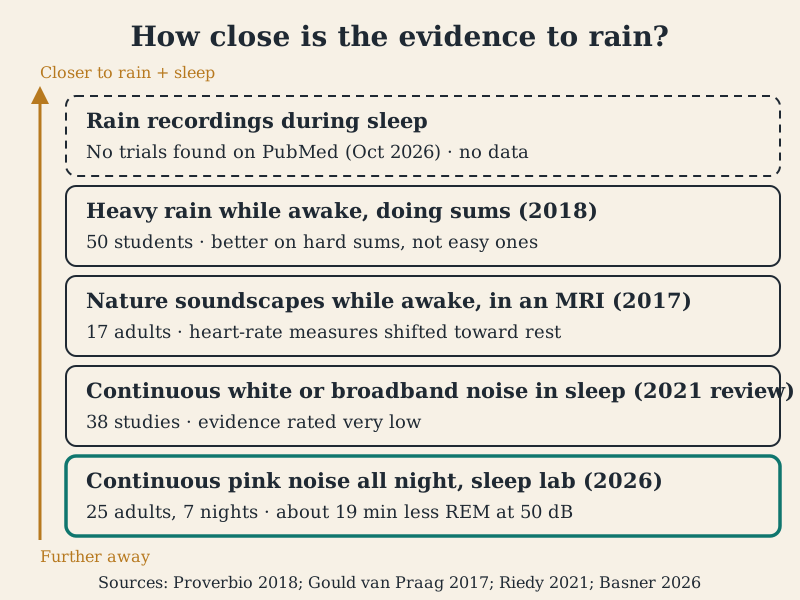
In a 2017 Brighton and Sussex Medical School study, 17 healthy volunteers (mean age 26) heard natural and artificial sounds in an MRI scanner while the researchers monitored their heart rate. Natural soundscapes raised high-frequency heart rate variability, a sign of rest-and-digest activity, compared with artificial ones. The school's release gives a babbling brook and wind in the trees as examples. Rain wasn't named. According to the school's release, the most stressed participants relaxed most.
How good is the evidence on rain sounds?
No trials of rain as a sleep aid
PubMed lists no trials of rain recordings as a sleep aid (searched October 2026). The studies cited for rain used white noise, pink noise or mixed nature soundscapes. Pink noise has been compared to the sound of rain.
Continuous noise as a sleep aid: rated "very low"
The 2021 review by Riedy and colleagues covered 38 studies and rated the evidence that continuous noise improves sleep "very low". The review covered continuous white noise and similar broadband noise. Findings ran from noise helping sleep to disrupting it, and the authors warned it "may also negatively affect sleep and hearing".
Rain doesn't suit everyone
"One person's gentle rain is another's flood worry or need to go to the bathroom," Buxton told Reviewed. He has received grants from Proactive Life LLC, which makes a white-noise app. In the Brighton study, people who were already relaxed showed a slight rise in stress with natural sounds.
Rain suits some sleepers and not others, so test it on yourself.
The 2026 Penn study: pink noise and REM sleep
What they tested
Mathias Basner's Penn Medicine team published it in Sleep in February 2026. The study's 25 healthy young adults (mean age 28.5) spent seven nights in a sleep lab. After a quiet first night to settle in, they had six conditions in random order: quiet, recorded traffic and aircraft noise, pink noise alone at 50 dB, that noise plus pink noise at 40 or 50 dB, and that noise with earplugs.
What they found
Pink noise alone at 50 dB came with about 19 fewer minutes of REM than the quiet night (99.5 against 118.1 minutes). REM matters for memory consolidation, emotional regulation and brain development, Basner noted in the Penn release. See what REM sleep does for more. Pink noise played over traffic and aircraft noise added about 15 minutes awake, which neither did alone.
Earplugs blocked nearly all of the traffic and aircraft noise effects but started failing at 65 dB. Morning cognition was unaffected, but people rated their sleep, alertness and mood worse after pink-noise and traffic-noise nights.
What it doesn't tell you
Rain wasn't tested, and pink noise is only its nearest stand-in. Stanford sleep physician Dr Rafael Pelayo told NBC News that because participants were in a lab, the findings might not apply to the average person at home.
Basner's own summary: "Overall, our results caution against the use of broadband noise, especially for newborns and toddlers, and indicate that we need more research in vulnerable populations, on long-term use, on the different colors of broadband noise, and on safe broadband noise levels in relation to sleep."
How to use rain sounds for sleep
These steps come from studies of white and pink noise. None of them used rain recordings.
1. Keep the volume low, and measure it
Use the lowest level that still covers the noise. Pink noise at 50 dB cut REM in the Penn study, so treat it as a ceiling, not a target. That's roughly moderate rainfall, a little quieter than normal conversation at about 60 dB.
Check with a decibel meter app at your pillow. Don't rely on a talk-over test. By the CDC's rule of thumb, needing to raise your voice to be heard at arm's length means the noise is likely above 85 dB.
2. Set a timer
Basner told NBC News that if a sound machine helps, you should play it low and set a timer so it isn't playing all night. The research gives no duration. In the Penn study the pink noise played all night, so switching it off once you're asleep is a reasonable hedge, if an untested one.
3. Put the speaker across the room
Sound fades with distance. A 2014 study measured 14 infant sleep machines at full volume at 30, 100 and 200 cm, and at 30 cm all of them topped 50 dB. Keep it off the nightstand and away from your pillow.
4. Pick steady rain, not thunder
Sudden sounds hit peak loudness almost instantly and cause arousals. Thunder is one. Thunder tracks haven't been studied for sleep, so treat this as an inference. Choose a long, high-quality recording so you don't notice the loop.
5. Give it a week
The New York study ran each phase for a week. Try a week with rain and a week without, and note how fast you fall asleep and how often you wake.
Rain sounds vs other sleep sounds
| Sound | What the sleep evidence says | Watch out for |
|---|---|---|
| Rain sounds | Very limited: no trials of rain recordings as a sleep aid; covered only by broadband-noise research | Thunder, short loops |
| White noise | Covered by a 38-study review that rated the evidence very low | Hiss can feel harsh |
| Pink noise | Sound bursts timed to slow brain waves strengthened those deep-sleep waves in a 2013 lab study; a continuous track cut REM in the 2026 Penn study | All-night playback |
| Earplugs | Promising: beat pink noise in one 2026 lab study | Fit; started failing at 65 dB |
If traffic noise wakes you, try earplugs first. They beat pink noise in the 2026 lab study, though the Penn authors note that meta-analyses found no convincing earplug benefit for hospital patients. Switch to rain if you can't sleep with them in. If your room is already quiet, you may not need any sound. More on white noise for sleep, or see the full comparison of sleep sounds.
Rain sounds for focus
What the Milano-Bicocca study found
Rain may help with hard mental work. The evidence comes from one 2018 study at the University of Milano-Bicocca, which gave 50 university students (25 introverts, 25 extroverts) 180 easy or difficult sums with heavy rain (a thunder-and-rain track), silence or classical music playing. On difficult sums, accuracy was 70.6% with rain and 62.2% in silence. Music the researchers called touching did about as well, at 72.2%, and cheerful music reached 67%.
Introverts were normally faster. With heavy rain, the extroverts caught up. The researchers think background sound raised alertness, most for extroverts, who tend to run at lower arousal.
When to use it for work
Rain helped on hard sums and made no difference on easy ones. Save it for demanding work, keep it low enough to fade into the background, and run it for a 90-minute focus block. The study's rain track included thunder, so the no-thunder rule is for sleep.
When rain sounds aren't enough
Rain covers outside noise. It does little for:
- A racing mind. Rain drowns out the street, and your thoughts carry on.
- An irregular schedule. No sound fixes a bedtime that moves every night.
- Screens before bed. In a 2015 study, reading a light-emitting e-reader before bed meant slower sleep onset and less melatonin than a printed book.
If stress keeps you awake, a guided wind-down may suit you better. NSDR is guided rest that uses yoga nidra-style body scanning. A 2026 meta-analysis of 73 yoga nidra studies (5,201 participants) reported less stress and anxiety, though the authors called the studies low quality and the effects likely inflated. See NSDR for sleep for bedtime use. NSDR.co is free.
This is general information, not medical advice. If poor sleep lasts for weeks, see a doctor.
FAQ
Is it bad to sleep with rain sounds every night?
Nobody has studied what sleeping with rain sounds every night does over the long term, and Basner lists long-term use as a research gap. One night of all-night pink noise at 50 dB cost about 19 minutes of REM, so keep it low and use a timer.
How loud should rain sounds be for sleep?
Rain sounds for sleep should be as low as still covers the noise. Treat 50 dB as the upper limit and check it at the pillow with a meter app.
Do rain sounds help babies sleep?
No sleep trial has tested whether rain sounds help babies sleep, and the machines that play them can be loud. A 2014 Pediatrics study from the University of Toronto tested 14 infant sleep machines at full volume. At 30 cm all topped 50 dB, the recommended limit for hospital nurseries, and three went above 85 dB. Keep any machine across the room, as low as works, and ask your paediatrician.
Are rain sounds better than white noise?
Rain sounds aren't shown to be better than white noise, and neither has strong sleep evidence. Rain has been compared to pink noise rather than white noise. Pick the one you can ignore.
Can rain sounds help with insomnia?
No study has shown that rain sounds help with insomnia. The 2017 sleep-onset study used healthy adults. Todd Arnedt, director of the Behavioral Sleep Medicine Program at the University of Michigan, told Reviewed of pink noise: "I am not aware that its benefit has been tested in people with insomnia". If insomnia persists, see a doctor.
Can rain sounds help with anxiety?
Rain sounds may help you relax, but no study has measured whether they help with anxiety. Nature sounds shifted heart-rate measures toward rest-and-digest in the Brighton study, and whether rain lowers cortisol is untested. Treat it as a support alongside care.
Sources
- Basner M, Smith MG, Cordoza M, et al. (2026). Efficacy of pink noise and earplugs for mitigating the effects of intermittent environmental noise exposure on sleep. Sleep 49(5):zsag001. https://pubmed.ncbi.nlm.nih.gov/41627391/
- Penn Medicine (2026). News release on the pink noise and earplugs study, 3 Feb 2026 (via ScienceDaily). https://www.sciencedaily.com/releases/2026/02/260203030529.htm
- NBC News (2026). Report on the Penn pink noise study, 4 Feb 2026. https://www.nbcnews.com/health/health-news/pink-noise-worse-sleep-quality-study-rem-rcna257099
- Riedy SM, Smith MG, Rocha S, Basner M (2021). Noise as a sleep aid: a systematic review. Sleep Medicine Reviews 55:101385. https://pubmed.ncbi.nlm.nih.gov/33007706/
- Buxton OM, Ellenbogen JM, Wang W, et al. (2012). Sleep disruption due to hospital noises: a prospective evaluation. Annals of Internal Medicine 157(3):170-179. https://pubmed.ncbi.nlm.nih.gov/22868834/
- Hadhazy A (2016). Why does the sound of water help you sleep? Live Science. https://www.livescience.com/53403-why-sound-of-water-helps-you-sleep.html
- Ebben MR, Yan P, Krieger AC (2021). The effects of white noise on sleep and duration in individuals living in a high noise environment in New York City. Sleep Medicine 83:256-259. https://pubmed.ncbi.nlm.nih.gov/34049045/
- Messineo L, Taranto-Montemurro L, Sands SA, et al. (2017). Broadband sound administration improves sleep onset latency in healthy subjects in a model of transient insomnia. Frontiers in Neurology 8:718. https://pubmed.ncbi.nlm.nih.gov/29312136/
- Gould van Praag CD, Garfinkel SN, Sparasci O, et al. (2017). Mind-wandering and alterations to default mode network connectivity when listening to naturalistic versus artificial sounds. Scientific Reports 7:45273. https://pubmed.ncbi.nlm.nih.gov/28345604/
- Brighton and Sussex Medical School (2017). The sound of nature helps us relax (news release). https://www.bsms.ac.uk/about/news/2017/03-31-the-sound-of-nature-helps-us-relax.aspx
- Tabin S, Brown KA (2024). Do rain noises really help you fall asleep? Reviewed. https://www.reviewed.com/sleep/features/do-rain-noises-really-help-you-fall-asleep
- Centers for Disease Control and Prevention (archived 2023). What noises cause hearing loss? https://web.archive.org/web/2023/https://www.cdc.gov/nceh/hearing_loss/what_noises_cause_hearing_loss.html
- Hugh SC, Wolter NE, Propst EJ, et al. (2014). Infant sleep machines and hazardous sound pressure levels. Pediatrics 133(4):677-681. https://pubmed.ncbi.nlm.nih.gov/24590753/
- Ngo HV et al. (2013). Auditory closed-loop stimulation of the sleep slow oscillation enhances memory. Neuron. https://pubmed.ncbi.nlm.nih.gov/23583623/
- Proverbio AM, De Benedetto F, Ferrari MV, Ferrarini G (2018). When listening to rain sounds boosts arithmetic ability. PLoS One 13(2):e0192296. https://pubmed.ncbi.nlm.nih.gov/29466472/
- Chang AM, Aeschbach D, Duffy JF, Czeisler CA (2015). Evening use of light-emitting eReaders negatively affects sleep, circadian timing, and next-morning alertness. PNAS 112(4):1232-1237. https://pubmed.ncbi.nlm.nih.gov/25535358/
- Ghai S, Odyniec P, Ghai I (2026). Effects of yoga nidra on stress, anxiety, and depression: a systematic review and meta-analysis. Annals of the New York Academy of Sciences 1556(1):e70149. https://pubmed.ncbi.nlm.nih.gov/41327816/