
The winter blues are the flat, tired, low feeling many people get when the days shorten in autumn and winter, and that lifts again in spring. It's an everyday phrase, not a diagnosis. The clinical version is seasonal affective disorder (SAD), which the NHS describes as a type of depression, and that one needs a GP rather than a list of tips.
UK clocks go back on Sunday 25 October, and US clocks on Sunday 1 November. Below is how to tell a winter dip from SAD, what's thought to be going on, and what helps.
What are the winter blues?
The US National Institute of Mental Health (NIMH) says many people feel down or have the "winter blues" when the days get shorter, and feel better in spring when longer daylight hours return.
Cleveland Clinic calls the winter blues a mild version of SAD. If that's right, the signs would be milder forms of these symptoms from the NHS and NIMH lists:
- feeling more tired and sleeping more than usual
- feeling hungrier and eating more, often carbohydrates
- less interest in things you usually enjoy
- trouble concentrating
- a lower, flatter mood
Is it real? The seasonal pattern is well described in people with SAD. Across the whole population the picture is less tidy. A US survey of 34,294 adults aged 18 to 99 found no link between depressive symptoms and any of the season-related measures it looked at. Its authors said this casts doubt on seasonal depression as a common disorder, but they also pointed out that a condition affecting only a very small share of people is hard to pick up in a survey that size. So the survey doesn't rule out seasonal depression in a small share of people. It suggests a winter low isn't something everyone goes through.
Winter blues or seasonal affective disorder?
The difference is how long it lasts and how much it gets in the way.
| Winter blues | Seasonal affective disorder (SAD) | |
|---|---|---|
| What it is | An everyday phrase for a seasonal dip | A type of depression with a seasonal pattern |
| How long | A low mood that can lift after a short time | The NHS says see a GP if depression symptoms last most of the day, every day, for more than 2 weeks; SAD may be diagnosed if it has come at the same time of year for 2 years or longer |
| Daily life | You feel flatter but you keep going | Bad enough to interfere with work, social life and family life |
| What to do | The steps below | See a GP. Treatments include talking therapies such as CBT, antidepressants and light therapy |
The NHS lists the symptoms of SAD as:
- low mood
- a lack of interest in things you usually enjoy
- feeling guilty, hopeless or worthless
- feeling restless or irritable
- difficulty concentrating
- being more hungry and eating more than usual
- being more tired and sleeping more than usual
- thoughts of suicide or self-harm
For most people with SAD, symptoms start in late autumn or early winter and ease in spring and summer, lasting about 4 to 5 months of the year, according to NIMH. A Cochrane review gives the prevalence of SAD as 1.5% to 9%, depending on latitude. NIMH says it's more common where winter days are shorter (in the US, farther north) and in women than in men.
Researchers described SAD as a syndrome in 1984, in a paper on 29 patients, most of whom had bipolar disorder, whose depression came back at the same time each year, generally with oversleeping, overeating and carbohydrate craving (Rosenthal et al. 1984).
If symptoms like these have lasted most of the day, every day, for more than 2 weeks, or you've had any thoughts of self-harm, go straight to the box near the end of this page.
Why darker days affect mood and energy
Nobody knows exactly. The NHS says SAD is thought to be linked to less daylight in winter, which may change brain chemicals like melatonin and serotonin that affect your mood and your sleep timing (circadian rhythm). NIMH says researchers are still working out the cause.
Light timing is the part that's been measured in the lab. Your body clock takes its cue from light, and when the light arrives matters. A lab study of 21 healthy people gave them 6.7 hours of very bright light (Khalsa et al. 2003). Light after their body temperature's lowest point moved the clock earlier, while light before it moved it later. That lowest point comes in the early morning (a common rule of thumb is about two hours before you usually wake), so morning light moves the clock earlier and light late in the evening moves it later.
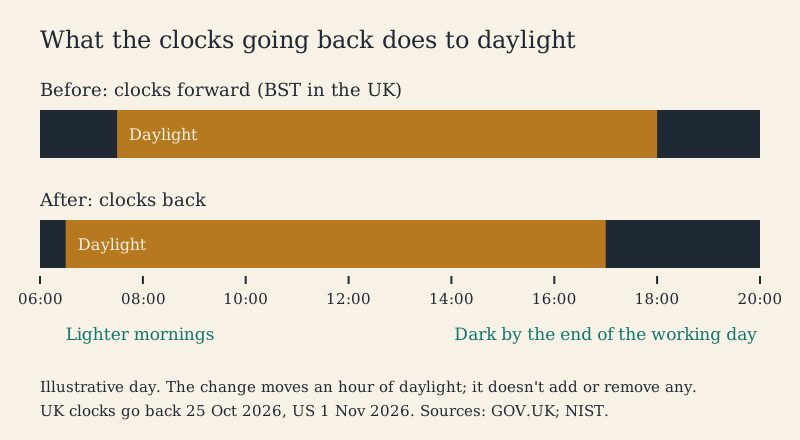
The clock change doesn't add or remove daylight. When the clocks go back, an hour of it moves from the evening to the morning. On the clock, mornings are an hour lighter and it gets dark an hour earlier, so it's dark by the end of the working day.
What helps with the winter blues
Items 1 to 6 are NHS or NICE self-care advice, not the result of trials on the winter blues. Item 7 is a general suggestion, not NHS or NICE advice.
- Get outside in daylight every day. It's the first item on the NHS self-care list for SAD. Morning light is the kind that moves your body clock earlier, so mornings are likely a good time to aim for. For the how-to, see how to get morning light.
- Keep a fixed wake time through the clock change. The NHS suggests going to bed and getting up at the same times every day, and not using phones and other devices right before bed. If your timing has already drifted, here's how to reset your sleep schedule.
- Move, outdoors if you can. The NHS lists regular exercise. NICE, the body that sets clinical guidance in England, advises that any regular activity, from walking to gardening, could help your sense of wellbeing, and that the benefits can be greater outdoors. That's an expert consensus view, not a trial result.
- Stay in contact with people. The NHS lists contact with friends and family, and "connect with other people" is the first of its 5 steps to mental wellbeing. It also suggests not relying on messages and social media alone.
- Plan things to look forward to. The NHS says to keep up your usual activities. NIMH says a version of CBT adapted for SAD uses the same idea, called behavioural activation, which means picking and scheduling pleasant activities to offset the loss of interest that winter brings. Here it's a reasonable habit, not a treatment.
- Go easy on alcohol. The NHS says not to drink too much, and NICE lists not over-using alcohol and getting enough sleep as part of a lifestyle that may help wellbeing.
- Take a short rest in the afternoon. Feeling more tired is on the NHS list of SAD symptoms, and winter afternoons can drag. See why the afternoon dip happens. A short guided rest is a short reset for a stressful afternoon, not a treatment for low mood.
More on the basics in how to sleep better.
Do light boxes and vitamin D help?
Light boxes. Light therapy means sitting near a bright lamp, sometimes called a SAD lamp, to simulate daylight. The evidence for it is limited:
- The NHS says it isn't usually available on the NHS because there isn't enough evidence to tell whether it works, though many people find it helps.
- NICE advises telling people with winter depression who want to try light therapy in preference to antidepressants or talking therapy that the evidence for it is uncertain.
- A 2020 meta-analysis of 19 trials in adults with SAD found bright light did better than a placebo (dim light or an inactive device) on depression scores, in the 18 trials that reported them. The authors concluded that light therapy can be regarded as effective for SAD. They also found the trials were small to medium in size, varied, and at moderate-to-high risk of bias, and called for larger, better trials.
- For preventing SAD, a 2019 Cochrane review found one usable trial, of 46 people, and rated the evidence very low quality.
So talk to a GP before buying one. The NHS says light therapy might not suit you if you have certain eye conditions or take medicines that make you more sensitive to light. If you do buy one, it says to check that it's UV-free and has a UKCA or CE mark. Light boxes are sold for SAD. For a milder winter dip, start with daylight outdoors, which costs nothing.
Vitamin D. In the UK, the advice is that adults should consider a daily 10 microgram (400 IU) vitamin D supplement in autumn and winter, because between October and early March the sun isn't strong enough for your skin to make enough (NHS). The NHS gives this advice for bone, tooth and muscle health and doesn't mention mood.
For mood, the trials are mixed. NIMH says studies testing vitamin D for SAD have mixed results. In the VITAL-DEP trial, 18,353 US adults aged 50 and over took 2,000 IU a day (five times the UK advice) or a placebo for a median of 5.3 years, and their risk of depression didn't differ. A 2023 meta-analysis of 41 trials found a positive effect on depressive symptoms, but rated the certainty of that evidence very low. Vitamin D can interact with some medicines. Talk to a doctor or pharmacist first if you take medication, are pregnant or have a health condition.
When it's more than the winter blues
“See a GP if:
- you have symptoms of depression for most of the day, every day, for more than 2 weeks
- you've lost interest in things you usually enjoy, or you're finding it hard to cope with work, friends or family
- you think you might have SAD, or you've been diagnosed and treatment isn't helping
The NHS lists talking therapies such as CBT, antidepressants and light therapy as options for SAD, and says many people need treatment every winter. In England, adults can also refer themselves to NHS Talking Therapies without seeing a GP.
If you're having thoughts of suicide or self-harm, get help now. In England, call 111 and choose the mental health option, or ask for an urgent GP appointment. Call 999 or go to A&E if you don't feel you can keep yourself safe.
If you're struggling, talk to your GP. UK: Samaritans 116 123. US: 988.
This is general information, not medical advice. NSDR is not a treatment for any condition.
“
FAQ
Why do I feel tired all the time in winter?
Being more tired and sleeping more than usual are on the NHS list of SAD symptoms, and the NHS links SAD to less daylight. Daylight, a fixed wake time and regular activity are all on its self-care list. If you're tired all the time for weeks, or it comes with low mood, see a GP. Tiredness can have other causes too.
Can you get SAD in summer?
Yes, a summer version exists, but it's less common. The NHS and NIMH both describe a summer pattern of SAD, where low mood comes in spring or summer instead of winter.
Does the clock change make it worse?
The clock change doesn't change how much daylight there is. It moves an hour of it from the evening to the morning, which is why it suddenly feels dark by late afternoon. Morning light is the kind that moves your body clock earlier, so the lighter mornings are worth using. Keep your wake time steady through the change.
Is it the same as the "January blues"?
Not quite. NIMH separates "holiday blues", the sadness or stress that comes with the holidays, family visits and busy times of year, from SAD, which follows daylight hours rather than the calendar. Low mood in January can be either, or both.
Sources
- NHS. Seasonal affective disorder (SAD). https://www.nhs.uk/mental-health/conditions/seasonal-affective-disorder-sad/
- NHS. Depression in adults: symptoms. https://www.nhs.uk/mental-health/conditions/depression-in-adults/symptoms/
- NHS. Depression in adults: overview. https://www.nhs.uk/mental-health/conditions/depression-in-adults/overview/
- NHS. Where to get urgent help for mental health. https://www.nhs.uk/nhs-services/mental-health-services/where-to-get-urgent-help-for-mental-health/
- NHS. 5 steps to mental wellbeing. https://www.nhs.uk/mental-health/self-help/guides-tools-and-activities/five-steps-to-mental-wellbeing/
- NHS. Vitamin D. https://www.nhs.uk/conditions/vitamins-and-minerals/vitamin-d/
- NICE (2022). Depression in adults: treatment and management (NG222), recommendations 1.4.39 to 1.4.41. https://www.nice.org.uk/guidance/ng222/chapter/Recommendations
- National Institute of Mental Health. Seasonal affective disorder. https://www.nimh.nih.gov/health/publications/seasonal-affective-disorder
- Cleveland Clinic. Seasonal depression (seasonal affective disorder). https://my.clevelandclinic.org/health/diseases/9293-seasonal-depression
- Rosenthal NE, Sack DA, Gillin JC, et al. (1984). Seasonal affective disorder: a description of the syndrome and preliminary findings with light therapy. Archives of General Psychiatry 41(1):72-80. https://pubmed.ncbi.nlm.nih.gov/6581756/
- Traffanstedt MK, Mehta S, LoBello SG (2016). Major depression with seasonal variation: is it a valid construct? Clinical Psychological Science. https://doi.org/10.1177/2167702615615867
- Khalsa SB, Jewett ME, Cajochen C, Czeisler CA (2003). A phase response curve to single bright light pulses in human subjects. Journal of Physiology 549(3):945-952. https://pubmed.ncbi.nlm.nih.gov/12717008/
- Pjrek E, Friedrich ME, Cambioli L, et al. (2020). The efficacy of light therapy in the treatment of seasonal affective disorder: a meta-analysis of randomized controlled trials. Psychotherapy and Psychosomatics 89(1):17-24. https://pubmed.ncbi.nlm.nih.gov/31574513/
- Nussbaumer-Streit B, Forneris CA, Morgan LC, et al. (2019). Light therapy for preventing seasonal affective disorder. Cochrane Database of Systematic Reviews 3:CD011269. https://pubmed.ncbi.nlm.nih.gov/30883670/
- Okereke OI, Reynolds CF 3rd, Mischoulon D, et al. (2020). Effect of long-term vitamin D3 supplementation vs placebo on risk of depression or clinically relevant depressive symptoms and on change in mood scores: a randomized clinical trial. JAMA 324(5):471-480. https://pubmed.ncbi.nlm.nih.gov/32749491/
- Mikola T, Marx W, Lane MM, et al. (2023). The effect of vitamin D supplementation on depressive symptoms in adults: a systematic review and meta-analysis of randomized controlled trials. Critical Reviews in Food Science and Nutrition 63(33):11784-11801. https://pubmed.ncbi.nlm.nih.gov/35816192/
- GOV.UK. When do the clocks change? https://www.gov.uk/when-do-the-clocks-change
- NIST. Daylight saving time. https://www.nist.gov/pml/time-and-frequency-division/popular-links/daylight-saving-time-dst