What is core sleep? It's Apple Watch's name for light sleep: sleep-lab stages N1 and N2, and mostly N2. It's normally the biggest part of your night, about half to 60% of the time you're asleep, so a large Core bar is what a normal night looks like.
| Apple Watch label | Sleep-lab stage | Typical share of an adult night |
|---|---|---|
| Core | N1 and N2 (light sleep) | About 50 to 60% |
| Deep | N3 (slow-wave sleep) | About 10 to 20% |
| REM | REM | About 20 to 25% |
| Awake | Wake | Brief wakings are normal |
What core sleep means on Apple Watch
If you're asking what is core sleep after checking your watch, the word is Apple's own. Apple Watch sorts your night into four labels: Awake, REM, Core and Deep. Awake and REM mean what they mean in a sleep lab. Deep is stage N3, the slow-wave sleep that comes mostly early in the night. Core covers stages N1 and N2.
N1 is the brief changeover from waking to sleep, usually a few minutes. So in practice, Core is mostly N2.
Other trackers call the same thing "light sleep". Apple's white paper says it chose "Core" to avoid the "possible unintended implications" of calling it light, because N2 is the predominant stage, "often making up more than 50 percent of a night's sleep", and a normal and important part of sleep.
The watch doesn't read your brain waves. It uses its motion sensor, which picks up small movements, including the ones your breathing makes, and gives each 30-second stretch of the night one of the four labels. Sleep stages arrived in 2022 with watchOS 9. In the Health app you can see the time and percentage you spent in each.
How much core sleep is normal?
For most adults, core sleep is about half to 60% of the night. That comes from the textbook figures: N1 is about 2 to 5% of sleep and N2 about 45 to 55%. On a 7 to 8 hour night, it works out at roughly 3.5 to 5 hours of Core.
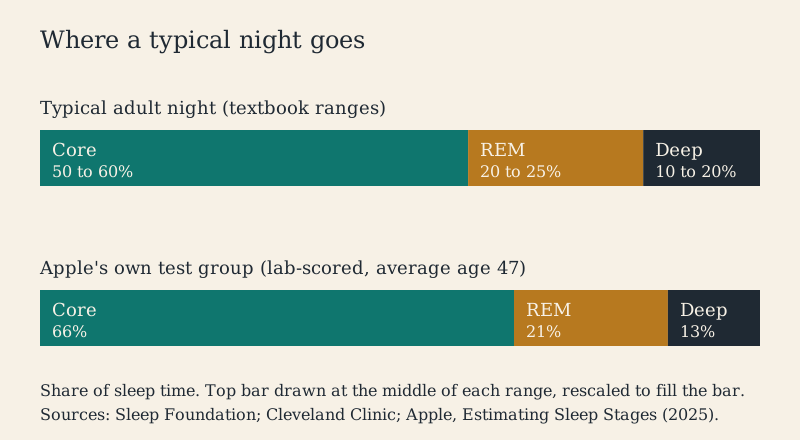
Higher shares turn up too. In Apple's own test group, 166 people with an average age of 47, lab-scored N1 and N2 averaged about two-thirds of their sleep.
There's no official target for core sleep. The number that matters more is the total. The American Academy of Sleep Medicine and Sleep Research Society recommend 7 or more hours a night for adults (Watson 2015).
Core sleep vs deep sleep vs REM
Your night runs in cycles that average about 90 minutes, four to six a night (Sleep Foundation). Each cycle moves from light sleep into deep sleep and then REM. Deep sleep is concentrated in the first half of the night. Later cycles are mostly REM and N2.
| Core (N1 + N2) | Deep (N3) | REM | |
|---|---|---|---|
| Brain waves | Slowing; N1 has theta waves, N2 has sleep spindles and K-complexes | Delta waves, the slowest and largest | Fast, close to waking |
| Body | Muscles relax, body temperature drops, eyes stop moving | Heartbeat and breathing at their lowest; hardest to wake | Eyes dart, arm and leg muscles paralysed, breathing and heart rate rise toward waking levels |
| When | All night, a big share of later cycles | Mostly the first half | Mostly the second half; each period longer than the last |
| Share of sleep | About 50 to 60% | About 10 to 20% | About 20 to 25% |
So core sleep vs deep sleep comes down to depth. Deep sleep is harder to wake from and comes early, while core sleep runs all night. REM is a different state again, with a brain that looks almost awake and most of your dreaming. For what each stage does in more detail, see what happens in each stage of sleep.
Is core sleep good for you?
Yes. It's normal sleep, not a lesser kind. N2 has its own features, and the best studied is the sleep spindle, a brief burst of brain activity that defines the stage.
A 2011 review reports that spindles increase in number and length after people learn something new, and that more spindles go with bigger improvements on the task. The authors link spindles to memory consolidation. Stage 2 and its spindles also play a part in learning motor skills (Rasch & Born 2013). In a 2010 Harvard sleep-lab study, people who produced more spindles on a quiet night slept through more noise on a later, noisy one (Dang-Vu et al. 2010).
These are links, not proof that more core sleep makes you sharper. Apple itself calls N2 normal and an important part of sleep.
How accurate is Apple Watch at measuring core sleep?
Good at spotting sleep, weaker at spotting wake, and rougher on the stages. Apple tested its system against full sleep studies (polysomnography), in the lab and at home, on 299 nights from 166 people. By Apple's own figures, on a typical night the watch correctly labelled 97.9% of real sleep as sleep, but 75% of real wake as wake. Its agreement score for the four stages (kappa, which corrects for chance) was 0.63, and 0.68 after a 2025 update.
Most errors end up in Core. Apple reports that its most common mistake was scoring deep sleep as Core, and that every stage, wake included, was most often mislabelled as Core. Apple also says its sleep stages aren't intended for clinical use.
Independent tests agree the stage minutes are estimates, but they don't agree on which way they're off:
- In a 2024 Harvard study of 35 healthy adults, an Apple Watch Series 8 overestimated light sleep by 45 minutes and underestimated deep sleep by 43 minutes. Its total sleep time was close to the lab's.
- In a 2026 Saudi study, 19 adults wore an Apple Watch Series 7 against a home sleep study. It underestimated light sleep by about 74 minutes and overestimated REM by about 30 minutes, though it still ranked best of the three devices tested.
- In a 2025 Belgian study of 62 adults, the Apple Watch Series 8 had the best stage agreement of six wrist devices (kappa 0.53). The authors rated the devices fair to moderate, and the better ones good enough to track lasting changes in sleep over time.
So look at the trend over weeks rather than one low Core figure. And don't chase the number. In 2017, sleep researchers in Chicago gave a name, orthosomnia, to patients who sought help because their tracker showed light or restless sleep, in what the authors call "a perfectionistic quest for the ideal sleep" (Baron et al. 2017). Your watch and a ring can also disagree on the same night. Why HRV readings differ between devices covers some of the reasons.
A wearable is not a diagnosis. If you're sleepy most days despite enough time in bed, see your GP.
The other meaning: "core sleep" in sleep science
Before Apple used the word, the answer to "what is core sleep?" was different. In 1985 the sleep researcher James Horne wrote that after total sleep deprivation, only part of the lost sleep is made up. That suggests one portion of a night's sleep ("obligatory" sleep) is essential and the rest ("facultative" sleep) is more dispensable (Horne 1985). A 1992 study of ageing cites Horne's later work for a split into "core" and "optional" sleep. In that study, core sleep was mainly deep slow-wave sleep, obtained in the first three sleep cycles, and the rest of the night was optional (Wauquier & van Sweden 1992).
That's close to the opposite of Apple's label, which leaves deep sleep out of Core. And Horne's idea isn't licence to cut your nights short. The 7-hour recommendation still stands.
How to get better sleep overall (not more "core")
You can't target core sleep, and there's no reason to. Deep sleep comes early and later cycles are mostly REM and N2, so a longer night tends to add Core. Aim for 7 or more hours, and get up at the same time every day, weekends included, as the AASM advises. To work back from your alarm, use the bedtime calculator.
If it's deep sleep you're worried about, see what's linked to more deep sleep. For the wider habits, see how to sleep better.
This is general information, not medical advice. NSDR is not a treatment for any condition. If you're struggling, talk to your GP. UK: Samaritans 116 123. US: 988.
FAQ
Is 4 hours of core sleep good?
Yes, 4 hours of core sleep is normal on a 7 to 8 hour night, where core usually runs about 3.5 to 5 hours. Your total matters more. Adults are advised to get 7 or more hours.
Why is my core sleep so high?
High core sleep is usually normal. Core is the largest stage for most adults. In Apple's own test group, it averaged about two-thirds of sleep. The watch's most common error is also scoring deep sleep as Core, so some of your Core may be deep sleep.
Can you increase core sleep?
Sleeping longer tends to add core sleep, since Core is the largest share of a typical night and later cycles are mostly REM and N2. There's no reason to try to raise it on its own. Aim for enough total sleep at regular times.
Is core sleep the same as light sleep?
Core sleep is Apple's name for what other trackers call light sleep: stages N1 and N2. Apple chose "Core" because N2 is the main, normal stage of sleep, not a lesser one. So the short answer to what is core sleep is light sleep, under Apple's name.
Sources
- Apple (2025). Estimating Sleep Stages from Apple Watch (updated October 2025). https://www.apple.com/health/pdf/Estimating_Sleep_Stages_from_Apple_Watch_Oct_2025.pdf
- Apple Support. Track your sleep with Apple Watch and the Health app. https://support.apple.com/en-us/108906
- Watson NF, Badr MS, Belenky G, et al. (2015). Recommended amount of sleep for a healthy adult: a joint consensus statement of the American Academy of Sleep Medicine and Sleep Research Society. Sleep 38(6):843-844. https://pubmed.ncbi.nlm.nih.gov/26039963/
- Fogel SM, Smith CT (2011). The function of the sleep spindle: a physiological index of intelligence and a mechanism for sleep-dependent memory consolidation. Neuroscience and Biobehavioral Reviews 35(5):1154-1165. https://pubmed.ncbi.nlm.nih.gov/21167865/
- Rasch B, Born J (2013). About sleep's role in memory. Physiological Reviews 93(2):681-766. https://pubmed.ncbi.nlm.nih.gov/23589831/
- Dang-Vu TT, McKinney SM, Buxton OM, Solet JM, Ellenbogen JM (2010). Spontaneous brain rhythms predict sleep stability in the face of noise. Current Biology 20(15):R626-R627. https://pubmed.ncbi.nlm.nih.gov/20692606/
- Robbins R, Weaver MD, Sullivan JP, et al. (2024). Accuracy of three commercial wearable devices for sleep tracking in healthy adults. Sensors 24(20):6532. https://pubmed.ncbi.nlm.nih.gov/39460013/
- Alhejaili F, Alshumrani R, Alamoudi W, et al. (2026). Performance of three consumer sleep-tracking devices compared with actigraphy and polysomnography. Sleep Medicine 146:109059. https://pubmed.ncbi.nlm.nih.gov/42258963/
- Schyvens AM, Peters B, Van Oost NC, et al. (2025). A performance validation of six commercial wrist-worn wearable sleep-tracking devices for sleep stage scoring compared to polysomnography. Sleep Advances 6(2):zpaf021. https://pubmed.ncbi.nlm.nih.gov/40303381/
- Baron KG, Abbott S, Jao N, Manalo N, Mullen R (2017). Orthosomnia: are some patients taking the quantified self too far? Journal of Clinical Sleep Medicine 13(2):351-354. https://pubmed.ncbi.nlm.nih.gov/27855740/
- Horne JA (1985). Sleep function, with particular reference to sleep deprivation. Annals of Clinical Research 17(5):199-208. https://pubmed.ncbi.nlm.nih.gov/3909914/
- Horne J (1988). Why We Sleep: The Functions of Sleep in Humans and Other Mammals. Oxford University Press.
- Wauquier A, van Sweden B (1992). Aging of core and optional sleep. Biological Psychiatry 31(9):866-880. https://pubmed.ncbi.nlm.nih.gov/1637928/
- Sleep Foundation. Stages of sleep. https://www.sleepfoundation.org/stages-of-sleep
- Sleep Foundation. Deep sleep. https://www.sleepfoundation.org/stages-of-sleep/deep-sleep
- Cleveland Clinic. Sleep basics. https://my.clevelandclinic.org/health/body/12148-sleep-basics
- National Institute of Neurological Disorders and Stroke. Brain basics: understanding sleep. https://www.ninds.nih.gov/health-information/public-education/brain-basics/brain-basics-understanding-sleep
- American Academy of Sleep Medicine. Healthy sleep habits. https://sleepeducation.org/healthy-sleep/healthy-sleep-habits/