A sleep cycle calculator counts back from your wake time in 90-minute blocks, then adds about 15 minutes to fall asleep. For a 7:00 AM alarm, that means bed by 11:15 PM for five cycles or 9:45 PM for six. The tables below do the same sum for 18 common times, in both directions. Treat every answer as an estimate. Cycles average about 90 minutes but run from roughly 70 to 120, so adjust from there.
TL;DR
- Count back from your wake time in 90-minute blocks, then allow about 15 minutes to fall asleep.
- Aim for five cycles (7.5 hours asleep) or six (9 hours). Adults need at least 7 hours.
- Four cycles is about 6 hours, below the CDC and AASM minimum. Treat it as a rough night, not a plan.
- Cycles vary. The first is often 70 to 100 minutes and later ones 90 to 120, so every time here is an estimate. Shift by 15 minutes and judge by how you feel.
- Not asleep after 20 minutes? Get up and do something quiet in low light, as the AASM advises.
- Keep the same wake time every day, a room around 65 to 68°F (about 18 to 20°C), and screens off 30 minutes before bed.
- See a doctor for persistent insomnia or daytime sleepiness.
Bedtime calculator quick reference
If you wake up at this time, go to bed at
Estimates: 90-minute cycles plus 15 minutes to fall asleep.
| Wake time | In bed by: 5 cycles (about 7.5 h asleep) | In bed by: 6 cycles (about 9 h asleep) |
|---|---|---|
| 5:00 AM | 9:15 PM | 7:45 PM |
| 5:30 AM | 9:45 PM | 8:15 PM |
| 6:00 AM | 10:15 PM | 8:45 PM |
| 6:30 AM | 10:45 PM | 9:15 PM |
| 7:00 AM | 11:15 PM | 9:45 PM |
| 7:30 AM | 11:45 PM | 10:15 PM |
| 8:00 AM | 12:15 AM | 10:45 PM |
| 8:30 AM | 12:45 AM | 11:15 PM |
| 9:00 AM | 1:15 AM | 11:45 PM |
If you go to bed at this time, wake up at
Estimates: 90-minute cycles plus 15 minutes to fall asleep.
| In bed at | Wake at: 5 cycles | Wake at: 6 cycles |
|---|---|---|
| 9:00 PM | 4:45 AM | 6:15 AM |
| 9:30 PM | 5:15 AM | 6:45 AM |
| 10:00 PM | 5:45 AM | 7:15 AM |
| 10:30 PM | 6:15 AM | 7:45 AM |
| 11:00 PM | 6:45 AM | 8:15 AM |
| 11:30 PM | 7:15 AM | 8:45 AM |
| 12:00 AM | 7:45 AM | 9:15 AM |
| 12:30 AM | 8:15 AM | 9:45 AM |
| 1:00 AM | 8:45 AM | 10:15 AM |
How to read these tables
Both tables assume 90-minute cycles and 15 minutes to fall asleep. Real cycles run about 70 to 120 minutes and shift with age, recent sleep and alcohol (Sleep Foundation). With those ranges, five cycles could take anywhere from about 7 h 10 min to 9 h 40 min. So a sleep cycle calculator gives you a starting point.
There is no four-cycle column because 6 hours is below the 7-hour adult minimum. If your time isn't listed, the five steps below do the same sum.
How to calculate your ideal bedtime in 5 steps
Step 1: Start with your wake time
Work, school or family usually fix your alarm. Bedtime is what you move.
Step 2: Count back in 90-minute blocks
For a 6:00 AM alarm:
- 4:30 AM
- 3:00 AM
- 1:30 AM
- 12:00 AM
- 10:30 PM
- 9:00 PM
Each block is a rough stand-in for one cycle. Real cycles run shorter or longer.
Step 3: Allow 15 minutes to fall asleep
Go to bed about 15 minutes before your target sleep time. Most healthy adults take 15 to 20 minutes to fall asleep (Sleep Foundation). To be asleep by 10:30 PM, get into bed by 10:15 PM.
Step 4: Choose 5 or 6 cycles
Five cycles is 7.5 hours asleep (7 hours 45 minutes in bed). Six is 9 hours asleep (9 hours 15 minutes in bed).
The Sleep Foundation suggests at least four full cycles and separately recommends 7 to 9 hours for most adults, which in practice means five or more. Four cycles, about 6 hours, is below the 7-hour minimum that the CDC and the American Academy of Sleep Medicine recommend for adults.
Step 5: Test and adjust
Shift your bedtime by about 15 minutes at a time and give each change a few nights. Judge by how you feel in the morning, not by the clock.
How sleep cycles work
How long a sleep cycle lasts
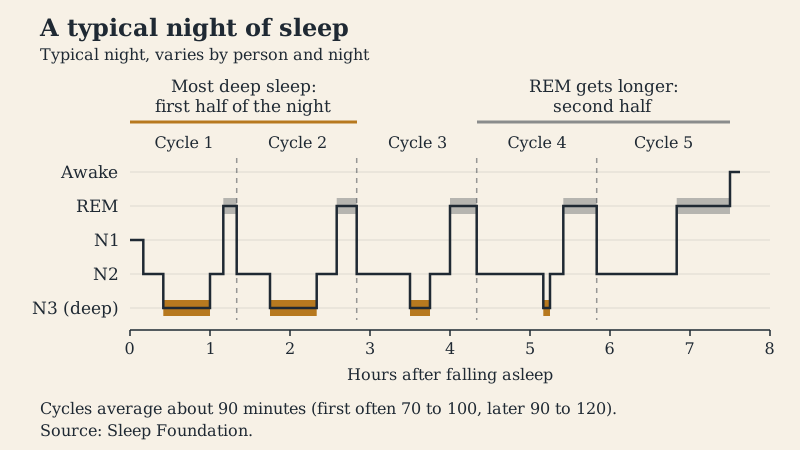
A cycle lasts about 90 minutes on average. The first is often 70 to 100 minutes and later ones 90 to 120. A typical night has four to six cycles. More on what happens in each stage of sleep.
The four sleep stages
Each cycle runs through three NREM stages and REM, and the mix changes through the night. Stage descriptions below are from NINDS and the Sleep Foundation. The shares are the Carskadon and Dement figures summarised by USC, with the Sleep Foundation for deep sleep:
- N1. The lightest stage, as you first fall asleep. About 2 to 5% of sleep.
- N2. Light sleep. Heartbeat and breathing slow, muscles relax, body temperature drops, eye movements stop. About 45 to 55%.
- N3. Deep, slow-wave sleep, which is consistently linked to growth hormone release (Van Cauter & Copinschi 2000). About 10 to 20% in adults, less with age. That is roughly 40 to 110 minutes a night (Sleep Foundation).
- REM. About 20 to 25%, in four to six episodes a night.
How cycles shift through the night
Deep sleep is front-loaded. Most of it falls in the first half of the night, with early N3 stretches of 20 to 40 minutes. Later, N3 shrinks and REM lengthens. So cutting sleep short in the morning likely costs you mostly REM.
What each stage does for memory
In a 2013 review, Rasch and Born describe how fact-based memory benefits from slow-wave sleep. REM and stage 2 also contribute, including to skills, and the stages likely work together. Both ends of the night matter.
Does sleep timing matter more than duration?
No. Duration comes first, and timing comes second. Calculators assume waking from lighter sleep feels easier, and the research on that is mixed (Hilditch & McHill 2019).
What the research on waking mid-cycle shows
Sleep inertia is the grogginess after waking. It usually fades within 30 minutes, sometimes within 15, and prior sleep loss makes it worse. Some studies find it worse after waking from deep N3 sleep, but results are mixed. No study has shown that 7.5 hours beats 8.
A sleep cycle calculator is good for picking a bedtime that gets you enough hours. The case that it can time your wake-up perfectly is weaker.
How much sleep adults need
| Age | CDC recommendation |
|---|---|
| 18 to 60 | 7 or more hours |
| 61 to 64 | 7 to 9 hours |
| 65 and older | 7 to 8 hours |
Source: CDC, About Sleep.
More than a third of US adults report sleeping under 7 hours (Liu et al. 2016), so for many people the first fix is more sleep.
What short sleep costs
Under 7 hours is associated with higher risk of obesity, diabetes, high blood pressure, coronary heart disease, stroke, frequent mental distress and all-cause mortality (Liu et al. 2016).
In a 2007 study led by Matt Walker at Harvard (Yoo et al. 2007; Harvard Gazette), students kept awake for about 35 hours before learning remembered on average 19% less, and up to 40% less, than students who had slept.
In a 1994 study of 23 healthy men (Irwin et al. 1994), staying awake from 3 to 7 AM lowered natural killer cell activity to about 72% of normal. It recovered after a normal night.
As sleep scientist Matt Walker put it in his 2019 TED talk: "Sleep, unfortunately, is not an optional lifestyle luxury. Sleep is a nonnegotiable biological necessity."
What to do when you can't fall asleep on time
The 20-minute rule
The AASM advises getting out of bed if you don't fall asleep after 20 minutes. Do something quiet without much light, avoid electronics, and don't go back to bed until you feel sleepy.
Doing it in another room keeps your brain from linking the bedroom with being awake. Walker puts it this way: "You'd never sit at the dinner table, waiting to get hungry, so why would you lie in bed, waiting to get sleepy?"
Quick fixes for your bedroom
- Cool. About 65°F (18°C) is often cited, and most doctors recommend 65 to 68°F (about 18 to 20°C) (Sleep Foundation). More on finding your ideal bedroom temperature.
- Dark. Darkness supports melatonin, which helps you feel sleepy at night, and light at night shifts circadian rhythms and sleep (Blume et al. 2019).
- Quiet. Some people use steady background noise to mask sounds, but a 2021 review rated the evidence that it improves sleep as very low (Riedy et al. 2021).
When you miss your bedtime
Go to bed when you're sleepy and keep your wake time fixed. Cycles aren't precise enough to be worth staying up 90 extra minutes for.
Sleep cycle tips for better rest
Keep the same wake time every day
The AASM advises a fixed wake-up time every day, weekends included. Walker says a regular schedule improves both how much and how well you sleep. Big gaps between weekday and weekend sleep times create what researchers call social jetlag (Wittmann et al. 2006). If yours has slipped, here's how to fix a sleep schedule that has drifted.
Keep the room cool
Core body temperature starts falling about two hours before sleep. A hot room increases night waking and cuts deep and REM sleep (Okamoto-Mizuno & Mizuno 2012).
Turn the thermostat down in the evening and keep heat out during the day.
A warm shower or bath helps too. In a 2019 meta-analysis (Haghayegh et al. 2019), water at about 40 to 42.5°C (about 104 to 108°F), 1 to 2 hours before bed, even for 10 minutes, helped people fall asleep faster. It likely works by sending blood to your hands and feet, so your body sheds heat and core temperature falls.
Get light right
Morning light shifts your body clock earlier. More on how morning sunlight sets your body clock.
Evening light shifts it later. In a small lab study (Chang et al. 2015), people who read on a light-emitting e-reader for about four hours before bed took longer to fall asleep, released less melatonin and were less alert the next morning than when they read a printed book. The AASM advises turning devices off at least 30 minutes before bed.
When sleep cycles alone aren't enough
Why real nights don't match the table
Travel, stress, deadlines and illness all get in the way. Knowing when to sleep and being able to sleep then are different problems, and a table only solves the first.
Resting after a short night
After a short night, a 10 to 20 minute NSDR session is one way to rest without napping. You lie down, follow a guided voice and try to stay awake, so it is an option if naps make it harder to sleep at night.
The evidence is early. Yoga nidra-style practices are linked to lower stress, though the studies are mostly low quality and the authors say the effects are likely inflated (Ghai et al. 2026). One insomnia trial of 41 patients found better sleep after weeks of practice (Datta et al. 2021). None tests it as a fix for lost sleep. It may help you feel calmer.
NSDR.co is free. See a same-day plan for recovering from poor sleep and how NSDR compares with a nap.
When to see a doctor
See a doctor if you have persistent insomnia or daytime sleepiness. If you regularly sleep 7 or more hours and still wake tired, raise that too, since a sleep disorder is one possible cause.
FAQ
What time should I go to bed to wake up at 7 AM?
Go to bed by 11:15 PM for five cycles or 9:45 PM for six. Both are estimates based on 90-minute cycles plus 15 minutes to fall asleep.
How many sleep cycles do I need?
Plan for five or more sleep cycles. The guideline is in hours, at least 7 for adults, and five 90-minute cycles (7.5 hours) is the first count that clears it. A typical night has four to six. Four cycles, about 6 hours, falls short.
Why do I feel tired after 8 hours of sleep?
You may feel tired after 8 hours of sleep if you wake from deep sleep, but cycles vary too much for any set number of hours to guarantee a clean wake-up. Prior sleep loss makes the grogginess after waking worse, and alcohol can change your cycles. A sleep disorder is another possible cause. See a doctor if it persists.
How accurate is a sleep cycle calculator?
A sleep cycle calculator is only as accurate as the averages behind it. Real cycles run about 70 to 120 minutes, and the evidence that waking between cycles feels better is mixed. Use the answer as a starting point.
Is 6 hours of unbroken sleep better than 8 hours with interruptions?
Neither 6 hours of unbroken sleep nor 8 hours with interruptions is ideal. Six hours is below the adult minimum, and both are worse than a full, unbroken night. One small Johns Hopkins study of 62 adults over 3 nights (Finan, Quartana & Smith 2015) found that, for the same total sleep, being woken repeatedly hurt next-day positive mood more than going to bed late, partly through lost deep sleep. It did not compare 6 hours with 8.
Sources
- Hilditch CJ, McHill AW (2019). Sleep inertia: current insights. Nature and Science of Sleep. https://pubmed.ncbi.nlm.nih.gov/31692489/
- Liu Y, Wheaton AG, Chapman DP, Cunningham TJ, Lu H, Croft JB (2016). Prevalence of healthy sleep duration among adults, United States, 2014. MMWR Morbidity and Mortality Weekly Report. https://pubmed.ncbi.nlm.nih.gov/26890214/
- Yoo SS, Hu PT, Gujar N, Jolesz FA, Walker MP (2007). A deficit in the ability to form new human memories without sleep. Nature Neuroscience. https://pubmed.ncbi.nlm.nih.gov/17293859/
- Irwin M, Mascovich A, Gillin JC, Willoughby R, Pike J, Smith TL (1994). Partial sleep deprivation reduces natural killer cell activity in humans. Psychosomatic Medicine. https://pubmed.ncbi.nlm.nih.gov/7871104/
- Rasch B, Born J (2013). About sleep's role in memory. Physiological Reviews. https://pubmed.ncbi.nlm.nih.gov/23589831/
- Van Cauter E, Copinschi G (2000). Interrelationships between growth hormone and sleep. Growth Hormone & IGF Research. https://pubmed.ncbi.nlm.nih.gov/10984255/
- Okamoto-Mizuno K, Mizuno K (2012). Effects of thermal environment on sleep and circadian rhythm. Journal of Physiological Anthropology. https://pubmed.ncbi.nlm.nih.gov/22738673/
- Riedy SM, Smith MG, Rocha S, Basner M (2021). Noise as a sleep aid: a systematic review. Sleep Medicine Reviews. https://pubmed.ncbi.nlm.nih.gov/33007706/
- Haghayegh S, Khoshnevis S, Smolensky MH, Diller KR, Castriotta RJ (2019). Before-bedtime passive body heating by warm shower or bath to improve sleep: a systematic review and meta-analysis. Sleep Medicine Reviews. https://pubmed.ncbi.nlm.nih.gov/31102877/
- Chang AM, Aeschbach D, Duffy JF, Czeisler CA (2015). Evening use of light-emitting eReaders negatively affects sleep, circadian timing, and next-morning alertness. PNAS. https://pubmed.ncbi.nlm.nih.gov/25535358/
- Blume C, Garbazza C, Spitschan M (2019). Effects of light on human circadian rhythms, sleep and mood. Somnologie. https://pubmed.ncbi.nlm.nih.gov/31534436/
- Wittmann M, Dinich J, Merrow M, Roenneberg T (2006). Social jetlag: misalignment of biological and social time. Chronobiology International. https://pubmed.ncbi.nlm.nih.gov/16687322/
- Finan PH, Quartana PJ, Smith MT (2015). The effects of sleep continuity disruption on positive mood and sleep architecture in healthy adults. Sleep. https://pubmed.ncbi.nlm.nih.gov/26085289/
- Datta K, Tripathi M, Verma M, Masiwal D, Mallick HN (2021). Yoga nidra practice shows improvement in sleep in patients with chronic insomnia: a randomized controlled trial. National Medical Journal of India. https://pubmed.ncbi.nlm.nih.gov/34825538/
- Ghai S, Odyniec P, Ghai I (2026). Effects of yoga nidra on stress, anxiety, and depression: a systematic review and meta-analysis. Annals of the New York Academy of Sciences. https://pubmed.ncbi.nlm.nih.gov/41327816/
- Centers for Disease Control and Prevention. About sleep. https://www.cdc.gov/sleep/about/index.html
- American Academy of Sleep Medicine. Healthy sleep habits. https://sleepeducation.org/healthy-sleep/healthy-sleep-habits/
- Sleep Foundation. Stages of sleep. https://www.sleepfoundation.org/stages-of-sleep
- Sleep Foundation. Deep sleep. https://www.sleepfoundation.org/stages-of-sleep/deep-sleep
- Sleep Foundation. Sleep calculator. https://www.sleepfoundation.org/sleep-calculator
- Sleep Foundation. How long should it take to fall asleep? https://www.sleepfoundation.org/sleep-faqs/how-long-should-it-take-to-fall-asleep
- Sleep Foundation. Best temperature for sleep. https://www.sleepfoundation.org/bedroom-environment/best-temperature-for-sleep
- National Institute of Neurological Disorders and Stroke. Brain basics: understanding sleep. https://www.ninds.nih.gov/health-information/public-education/brain-basics/brain-basics-understanding-sleep
- USC Ostrow School of Dentistry. Sleep stages (Carskadon and Dement figures). https://wiki.ostrowonline.usc.edu/sleep-stages
- Harvard Gazette (2007). Study shows importance of sleep for optimal memory functioning. https://news.harvard.edu/gazette/story/2007/02/study-shows-importance-of-sleep-for-optimal-memory-functioning/
- Walker M (2019). Sleep is your superpower. TED. https://www.ted.com/talks/matt_walker_sleep_is_your_superpower/transcript