There are four stages of sleep: three stages of non-REM sleep (N1, N2 and N3) and REM. Your brain runs through them in cycles that average about 90 minutes, four to six times a night. Deep N3 sleep is concentrated in the first half of the night and REM in the second, so the hour you cut off the end of a night costs you more REM than its share.
Why your sleep stages matter
Each stage does different work. Your body does much of its physical repair in deep sleep. Most vivid dreaming happens in REM, which is also linked to emotional processing. Memory consolidation most likely needs both (NINDS).
The four stages of sleep: a quick overview
| Stage | Share of a night (adults) | What's happening |
|---|---|---|
| N1 | About 2 to 5% | The changeover from waking to sleep |
| N2 | About 45 to 55% | Light sleep with sleep spindles |
| N3 | About 10 to 20% | Deep, slow-wave sleep |
| REM | About 20 to 25% | Most vivid dreams, muscles paralysed |
N1, N2 and REM shares are the textbook figures summarised by USC (Kryger et al. 2017). The N3 range is the Sleep Foundation estimate, roughly 40 to 110 minutes on seven to nine hours of sleep. Cleveland Clinic puts deep sleep as high as 25%.
Stage 1 (N1): the doorway to sleep
N1 is the lightest stage, the changeover from waking to sleep. Your heartbeat, breathing and eye movements slow, and your muscles relax, sometimes with a twitch. It usually lasts one to seven minutes.
On an EEG, the alpha rhythm of relaxed, eyes-closed wakefulness gives way to slower theta waves. N1's share of the night rises with age, along with night-time arousals (Mander et al. 2017).
Stage 2 (N2): where most of your night goes
About half your sleep is N2. Heartbeat and breathing slow further, muscles relax more, body temperature drops and your eyes stop moving.
N2's signature is the sleep spindle, a brief burst of 11 to 15 Hz activity that may dampen the effect of outside noise. In a 2010 Harvard sleep-lab study, people who produced more spindles on a quiet night slept through more noise on a later, noisy one (Dang-Vu et al. 2010). Stage 2 and its spindles also play a part in memory, including learning motor skills (Rasch & Born 2013).
Stage 3 (N3): deep sleep and physical repair
N3 is deep, slow-wave sleep. As you sink into it, in Walker's words, "the brain erupts with these huge, big, powerful brain waves." These are delta waves, under 4 cycles per second and the largest of the night. Heart rate and breathing reach their lowest levels, and you're hardest to wake.
Your body builds and repairs tissue, muscle and bone in deep sleep, with high levels of growth hormone. Deep sleep may also bolster the immune system, and fact-based memories benefit from it. In a study of 784 men over 65, those with the least deep sleep had about 1.8 times the odds of developing high blood pressure over an average of 3.4 years as those with the most (Fung et al. 2011). That's an association in older men, not proof that low deep sleep causes high blood pressure.
Waking from deep sleep brings more grogginess, called sleep inertia, than waking from N1 or N2. Without major sleep loss it rarely lasts beyond 30 minutes (Tassi & Muzet 2000). It's why a nap that runs into deep sleep can leave you foggy. For a nap that doesn't, see how to nap without the grogginess.
REM sleep: dreams and emotional first aid
In REM, your eyes flick from side to side behind closed lids and your brain activity looks close to waking. Breathing turns faster and irregular, and heart rate and blood pressure rise to near waking levels. Your arm and leg muscles are temporarily paralysed, so you don't act out your dreams. This paralysis, called atonia, spares only your eyes and breathing muscles.
You can dream in any stage, but the most vivid dreams happen in REM.
Walker puts it this way: "It's during REM sleep that we receive almost a form of emotional first aid." His lab's "sleep to forget, sleep to remember" hypothesis proposes that REM keeps the memory of a hard day while dulling its emotional sting (Walker & van der Helm 2009). It remains a hypothesis.
How sleep cycles work
The 90-minute cycle
Each cycle runs from light sleep into deep sleep and then into REM. Your first REM period usually starts about 90 minutes after you fall asleep and lasts around 10 minutes. Each later one runs longer, up to about an hour.
Ninety minutes is an average. The first cycle often takes 70 to 100 minutes and later ones 90 to 120, and length shifts from night to night. Use a calculator to work out a bedtime from your alarm time, then adjust by how you feel.
Why the mix shifts overnight
Sleep pressure builds with every hour you're awake and makes sleep deeper (NINDS). It's highest when you lie down, which is thought to be why deep sleep comes first, in early stretches of 20 to 40 minutes (Sleep Foundation). As the night goes on, N3 shrinks or drops out, and later cycles fill with REM and lighter N2. Walker calls it "a battle for brain domination throughout the night."
What waking early costs
Walker gives an example. Someone who usually sleeps from 10 pm to 6 am sets an alarm for 4 am. They lose 25% of their sleep, but because REM comes mostly in those last hours, "they may have lost perhaps 50, 60, maybe even 70 percent of all of their REM sleep."
That range is his estimate. The direction is well established, because the end of the night is the REM-heavy part.
What happens in each stage (deep dive)
Brain wave patterns stage by stage
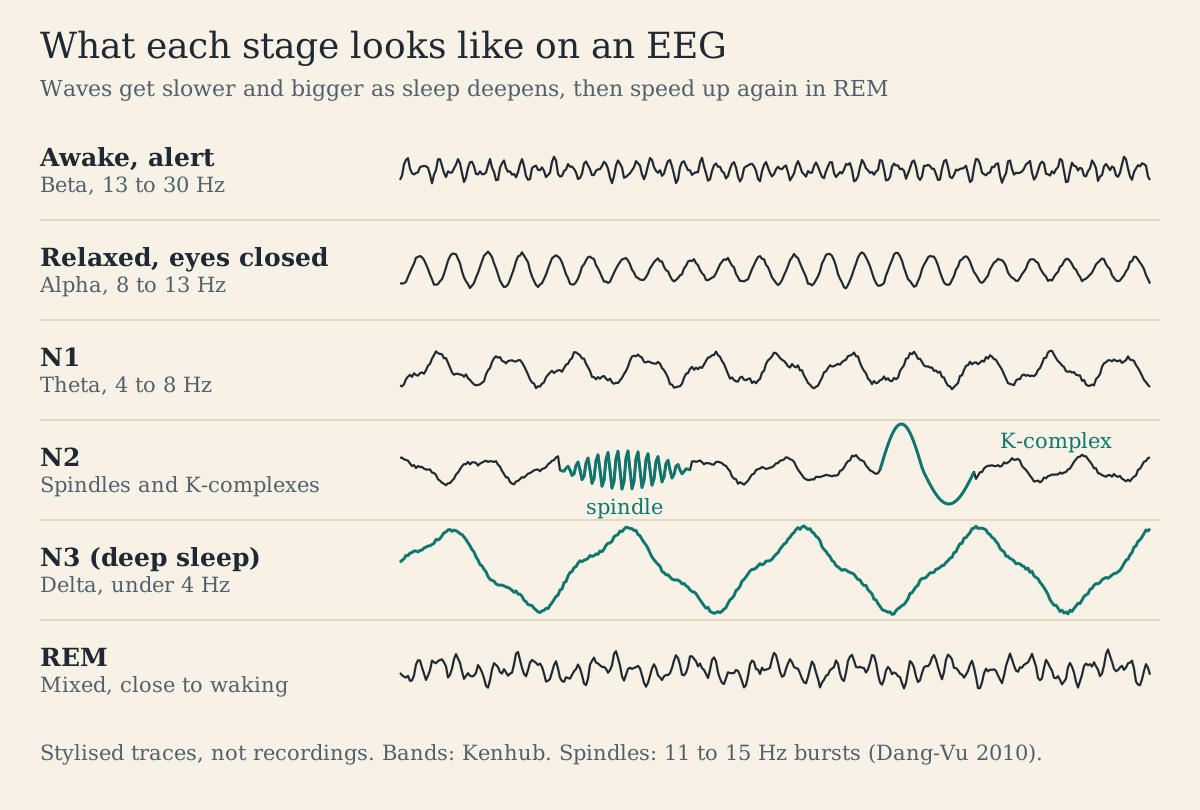
Each stage has its own electrical signature on an EEG.
- Alert and awake. Beta waves, 13 to 30 Hz, fast and small.
- Relaxed, eyes closed. Alpha waves, 8 to 13 Hz.
- N1. Theta waves, 4 to 8 Hz.
- N2. A theta background with sleep spindles and K-complexes.
- N3. Delta waves under 4 Hz, the slowest and biggest.
- REM. Fast, mixed-frequency activity close to waking.
From waking to N3 the waves get slower and larger. REM returns to a waking-like pattern while the body stays paralysed. Bands are from Kenhub.
Your body's physical state during sleep
Heart rate and breathing slow through non-REM and reach their lowest in N3, then climb back toward waking levels in REM. Core temperature starts falling about two hours before sleep and swings by about 2°F (about 1°C) across the night (Sleep Foundation).
Sleep spindles and K-complexes
Spindles, the N2 bursts above, are among the most heritable features of the sleep EEG and are tied to memory and sensory processing (Fernandez & Lüthi 2020).
K-complexes are single large waves, about a second long, that a sound or a touch can set off. A 2005 review links them to processing incoming information and to defending sleep against it (Halász 2005).
How age changes your sleep stages
Older adults
With age, people go to bed and wake earlier, take longer to fall asleep and wake more often. Deep sleep falls the most. In a study of 149 healthy men, it dropped from about 19% of the night at ages 16 to 25 to about 3% at 36 to 50, with no significant further fall into late life (ages 71 to 83) (Van Cauter et al. 2000). Men lose more deep sleep than women, and REM changes often wait until the 80s (Mander et al. 2017).
Older adults with weaker slow-wave activity also forget more overnight. In the Framingham study of 346 people with an average age of 69, each 1% yearly drop in deep sleep went with a 27% higher dementia risk over 17 years (Himali et al. 2023). Again, that's an association: the study can't show that losing deep sleep causes dementia.
What affects your sleep stages
- Alcohol. It delays your first REM period at any dose and cuts total REM at moderate and high doses, and the second half of the night gets more broken (Ebrahim et al. 2013).
- Irregular or short sleep. A few days of it can throw the normal cycle off (Sleep Foundation).
- Sleep disorders. Sleep apnea, restless legs syndrome and other conditions that wake you repeatedly break up the cycle. See a doctor about persistent insomnia, loud snoring or daytime sleepiness.
Sleep trackers only estimate stages. In a lab test of seven consumer devices on 34 healthy young adults, stage estimates were mixed and worse on disrupted nights (Chinoy et al. 2021).
How to support each sleep stage
Protecting your deep sleep (N3)
- Keep the room cool. Heat increases waking and cuts deep and REM sleep (Okamoto-Mizuno & Mizuno 2012). Most doctors suggest 65 to 68°F (about 18 to 20°C). More on finding your ideal bedroom temperature.
- Exercise, evenings included. A 2015 meta-analysis of 66 studies found that a single session of exercise gives a small boost to deep sleep (Kredlow et al. 2015). In a review of 23 studies, evening exercise added about 1.3 percentage points of deep sleep, though hard exercise ending within an hour of bed might delay sleep (Stutz et al. 2019).
- Keep a fixed wake time, weekends included, as the AASM advises.
For more, see these seven changes linked to more deep sleep.
Protecting your REM sleep
Most REM comes in the second half of the night, so the best protection is a full night. If your alarm time is fixed, move bedtime earlier. Go easy on alcohol, which delays and cuts REM.
Resting during the day
After a short night, a short nap has the better evidence. In a lab study of 24 young adults who had slept about 5 hours, a 10-minute afternoon nap improved alertness and performance straight away, and some gains lasted over two hours (Brooks & Lack 2006). If you have the time, nap.
If you can't, or need to go straight back to work, try 10 minutes of NSDR (non-sleep deep rest), the session length used in most NSDR trials. It's guided rest where you stay awake, so there's no grogginess to wake up from. The evidence is thinner. Studies of yoga nidra, a related practice, link it to lower stress, but most are low quality and the effects are likely inflated (Ghai et al. 2026). Neither replaces a full night. The NSDR vs nap comparison has the trial details.
FAQ
What are the 4 stages of sleep?
The 4 stages of sleep are N1, the brief changeover into sleep; N2, light sleep that fills about half the night; N3, deep slow-wave sleep, about 10 to 20%; and REM, about 20 to 25%, when most vivid dreaming happens.
What is the most important stage of sleep?
No single stage of sleep is the most important. Deep N3 sleep handles physical repair and growth hormone release, REM is linked to emotional processing, and memory likely needs both. Losing either costs you something different.
How long should each stage of sleep last?
Each stage of sleep takes a share of the night. Over 8 hours, that's roughly 10 to 25 minutes of N1, 3.5 to 4.5 hours of N2, 50 to 95 minutes of deep sleep and 1.5 to 2 hours of REM. The first REM period lasts around 10 minutes, later ones up to an hour.
What happens if you don't get enough deep sleep?
If you don't get enough deep sleep, studies link that to worse overnight memory, to higher blood pressure in older men and to higher dementia risk in older adults. These are associations. In mice, sleep speeds the clearance of waste such as beta-amyloid from the brain (Xie et al. 2013). Night terrors happen in deep sleep, usually in the first third of the night, and nightmares mostly in REM (Sleep Foundation).
Which sleep stage is the most restorative?
Deep N3 sleep is the stage most tied to physical restoration, with tissue repair, growth hormone and possibly immune support. REM is tied to memory and mood. Waking refreshed takes a full night with enough of both.
Sources
- Walker M (2020). A walk through the stages of sleep (Sleeping with Science). TED. https://www.ted.com/talks/matt_walker_a_walk_through_the_stages_of_sleep/transcript
- Dang-Vu TT, et al. (2010). Spontaneous brain rhythms predict sleep stability in the face of noise. Current Biology. https://pubmed.ncbi.nlm.nih.gov/20692606/
- Rasch B, Born J (2013). About sleep's role in memory. Physiological Reviews. https://pubmed.ncbi.nlm.nih.gov/23589831/
- Fernandez LMJ, Lüthi A (2020). Sleep spindles: mechanisms and functions. Physiological Reviews. https://pubmed.ncbi.nlm.nih.gov/31804897/
- Halász P (2005). K-complex, a reactive EEG graphoelement of NREM sleep: an old chap in a new garment. Sleep Medicine Reviews. https://pubmed.ncbi.nlm.nih.gov/16122950/
- Fung MM, et al. (2011). Decreased slow wave sleep increases risk of developing hypertension in elderly men. Hypertension. https://pubmed.ncbi.nlm.nih.gov/21876072/
- Tassi P, Muzet A (2000). Sleep inertia. Sleep Medicine Reviews. https://pubmed.ncbi.nlm.nih.gov/12531174/
- Walker MP, van der Helm E (2009). Overnight therapy? The role of sleep in emotional brain processing. Psychological Bulletin. https://pubmed.ncbi.nlm.nih.gov/19702380/
- Van Cauter E, et al. (2000). Age-related changes in slow wave sleep and REM sleep and relationship with growth hormone and cortisol levels in healthy men. JAMA. https://pubmed.ncbi.nlm.nih.gov/10938176/
- Mander BA, et al. (2017). Sleep and human aging. Neuron. https://pubmed.ncbi.nlm.nih.gov/28384471/
- Himali JJ, et al. (2023). Association between slow-wave sleep loss and incident dementia. JAMA Neurology. https://pubmed.ncbi.nlm.nih.gov/37902739/
- Ebrahim IO, et al. (2013). Alcohol and sleep I: effects on normal sleep. Alcoholism: Clinical and Experimental Research. https://pubmed.ncbi.nlm.nih.gov/23347102/
- Chinoy ED, et al. (2021). Performance of seven consumer sleep-tracking devices compared with polysomnography. Sleep. https://pubmed.ncbi.nlm.nih.gov/33378539/
- Okamoto-Mizuno K, Mizuno K (2012). Effects of thermal environment on sleep and circadian rhythm. Journal of Physiological Anthropology. https://pubmed.ncbi.nlm.nih.gov/22738673/
- Kredlow MA, et al. (2015). The effects of physical activity on sleep: a meta-analytic review. Journal of Behavioral Medicine. https://pubmed.ncbi.nlm.nih.gov/25596964/
- Stutz J, et al. (2019). Effects of evening exercise on sleep in healthy participants: a systematic review and meta-analysis. Sports Medicine. https://pubmed.ncbi.nlm.nih.gov/30374942/
- Brooks A, Lack L (2006). A brief afternoon nap following nocturnal sleep restriction: which nap duration is most recuperative? Sleep. https://pubmed.ncbi.nlm.nih.gov/16796222/
- Ghai S, et al. (2026). Effects of yoga nidra on stress, anxiety, and depression: a systematic review and meta-analysis. Annals of the New York Academy of Sciences. https://pubmed.ncbi.nlm.nih.gov/41327816/
- Xie L, et al. (2013). Sleep drives metabolite clearance from the adult brain. Science. https://pubmed.ncbi.nlm.nih.gov/24136970/
- National Institute of Neurological Disorders and Stroke. Brain basics: understanding sleep. https://www.ninds.nih.gov/health-information/public-education/brain-basics/brain-basics-understanding-sleep
- Sleep Foundation pages: stages of sleep, deep sleep, sleep temperature, night terrors. https://www.sleepfoundation.org/stages-of-sleep
- Cleveland Clinic. Sleep: what it is, stages, REM and NREM. https://my.clevelandclinic.org/health/body/12148-sleep-basics
- USC Ostrow School of Dentistry. Sleep stages (summarising Kryger et al. 2017). https://wiki.ostrowonline.usc.edu/sleep-stages
- Kenhub. Stages of sleep: NREM, REM and brain waves. https://www.kenhub.com/en/library/physiology/stages-of-sleep
- American Academy of Sleep Medicine. Healthy sleep habits. https://sleepeducation.org/healthy-sleep/healthy-sleep-habits/