Why do I wake up at 3am? By then most of your deep sleep is done for the night. You're in lighter sleep and longer REM periods, melatonin is near its peak, and cortisol has started its climb toward morning. Sleep breaks easily at that point, so a small trigger wakes you: stress, a drink at dinner, a warm room, a full bladder or a breathing problem.
It's common. In a telephone survey of 8,937 adults in Texas, New York and California, 35.5% woke in the night at least three nights a week. Fewer than half of them (15.2% of everyone) had trouble getting back to sleep, and that smaller group reported shorter sleep and more daytime trouble.
Why you keep waking up at 3am: the biology
Sleep gets lighter in the second half of the night
Sleep cycles average about 90 minutes. The first is often 70 to 100, later ones 90 to 120. Fall asleep at 10pm and 3am lands five hours in, somewhere in your third or fourth cycle.
Most deep sleep happens in the first half of the night. Later cycles carry more REM, the dreaming stage. Nancy Foldvary-Schaefer, a sleep medicine specialist at Cleveland Clinic, says that for adults who go to bed around 10pm, 3am "is typically when you're in REM sleep," and Cleveland Clinic describes REM as the lightest stage. More on how sleep cycles work.
Melatonin peaks, cortisol starts climbing
Melatonin, the hormone that signals night, peaks between about 2 and 4am and then tapers. Cortisol runs the other way. In 33 healthy adults it bottomed out at about 00:18 on average and rose through the second half of the night to a peak around 8:30am. That rise is your body getting ready to wake, and it's normal.
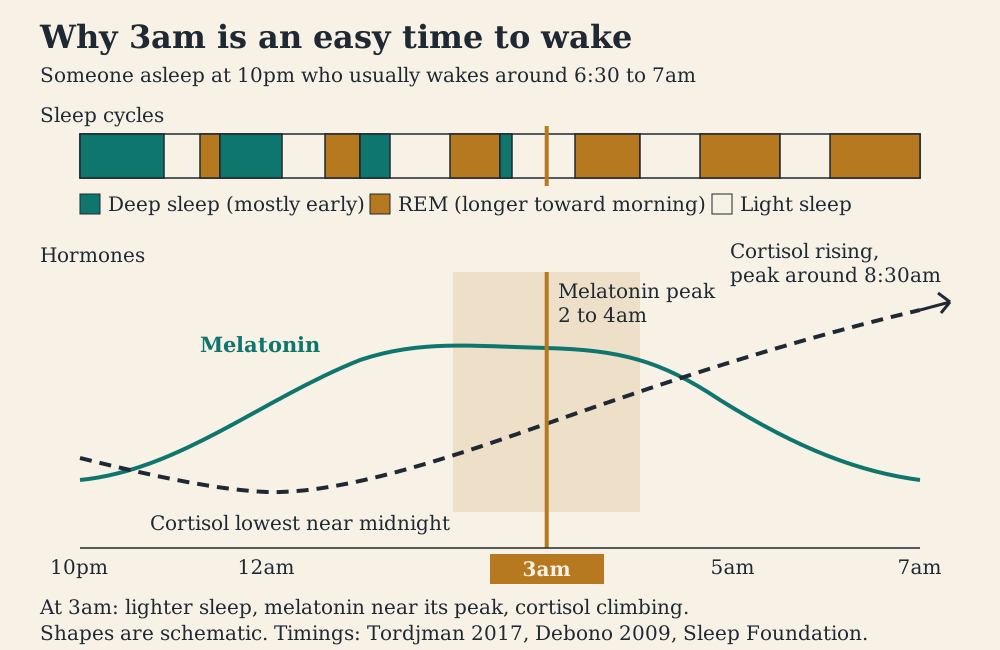
Nobody has shown that this overlap wakes people on its own. The cautious reading is that it leaves sleep easier to break, so a smaller trigger does it.
Waking up is normal; staying awake is the problem
Andrew Huberman's Toolkit for Sleep newsletter calls waking in the night "normal to do once or so each night". In the 2010 survey, night waking without other insomnia symptoms was unlikely to come with daytime problems. Trouble getting back to sleep did. So the first few minutes awake matter more than the waking.
7 reasons you wake up at 3am (and how to tell which one is yours)
1. Stress, and a body that has learned the time
Stress switches on your fight-or-flight system, and you can jolt awake with a faster heart and higher blood pressure. "People with anxiety tend to have more insomnia than those without mood disorders," Foldvary-Schaefer says.
If you wake at the same minute every night, your body may have learned it. "At one point, you may have had a reason to wake up at that time, like in response to sleep apnea or a crying baby. Your body can become conditioned to it," she told Cleveland Clinic. This is a clinicians' explanation more than a tested finding; the prevention section has a cheap test for it.
Signs it's this one. Your mind starts running the moment you surface. "Waking up with a racing mind, heightened alertness, or worry often signals sleep disturbances related to stress and anxiety," Dr. William Lu, a sleep medicine physician at the digital sleep clinic Dreem Health, told Tom's Guide. See also calming sleep anxiety.
2. Low blood sugar (mostly a diabetes-medicine problem)
Low blood sugar can be a side effect of insulin and some other diabetes medicines, and it can happen while you sleep. The NIDDK lists the signs: crying out or nightmares, sweat-damp pajamas or sheets, and waking tired, irritable or confused. For people without diabetes, the blood sugar explanation is popular online but rests on clinicians' impressions rather than studies.
Signs it's this one. You're on one of those medicines and wake sweaty or from bad dreams. Tell the doctor who prescribes it.
3. Alcohol
"Alcohol helps you fall asleep, but sleep is very fragmented afterward," Foldvary-Schaefer says. A 2013 review of all known studies in healthy volunteers found that at every dose, alcohol helps you fall asleep faster, makes the first half of the night more settled, with extra deep sleep, and disrupts the second half. For most sleepers, 3am falls in that second half. Cleveland Clinic suggests a last drink at least three hours before bed.
Signs it's this one. The wake-ups cluster on nights you drank and get worse with more drinks.
4. Heat, light and noise
Core temperature falls through the night and bottoms out in the early morning, roughly 90 minutes to two hours before you usually wake. In a 2012 review, heat in real bedrooms (with bedding and clothes) increased time awake and cut deep and REM sleep.
Outside disturbances such as noise are more likely to wake you very early in the morning, "as you're coming out of REM sleep," Foldvary-Schaefer says. Light matters too: "Light exposure at night is absorbed through our eyes into our retina, and our brain starts to think it's daytime," she says.
Signs it's this one. You wake hot, it's worse in summer, or a streetlight or glowing charger reaches the bed. More on the best bedroom temperature for sleep.
5. Restless legs and cramps
Restless legs syndrome (RLS) brings an urge to move your legs, usually worse in the evening and at night, and it can make it hard to get back to sleep. Most people with RLS also have periodic limb movements in sleep, twitches every 15 to 40 seconds that can run all night. Low iron in the brain may be involved, according to the US National Institute of Neurological Disorders and Stroke, and a blood test can rule out low iron levels. Magnesium is often blamed, but its sleep evidence is thin (see prevention).
Signs it's this one. You wake with crawling or aching legs that ease when you move, with cramps, or with a partner who says your legs jerk all night.
6. Age, menopause and hormones
In a study of more than 9,000 people aged 65 and over, more than half had at least one sleep complaint most of the time. "As we get older, our sleep rhythms get a bit more fragile," Foldvary-Schaefer says. Much of it comes with illness, though. In the same study, complaints went with breathing problems, disability, over-the-counter medicines and low mood.
For women over 55, a Harvard Health article reviewed by Kathryn Corelli, an internist and menopause specialist at Brigham and Women's Hospital, puts the steep fall in estrogen and progesterone at menopause first. Hot flashes and night sweats often strike in the early morning hours.
Signs it's this one. The wake-ups crept in over months or years, or you're in perimenopause and wake hot or sweating.
7. Sleep apnea, reflux and a full bladder
Sleep apnea makes you stop breathing for short spells, which can wake you, and "Sleep apnea is most common during REM sleep, especially for women," Foldvary-Schaefer says. For reflux, the NIDDK suggests raising your head 6 to 8 inches while you sleep, with a foam wedge or extra pillows under your head and upper back. And "Getting up once a night to use the bathroom is considered normal; twice or three times can really disrupt sleep," Corelli says. Some drugs fragment sleep too, especially those for high blood pressure or mood, so ask the prescriber before changing anything.
Signs it's this one. A partner hears loud snoring or gasping, you wake with a dry mouth or heartburn, or you need the toilet twice or more a night.
When to see a doctor
See a doctor if you're awake three or more nights a week for three months with daytime effects (the threshold for chronic insomnia), snore loudly or gasp in your sleep, have regular night sweats, or take diabetes medicines and suspect night-time lows. For chronic insomnia, the American College of Physicians recommends cognitive behavioral therapy for insomnia (CBT-I) before sleeping pills. This post is general information, not a diagnosis.
What to do right now at 3am
Give it 15 to 20 minutes, then get up
Cleveland Clinic's advice is to give yourself 15 to 20 minutes to drift off again, then get out of bed if you're still awake. Guess the time rather than checking.
"When you're feeling frustrated that you can't fall back to sleep, it's best not to keep lying in bed awake," Foldvary-Schaefer says. Get up and do something calming: read something boring, drink decaf tea or listen to quiet music. Go back to bed when you feel sleepy. This is stimulus control, part of CBT-I, built to break the link between your bed and lying awake. The American Academy of Sleep Medicine suggests it for chronic insomnia.
Slow your breathing
Lu's advice for stress wake-ups: "keeping lights low and not checking the time, and by slowing your breathing." If your mind is racing, he suggests counting breaths or silently naming objects. More in breathing exercises for sleep.
Try an NSDR session in bed
Non-sleep deep rest (NSDR) is a guided practice where you lie still and follow a voice through your body and breathing. If you can't fall back asleep, Huberman's newsletter says to "consider doing an NSDR protocol when you wake up".
No trial has tested NSDR for night waking. The closest data is from yoga nidra, a related guided practice. In a 2023 study with no control group, 30 healthy young men who practised 20-minute sessions for four weeks spent about 20 fewer minutes awake during the night.
What not to do at 3am
- Don't pick up your phone. "If you pick it up in the middle of the night, even to check the time, that can absolutely keep you awake," Corelli says.
- Don't watch the clock. In two 2007 experiments, people told to watch a clock while trying to sleep worried more and took longer to drop off, whether they were good sleepers, poor sleepers or had insomnia. Turn it to the wall.
- Don't lie there getting angry at it. That's the habit stimulus control is designed to undo.
How to stop waking up at 3am: prevention protocols
Match the fix to the cause.
Move your caffeine earlier
Caffeine's half-life averages about 4 hours in healthy adults, with a range of 2 to 8 (European Food Safety Authority). A 2023 meta-analysis of 24 studies found caffeine cut total sleep by 45 minutes and added about 12 minutes of waking during the night. Its cutoff for a cup of coffee was at least 8.8 hours before bed, around 1pm for a 10pm bedtime. More on how long caffeine stays in your system.
Run a two-week alcohol test
Skip alcohol for two weeks and note which nights you wake. If the 3am wake-ups fade, you have your answer. If you drink heavily every day, talk to a doctor before stopping.
Make the bedroom cooler, darker and quieter
Cleveland Clinic suggests 60 to 67°F (15 to 19°C); the Sleep Foundation puts the best figure at about 65°F (18.3°C). Add breathable bedding, blackout curtains or a sleep mask, cover standby lights, and try earplugs or a white or pink noise machine at low volume.
Test a later bedtime
If you wake at the same time most nights, Cleveland Clinic sleep psychologist Alicia Roth suggests going to bed 30 minutes to an hour later, to see if you're losing sleep drive by calling it a night too early.
Supplements: magnesium, with limits
The evidence is small. A 2021 review of three trials in 151 older adults found people fell asleep about 17 minutes sooner on magnesium, with evidence rated low to very low quality. A 2025 trial in 155 adults (250 mg a day as bisglycinate for four weeks) found a small improvement in insomnia scores. A 2026 trial gave about 25 healthy adults the three supplements Huberman's newsletter lists (magnesium threonate, theanine and apigenin) for two weeks, and their sleep-disturbance scores were no better than placebo. It was small, short and funded by Momentous, a supplement company. So treat magnesium as a small maybe.
If you try it, stay under 350 mg a day of supplemental magnesium, the NIH upper limit for adults, and check with a doctor first if you have kidney disease, are pregnant or take regular medicines.
Put the phone away for the last hour
In a 2024 study, 35 young men read for 90 minutes on a smartphone without a blue-light filter, and their melatonin was still lower at bedtime, 50 minutes after they stopped. The authors advise no smartphones in the last hour before bed.
Where NSDR fits
NSDR is ten to thirty minutes of guided, awake rest. At 3am, use it in those first 15 to 20 minutes instead of lying there thinking, and if you're still awake after that, get up. You can also use it to wind down in the hour before bed. It's free on NSDR.co, and there will always be a free plan. More in NSDR for sleep.
FAQ
Is waking up at 3am a sign of something serious?
Waking up at 3am is usually not serious, especially if you fall back asleep and feel fine the next day. See a doctor if it happens three or more nights a week for three months with daytime effects, or if you snore loudly, gasp in your sleep or have night sweats.
What does it mean spiritually when you wake up at 3am?
Spiritually, nothing that can be tested. A popular claim online ties 3am to your liver detoxing, but BetterSleep points out the liver does that work all the time and has nothing to do with night waking. Cleveland Clinic says spiritual meaning is "not the domain of sleep medicine." Biologically, 3am is a point of lighter sleep, peak melatonin and rising cortisol, so small disturbances wake you more easily.
Why do I wake up at 3am and can't go back to sleep?
Waking up at 3am and not getting back to sleep usually comes down to the first few minutes: you check the time, start worrying and stay alert. Leave the clock alone, slow your breathing, and if you're still awake after 15 to 20 minutes, get up and do something dull in dim light until you're sleepy.
Is waking up at 3am related to blood sugar?
Blood sugar is a documented cause of night waking mainly in people on insulin or some other diabetes medicines. Signs include nightmares, damp sheets and waking confused or irritable. For people without diabetes, it's a popular theory without good studies behind it.
Should I take melatonin for 3am waking?
Melatonin probably won't fix 3am waking. The American Academy of Sleep Medicine's 2017 guideline on chronic insomnia weakly suggests doctors don't use it for trouble falling or staying asleep. In two meta-analyses it helped people fall asleep 4 to 7 minutes sooner and added roughly 8 to 13 minutes of total sleep. Finding your trigger from the list above is a better use of the effort.
Sources
- Ohayon MM, Krystal A, Roehrs TA, Roth T, Vitiello MV. 2010. Using difficulty resuming sleep to define nocturnal awakenings. Sleep Medicine. https://pubmed.ncbi.nlm.nih.gov/20075004/
- Sleep Foundation. Stages of Sleep. https://www.sleepfoundation.org/stages-of-sleep
- Cleveland Clinic Health Essentials (Nancy Foldvary-Schaefer, DO). 2025. Why You Keep Waking Up at 3 a.m. https://health.clevelandclinic.org/why-do-you-always-wake-up-at-3-a-m
- Tordjman S, Chokron S, Delorme R, et al. 2017. Melatonin: pharmacology, functions and therapeutic benefits. Current Neuropharmacology. https://pubmed.ncbi.nlm.nih.gov/28503116/
- Debono M, Ghobadi C, Rostami-Hodjegan A, et al. 2009. Modified-release hydrocortisone to provide circadian cortisol profiles. Journal of Clinical Endocrinology and Metabolism. https://pubmed.ncbi.nlm.nih.gov/19223520/
- Hirotsu C, Tufik S, Andersen ML. 2015. Interactions between sleep, stress, and metabolism: from physiological to pathological conditions. Sleep Science. https://pubmed.ncbi.nlm.nih.gov/26779321/
- Healthline. Why Do I Keep Waking Up at 3 a.m.? https://www.healthline.com/health/sleep/why-do-i-keep-waking-up-at-3-am
- BetterSleep. Why Do I Wake Up at 3 a.m.? Common Causes & Fixes. https://bettersleep.com/blog/why-do-i-wake-up-at-3am
- Australian Journal of General Practice. 2019. Insomnia: theory and assessment (ICSD-3 criteria for chronic insomnia). https://www.racgp.org.au/ajgp/2019/april/insomnia-theory-and-assessment
- Huberman A. 2021. Toolkit for Sleep. Huberman Lab newsletter. https://www.hubermanlab.com/newsletter/toolkit-for-sleep
- Tom's Guide (Nicola Appleton, quoting Dr. William Lu and Dr. Carleara Weiss). For months I've been waking up at 3 a.m. unable to fall back asleep: two doctors have explained why and how to stop it. https://www.tomsguide.com/wellness/sleep/why-do-i-keep-waking-up-at-3am
- National Institute of Diabetes and Digestive and Kidney Diseases. Low Blood Glucose (Hypoglycemia). https://www.niddk.nih.gov/health-information/diabetes/overview/preventing-problems/low-blood-glucose-hypoglycemia
- Ebrahim IO, Shapiro CM, Williams AJ, Fenwick PB. 2013. Alcohol and sleep I: effects on normal sleep. Alcoholism: Clinical and Experimental Research. https://pubmed.ncbi.nlm.nih.gov/23347102/
- Huberman A. 2021. Find Your Temperature Minimum to Defeat Jetlag, Shift Work & Sleeplessness. Huberman Lab podcast. https://www.hubermanlab.com/episode/find-your-temperature-minimum-to-defeat-jetlag-shift-work-and-sleeplessness
- Sleep Foundation. Best Temperature for Sleep. https://www.sleepfoundation.org/bedroom-environment/best-temperature-for-sleep
- Okamoto-Mizuno K, Mizuno K. 2012. Effects of thermal environment on sleep and circadian rhythm. Journal of Physiological Anthropology. https://pubmed.ncbi.nlm.nih.gov/22738673/
- National Institute of Neurological Disorders and Stroke. Restless Legs Syndrome. https://www.ninds.nih.gov/health-information/disorders/restless-legs-syndrome
- Foley DJ, Monjan AA, Brown SL, et al. 1995. Sleep complaints among elderly persons: an epidemiologic study of three communities. Sleep. https://pubmed.ncbi.nlm.nih.gov/7481413/
- Harvard Health Publishing (Kathryn Corelli, MD). The 3 a.m. wake-up: Why it happens to women more often after 55. https://www.health.harvard.edu/sleep/the-3-am-wake-up-why-it-happens-to-women-more-often-after-55
- National Institute of Diabetes and Digestive and Kidney Diseases. Treatment for GER & GERD. https://www.niddk.nih.gov/health-information/digestive-diseases/acid-reflux-ger-gerd-adults/treatment
- Qaseem A, Kansagara D, Forciea MA, Cooke M, Denberg TD. 2016. Management of chronic insomnia disorder in adults: a clinical practice guideline from the American College of Physicians. Annals of Internal Medicine. https://pubmed.ncbi.nlm.nih.gov/27136449/
- Edinger JD, Arnedt JT, Bertisch SM, et al. 2021. Behavioral and psychological treatments for chronic insomnia disorder in adults: an American Academy of Sleep Medicine clinical practice guideline. Journal of Clinical Sleep Medicine. https://pubmed.ncbi.nlm.nih.gov/33164742/
- Tang NK, Schmidt DA, Harvey AG. 2007. Sleeping with the enemy: clock monitoring in the maintenance of insomnia. Journal of Behavior Therapy and Experimental Psychiatry. https://pubmed.ncbi.nlm.nih.gov/16793001/
- Datta K, Bhutambare A, V L M, et al. 2023. Improved sleep, cognitive processing and enhanced learning and memory task accuracy with yoga nidra practice in novices. PLoS ONE. https://pubmed.ncbi.nlm.nih.gov/38091317/
- European Food Safety Authority. 2015. Caffeine: EFSA explains risk assessment. https://www.efsa.europa.eu/sites/default/files/corporate_publications/files/efsaexplainscaffeine150527.pdf
- Gardiner C, Weakley J, Burke LM, et al. 2023. The effect of caffeine on subsequent sleep: a systematic review and meta-analysis. Sleep Medicine Reviews. https://pubmed.ncbi.nlm.nih.gov/36870101/
- Cleveland Clinic Health Essentials (Michelle Drerup, PsyD). What Is the Ideal Sleeping Temperature for My Bedroom? https://health.clevelandclinic.org/what-is-the-ideal-sleeping-temperature-for-my-bedroom
- Cleveland Clinic Newsroom (Alicia Roth, PhD). 2024. Why You're Waking Up at 3 A.M. https://newsroom.clevelandclinic.org/2024/02/16/why-youre-waking-up-at-3-a-m
- Mah J, Pitre T. 2021. Oral magnesium supplementation for insomnia in older adults: a systematic review and meta-analysis. BMC Complementary Medicine and Therapies. https://pubmed.ncbi.nlm.nih.gov/33865376/
- Schuster J, Cycelskij I, Lopresti A, Hahn A. 2025. Magnesium bisglycinate supplementation in healthy adults reporting poor sleep: a randomized, placebo-controlled trial. Nature and Science of Sleep. https://pubmed.ncbi.nlm.nih.gov/40918053/
- NIH Office of Dietary Supplements. Magnesium: Fact Sheet for Health Professionals. https://ods.od.nih.gov/factsheets/Magnesium-HealthProfessional/
- Mastrofini GF, Romersi RF, Lombardi MG, et al. 2026. Modulating stress and sleep through a multi-compound dietary supplement: a randomized, double-blind, placebo-controlled trial. Journal of the International Society of Sports Nutrition. https://pubmed.ncbi.nlm.nih.gov/42829807/ [funded by Momentous]
- Höhn C, Hahn MA, Gruber G, et al. 2024. Effects of evening smartphone use on sleep and declarative memory consolidation in male adolescents and young adults. Brain Communications. https://pubmed.ncbi.nlm.nih.gov/38846535/
- Sateia MJ, Buysse DJ, Krystal AD, Neubauer DN, Heald JL. 2017. Clinical practice guideline for the pharmacologic treatment of chronic insomnia in adults: an American Academy of Sleep Medicine clinical practice guideline. Journal of Clinical Sleep Medicine. https://pubmed.ncbi.nlm.nih.gov/27998379/
- Brzezinski A, Vangel MG, Wurtman RJ, et al. 2005. Effects of exogenous melatonin on sleep: a meta-analysis. Sleep Medicine Reviews. https://pubmed.ncbi.nlm.nih.gov/15649737/
- Ferracioli-Oda E, Qawasmi A, Bloch MH. 2013. Meta-analysis: melatonin for the treatment of primary sleep disorders. PLoS ONE. https://pubmed.ncbi.nlm.nih.gov/23691095/