Most melatonin side effects are mild and uncommon. Daytime sleepiness, headache and dizziness top the list, and across 37 placebo-controlled trials the most frequent, daytime sleepiness, showed up in about 1.7% of people. The open questions sit elsewhere: years of nightly use, high doses, and what's really in the bottle.
This is general information, not medical advice. Check with your doctor or pharmacist before taking melatonin, especially if you're pregnant, take other medicines, or want to give it to a child.
Common melatonin side effects
The best count comes from a 2019 review of 37 randomised trials that compared melatonin with a placebo. Doses ranged from 0.15 mg to 12 mg, and most trials lasted four weeks or less. The most reported side effects were:
- daytime sleepiness, about 1.7%
- headache, about 0.7%
- dizziness, about 0.7%
- hypothermia, a drop in body temperature, about 0.6%
Most cleared up within a few days, or as soon as people stopped. The NHS adds stomach ache, nausea, irritability, dry mouth, itchy skin, aching limbs, strange dreams and night sweats to its list of common ones, and Mayo Clinic counts vivid dreams or nightmares among the less common.
Next-day grogginess
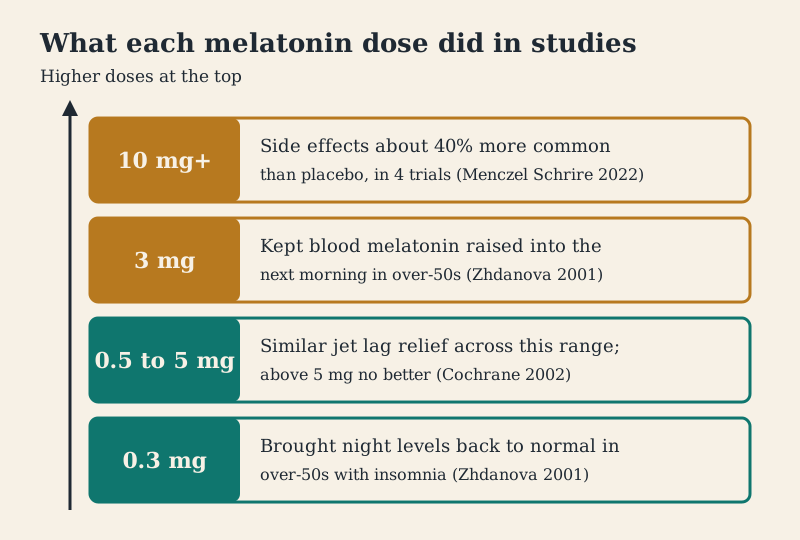
Dose seems to matter. In an MIT study of adults over 50, 3 mg kept blood melatonin raised into the next morning, while 0.3 mg didn't. The US National Center for Complementary and Integrative Health (NCCIH) says melatonin may stay active longer in older people. Mayo Clinic advises against driving or using machinery within five hours of a dose. If you take more than one 2 mg tablet and feel sleepy in the day, the NHS suggests asking your doctor about lowering the dose.
Irritability and low mood
If irritability hasn't eased within a few days, the NHS says to stop and see a doctor. Low mood is on its list of rare, serious effects, and in the 2019 review, mood swings and agitation were among the few side effects judged clinically significant.
Rare but serious side effects
According to the NHS, serious side effects affect fewer than 1 in 1,000 people. Call your doctor if you get:
- low or sad mood
- blurred vision or other changes in your eyesight
- fainting, confusion or vertigo
- bleeding that won't stop, unexplained bruising, or blood in your urine
A serious allergic reaction is rare. Swelling of the lips, mouth, throat or tongue, or trouble breathing or swallowing, means calling emergency services straight away.
How dose changes the picture
Small doses can do the job
In that MIT study, 0.3 mg brought night-time melatonin back to normal levels and restored sleep efficiency in over-50s with insomnia. People who already slept well got nothing from any dose. For jet lag, a Cochrane review found doses from 0.5 mg to 5 mg worked about equally well, though people fell asleep faster and slept better on 5 mg than 0.5 mg. Above 5 mg, they did no better.
Higher doses add side effects
Use of more than 5 mg a day didn't show up in US national surveys before 2005-2006 and reached 0.28% of adults by 2017-2018. A 2022 review of trials using 10 mg or more found only four good enough to pool. In those four, side effects such as drowsiness, headache and dizziness were about 40% more common than on placebo, and serious ones didn't rise. The evidence is thin, but it points the same way as the grogginess data. Dose is one reason why Huberman leaves melatonin out of his sleep stack.
Labels are unreliable
In the US, melatonin is regulated as a dietary supplement. When a 2023 JAMA study tested 25 melatonin gummies, 22 of them (88%) were mislabeled, holding between 74% and 347% of the stated dose. An earlier Canadian test of 31 supplements found a wider spread, from 83% below the label to 478% above it. Buying a lower dose doesn't guarantee you'll get one.
Long-term use: what the heart failure study found
In November 2025, researchers presented a study at the American Heart Association's Scientific Sessions linking long-term melatonin use to heart failure. They searched health records for 130,828 adults with insomnia, average age 55.7. Of these, 65,414 had been prescribed melatonin and had taken it for at least a year. They were compared with 65,414 matched non-users.
Over five years:
- 4.6% of melatonin users were diagnosed with heart failure, against 2.7% of non-users, about a 90% higher rate
- 19.0% were hospitalized for heart failure, against 6.6%
- 7.8% died from any cause, against 4.3%
"Melatonin supplements may not be as harmless as commonly assumed," said lead author Ekenedilichukwu Nnadi, a chief resident in internal medicine at SUNY Downstate/Kings County Primary Care.
What it can't tell you
The authors say the study can't show that melatonin caused any of this. People with worse insomnia, depression or anxiety may be more likely both to take melatonin and to have heart problems, and the records held no data on insomnia severity. Over-the-counter users were probably counted as non-users. The AHA also notes the hospital figures run high because several related diagnostic codes can count. As of October 2026, no peer-reviewed paper has appeared, so the work is still a conference abstract.
Treat it as a reason for caution, in a field with almost no long-term trials. Marie-Pierre St-Onge, who chairs the writing group for the AHA's 2025 statement on sleep health and wasn't involved in the study, said: "I'm surprised that physicians would prescribe melatonin for insomnia and have patients use it for more than 365 days, since melatonin, at least in the U.S., is not indicated for the treatment of insomnia."
Does melatonin cause dependence?
Probably not. In 21 night-shift workers, a week of 0.5 mg at bedtime didn't change how much melatonin their bodies made, and one blind person who took 50 mg a day for 37 days showed no change either. Side effects in the 2019 review cleared when people stopped, and Mayo Clinic says dependence is unlikely. A 2013 meta-analysis found melatonin's effect on sleep didn't fade with continued use, which doesn't fit the idea of tolerance.
Hormone effects are less clear. In a 2002 study, 8 healthy men took 3 mg a day for six months, and sperm quality fell in 2 of them. That's a small, early signal.
Who should check with a doctor first
Mayo Clinic and WebMD list these medicines as possible interactions:
- medicines that slow blood clotting, such as blood thinners
- medicines that prevent seizures
- medicines that suppress the immune system
- high blood pressure and diabetes medicines
- birth control medicine
- sedatives such as clonazepam, diazepam and lorazepam, and anything else that makes you sleepy
A Cochrane review flagged case reports of harm in people with epilepsy and people taking warfarin. NCCIH notes there's little research on melatonin in pregnancy or breastfeeding.
In the UK, melatonin is prescription-only. Australia also requires a prescription, except for 2 mg slow-release tablets, which a pharmacist can sell to adults 55 and over for short-term insomnia.
Children
US poison centers logged 260,435 reports of children swallowing melatonin from 2012 to 2021, and the yearly number rose 530%. Most children had no symptoms, but five needed a ventilator and two died. Keep gummies out of reach.
Is the benefit worth it?
For most people the benefit is small. In a meta-analysis of 17 studies and 284 people, melatonin helped people fall asleep about 4 minutes sooner. Another, of 19 studies and 1,683 people with sleep disorders, found about 7 minutes sooner and about 8 minutes more sleep. The American Academy of Sleep Medicine suggests doctors not use it for chronic insomnia, though it rates that advice as weak.
In his TED talk, sleep scientist Matt Walker describes melatonin as the hormone that tells your brain and body it's time to sleep. It's a timing signal, so it does best when timing is the problem. It eases jet lag (see this jet lag recovery plan), and taken hours before bed it can shift a late body clock earlier, which is how timed, low-dose melatonin for a late body clock works.
If you lie awake keyed up, a timing signal won't fix that.
What to try when your body won't wind down
The American College of Physicians recommends cognitive behavioural therapy for insomnia (CBT-I) as the first treatment for all adults with chronic insomnia.
A few changes cost nothing:
- Dim the evening. In a lab study, reading on a light-emitting e-reader before bed cut melatonin and delayed sleep compared with a paper book. Pair it with morning sunlight.
- Take a warm bath or shower 1 to 2 hours before bed. In a 2019 meta-analysis, water at 40 to 42.5°C, for as little as 10 minutes, shortened the time it took to fall asleep.
- Practise a wind-down. Yoga nidra, which overlaps with NSDR, has some sleep evidence. In a 2021 trial of 41 people with chronic insomnia, those doing yoga nidra got more deep sleep and spent less time awake. A 2026 meta-analysis rated that evidence very low certainty, and none of the four trials that use the NSDR name studied insomnia. It involves no pills, and a session in bed can replace the scrolling.
For a full routine, see NSDR for sleep.
FAQ
Is it OK to take melatonin every night?
Taking melatonin every night for a short spell appears to be safe for most adults, according to NCCIH. Long-term nightly use is less certain, and a 2025 conference study linked a year or more of use to heart failure. If you've needed it nightly for months, ask your doctor what's keeping you awake.
Can melatonin cause heart problems?
Melatonin has been linked to heart failure but not shown to cause it. In a November 2025 records study of 130,828 adults with insomnia, long-term users were diagnosed with heart failure at a 90% higher rate. The study is observational and not yet peer-reviewed, so other factors may explain it.
Does melatonin cause dependency?
Melatonin doesn't appear to cause dependency. Small studies found your own production carries on unchanged, side effects in trials cleared on stopping, and the effect on sleep doesn't seem to fade. Mayo Clinic calls dependence unlikely.
What are natural alternatives to melatonin?
Of the natural alternatives to melatonin, CBT-I has the best support for chronic insomnia. Dimmer evenings and a warm bath 1 to 2 hours before bed both have some evidence. Guided rest like NSDR or yoga nidra lets you wind down without any of the melatonin side effects above, though its sleep evidence is thin.
How long does it take to recover from melatonin use?
Recovery from melatonin use is usually quick. In trials, side effects cleared within days or as soon as people stopped. What can come back is the original sleep problem. In one trial in adults with ADHD and a late body clock, clock timing returned to where it started within two weeks of stopping.
Sources
- Besag FMC, Vasey MJ, Lao KSJ, Wong ICK. 2019. "Adverse Events Associated with Melatonin for the Treatment of Primary or Secondary Sleep Disorders: A Systematic Review." CNS Drugs. https://pubmed.ncbi.nlm.nih.gov/31722088/
- NHS. "Side effects of melatonin." https://www.nhs.uk/medicines/melatonin/side-effects-of-melatonin/ and "Melatonin: common questions." https://www.nhs.uk/medicines/melatonin/common-questions-about-melatonin/
- Zhdanova IV, Wurtman RJ, Regan MM, Taylor JA, Shi JP, Leclair OU. 2001. "Melatonin treatment for age-related insomnia." Journal of Clinical Endocrinology and Metabolism. https://pubmed.ncbi.nlm.nih.gov/11600532/
- National Center for Complementary and Integrative Health. "Melatonin: What You Need To Know." https://www.nccih.nih.gov/health/melatonin-what-you-need-to-know
- Mayo Clinic. "Is melatonin a helpful sleep aid? What should I know about its side effects?" https://www.mayoclinic.org/healthy-lifestyle/adult-health/expert-answers/melatonin-side-effects/faq-20057874
- Herxheimer A, Petrie KJ. 2002. "Melatonin for the prevention and treatment of jet lag." Cochrane Database of Systematic Reviews. https://pubmed.ncbi.nlm.nih.gov/12076414/
- Li J, Somers VK, Xu H, Lopez-Jimenez F, Covassin N. 2022. "Trends in Use of Melatonin Supplements Among US Adults, 1999-2018." JAMA. https://pubmed.ncbi.nlm.nih.gov/35103775/
- Menczel Schrire Z, Phillips CL, Chapman JL, et al. 2022. "Safety of higher doses of melatonin in adults: A systematic review and meta-analysis." Journal of Pineal Research. https://pubmed.ncbi.nlm.nih.gov/34923676/
- Cohen PA, Avula B, Wang YH, Katragunta K, Khan I. 2023. "Quantity of Melatonin and CBD in Melatonin Gummies Sold in the US." JAMA. https://pubmed.ncbi.nlm.nih.gov/37097362/
- Erland LA, Saxena PK. 2017. "Melatonin Natural Health Products and Supplements: Presence of Serotonin and Significant Variability of Melatonin Content." Journal of Clinical Sleep Medicine. https://pubmed.ncbi.nlm.nih.gov/27855744/
- American Heart Association. 2025. "Long-term use of melatonin supplements to support sleep may have negative health effects" (Nnadi E et al., abstract, Scientific Sessions 2025). https://newsroom.heart.org/news/long-term-use-of-melatonin-supplements-to-support-sleep-may-have-negative-health-effects
- Matsumoto M, Sack RL, Blood ML, Lewy AJ. 1997. "The amplitude of endogenous melatonin production is not affected by melatonin treatment in humans." Journal of Pineal Research. https://pubmed.ncbi.nlm.nih.gov/9062869/
- Ferracioli-Oda E, Qawasmi A, Bloch MH. 2013. "Meta-analysis: melatonin for the treatment of primary sleep disorders." PLoS ONE. https://pubmed.ncbi.nlm.nih.gov/23691095/
- Luboshitzky R, Shen-Orr Z, Nave R, Lavi S, Lavie P. 2002. "Melatonin administration alters semen quality in healthy men." Journal of Andrology. https://pubmed.ncbi.nlm.nih.gov/12065466/
- WebMD. "Melatonin: Uses, Side Effects, and More." https://www.webmd.com/vitamins-supplements/melatonin
- Therapeutic Goods Administration. 2021. "Notice of final decision to amend the current Poisons Standard in relation to melatonin." https://www.tga.gov.au/book-page/32-melatonin
- Lelak K, Vohra V, Neuman MI, Toce MS, Sethuraman U. 2022. "Pediatric Melatonin Ingestions, United States, 2012-2021." MMWR. https://pubmed.ncbi.nlm.nih.gov/35653284/
- Burgess HJ, Revell VL, Molina TA, Eastman CI. 2010. "Human phase response curves to three days of daily melatonin: 0.5 mg versus 3.0 mg." Journal of Clinical Endocrinology and Metabolism. https://pubmed.ncbi.nlm.nih.gov/20410229/
- Brzezinski A, Vangel MG, Wurtman RJ, et al. 2005. "Effects of exogenous melatonin on sleep: a meta-analysis." Sleep Medicine Reviews. https://pubmed.ncbi.nlm.nih.gov/15649737/
- Sateia MJ, Buysse DJ, Krystal AD, Neubauer DN, Heald JL. 2017. "Clinical Practice Guideline for the Pharmacologic Treatment of Chronic Insomnia in Adults." Journal of Clinical Sleep Medicine. https://pubmed.ncbi.nlm.nih.gov/27998379/
- Walker M. "What is melatonin, and should you take it to fall asleep?" TED. https://www.ted.com/talks/matt_walker_what_is_melatonin_and_should_you_take_it_to_fall_asleep
- Qaseem A, Kansagara D, Forciea MA, Cooke M, Denberg TD. 2016. "Management of Chronic Insomnia Disorder in Adults: A Clinical Practice Guideline From the American College of Physicians." Annals of Internal Medicine. https://pubmed.ncbi.nlm.nih.gov/27136449/
- Chang AM, Aeschbach D, Duffy JF, Czeisler CA. 2015. "Evening use of light-emitting eReaders negatively affects sleep, circadian timing, and next-morning alertness." PNAS. https://pubmed.ncbi.nlm.nih.gov/25535358/
- Haghayegh S, Khoshnevis S, Smolensky MH, Diller KR, Castriotta RJ. 2019. "Before-bedtime passive body heating by warm shower or bath to improve sleep: A systematic review and meta-analysis." Sleep Medicine Reviews. https://pubmed.ncbi.nlm.nih.gov/31102877/
- Datta K, Tripathi M, Verma M, Masiwal D, Mallick HN. 2021. "Yoga nidra practice shows improvement in sleep in patients with chronic insomnia: a randomized controlled trial." National Medical Journal of India. https://pubmed.ncbi.nlm.nih.gov/34825538/
- Singh S, Dhanlika D, Singh U, Haldar P, Sharma G. 2026. "Effect of yoga Nidra (yogic sleep) in sleep disturbances and insomnia: systematic review and metanalysis." Sleep and Breathing. https://pubmed.ncbi.nlm.nih.gov/42043659/
- van Andel E, Bijlenga D, Vogel SWN, Beekman ATF, Kooij JJS. 2021. "Effects of chronotherapy on circadian rhythm and ADHD symptoms in adults with attention-deficit/hyperactivity disorder and delayed sleep phase syndrome: a randomized clinical trial." Chronobiology International. https://pubmed.ncbi.nlm.nih.gov/33121289/