Take 3 grams of glycine 30 to 60 minutes before bed. That's the dose used in the three main trials of glycine for sleep. In them, people rated their sleep better, fell asleep sooner on overnight recordings (one trial) or felt less tired after short nights. The evidence is thin, though. All three trials were small, and Ajinomoto, a company that sells glycine sleep supplements, had researchers on at least two of them. Researchers have traced the likely mechanism in rats: glycine cools the body by opening blood vessels in the skin.
Glycine for sleep: the 30-second answer
The short version is 3 g, 30 to 60 minutes before bed, backed by three small trials and a mechanism mapped in rats.
What glycine is
Glycine is the simplest amino acid, and a non-essential one, so your body makes its own. It uses glycine to build creatine, glutathione and haem, and as a messenger between nerve cells. Food supplies some too. The Sleep Foundation puts typical intake at 3 to 5 grams a day, from meat, fish, beans, lentils and dairy.
The bottom line
- Dose: 3 g. All three sleep trials used it.
- Timing: 30 to 60 minutes before bed, as the Sleep Foundation recommends.
- Evidence: three small trials, at least two co-written by researchers from a glycine supplement maker, plus an independent 2023 review that called the sleep studies small and at high risk of bias.
- Mechanism: mapped in rats, not yet confirmed in people.
- Cycling: Andrew Huberman takes 2 g, with GABA, every third or fourth night. No study has tested cycling.
- Ask first if: you take clozapine, are pregnant or breastfeeding, or take other medication.
How glycine works for sleep
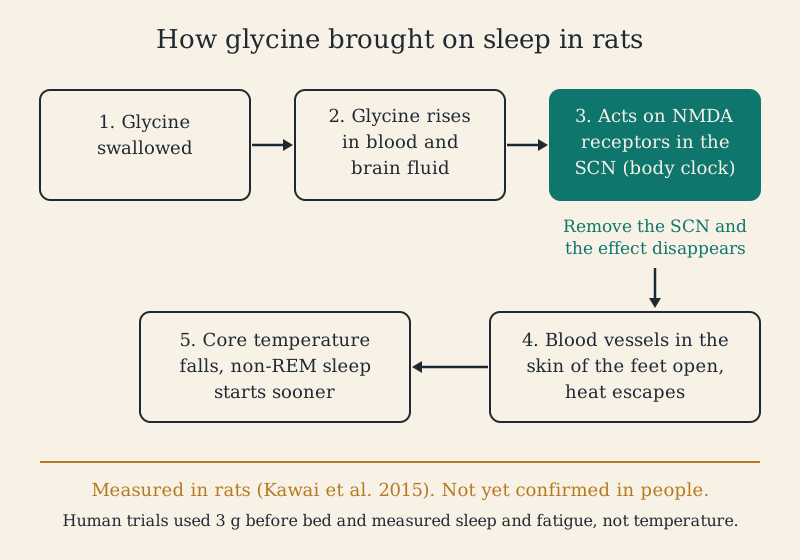
The mechanism was mapped in a 2015 rat study by Kawai and colleagues, a team from Ajinomoto and Stanford. In their abstract they admitted that "despite clinical evidence of its efficacy, the details of its mechanism remain poorly understood." Every step below comes from rats.
Step 1: it reaches the brain
When rats swallowed glycine, levels rose in their blood and in the fluid around the brain and spinal cord.
Step 2: it acts on the brain's master clock
The suprachiasmatic nucleus (SCN) is a small cluster of cells in the hypothalamus that runs the body's daily clock. Glycine switched on cells in its outer shell. Injecting glycine straight into the SCN reproduced the effect, and drugs that block NMDA receptors, one of the receptors glycine acts on, stopped it.
The cleanest result came from rats whose SCN had been destroyed. In the authors' words, "SCN ablation completely abolished the sleep-promoting and hypothermic effects of glycine."
Step 3: blood vessels in the skin open
Glycine raised blood flow to the skin on the soles of the rats' feet, and more glycine raised it further. More blood near the skin means more heat leaving the body.
Step 4: core temperature falls and sleep comes sooner
As heat escaped, core temperature dropped. In rats whose sleep had been disturbed, glycine brought on non-REM sleep sooner. The authors concluded that their data "suggest that exogenous glycine promotes sleep via peripheral vasodilatation through the activation of NMDA receptors in the SCN shell."
The human link is plausible. Sleep usually starts while core temperature is falling, and heat loss through warm hands and feet before lights out promotes sleepiness (Kräuchi 2007). Women with chronically cold hands and feet take longer to fall asleep. Nobody has yet measured glycine doing this in humans. More on the temperature side is in our guide to how room and body temperature affect sleep.
The human evidence: what the studies found
Each trial measured something different.
Inagawa 2006: better-rated sleep
People who had long complained about their sleep quality took 3 g of glycine before bedtime and rated their sleep quality higher. The abstract isn't public, so this comes from the same group's summary in Bannai 2012.
Yamadera 2007: faster to sleep on overnight recordings
This trial added polysomnography, the overnight brain-wave recording used in sleep labs. In volunteers who had been sleeping badly for a while, 3 g before bed:
- improved how they rated their sleep, and their sleep efficiency (time asleep divided by time in bed);
- shortened the time to fall asleep and the time to reach slow-wave sleep;
- left the overall mix of sleep stages unchanged;
- reduced daytime sleepiness and improved scores on a memory recognition task.
The authors wrote that glycine seemed to improve sleep "in a different way than traditional hypnotic drugs such as benzodiazepines."
Bannai 2012: less fatigue after short nights
Ten healthy men, all Ajinomoto employees, cut their time in bed by 25% for three nights (from an average of 7.3 hours to 5.5). Seven finished and were analysed. In a single-blind crossover, each took 3 g of glycine or placebo 30 minutes before bedtime. On glycine they rated their fatigue lower, though only on the first day, with a trend toward less sleepiness. They also scored better on an alertness test on days 1 and 3.
This study tracked sleep with sleep logs only, with no overnight recording, and did not measure body temperature.
Who ran the studies
Ajinomoto sells glycine sleep supplements, and its researchers co-wrote the Yamadera and Bannai trials. The rat work fits the results.
An independent 2023 systematic review in GeroScience found the sleep benefit in healthy people but warned that "these studies had small sample sizes with a high risk of bias." It called for larger, longer studies in healthy people, mainly to test effects on ageing.
How to take glycine for sleep: dose, timing, and form
Dose: 3 g
Stick with 3 g. It's the only dose the sleep trials tested, and the Sleep Foundation notes that 3 g caused no side effects in them.
Much larger amounts have been given for other reasons. Schizophrenia trials have used 60 g a day for 8 weeks, and 0.8 g per kilogram of body weight a day for 6 weeks, which one trial described as "well tolerated." None of that is a reason to take more for sleep.
Timing: 30 to 60 minutes before bed
Bannai 2012 gave glycine 30 minutes before bedtime, and the other two trials say only "before bedtime". The Sleep Foundation recommends 30 to 60 minutes and says glycine works quickly enough to take within an hour of bed.
Powder or capsules
Glycine powder tastes sweet. Stir 3 g into a small glass of water or herbal tea. A small digital scale is the simplest way to measure 3 g.
Capsules work too. Check the grams per capsule on the label, because 3 g usually means several of them.
Should you cycle glycine? The Huberman protocol
Cycling glycine is one person's routine, not a tested protocol.
What Huberman takes
In his "Sleep Toolkit" episode (Huberman Lab, 8 August 2022), Andrew Huberman, a Stanford neuroscientist, says he takes 2 g of glycine and 100 mg of GABA every third or fourth night. He adds them to his standard sleep stack of magnesium threonate, apigenin and theanine, and says the pair "greatly enhances my ability to get into sleep."
His 2021 "Toolkit for Sleep" newsletter gives a different rhythm: "3-4 nights per week I also take 2g of Glycine and 100mg GABA."
Why he cycles it
His reason, in his own words: "if I take it too often, I find that the entire sleep stack doesn't work quite as effectively. I don't know exactly why this is the case."
None of the studies covered here tested whether glycine stops working with nightly use. The glycine studies in healthy people in the 2023 review ran for 14 days at most.
What to do with that
The sleep trials gave 3 g on the nights they tested, three nights in a row in Bannai 2012. Taking it every night, only on nights you expect to struggle, or on Huberman's every-third-night rhythm are all personal choices, and none of these trials compared them.
His full routine is in Huberman's full sleep stack, and the theanine part in L-theanine for sleep.
Glycine vs. magnesium vs. melatonin: which is better?
They do different jobs, and none has strong evidence for everyday sleep trouble.
| Glycine | Magnesium threonate | Melatonin | |
|---|---|---|---|
| What it is | Amino acid | Magnesium bound to threonic acid | The body's night-time hormone |
| Dose in the main studies | 3 g before bed | 1 g a day of the compound (Huberman uses 145 mg of magnesium threonate) | 0.5 to 5 mg |
| Best human evidence | Three small trials: faster sleep onset, better-rated sleep, less next-day fatigue | One trial of 80 adults over 21 days: better deep and REM sleep scores on an Oura ring | Meta-analysis of 19 trials: about 7 minutes faster to sleep |
When glycine fits
Pick glycine if falling asleep is your main problem and you want the option with no reported side effects at 3 g. The evidence behind it is three small trials.
When magnesium fits
Pick magnesium threonate if you'd rather try the supplement with one 80-person trial on sleep scores. Hausenblas and colleagues (2024) gave 80 adults aged 35 to 55 with sleep complaints either magnesium threonate or placebo for three weeks. Three of the six authors were affiliated with AIDP, the ingredient's distributor. More in our guide to magnesium threonate for sleep.
When melatonin fits
Pick melatonin for jet lag. A Cochrane review found that in nine of ten trials, 0.5 to 5 mg taken near the new bedtime reduced jet lag after flights across five or more time zones, and doses above 5 mg worked no better. For everyday insomnia, two meta-analyses found modest effects. Brzezinski 2005 found people fell asleep about 4 minutes sooner, and Ferracioli-Oda 2013 about 7 minutes sooner across 19 trials and 1,683 people.
Who should take glycine (and who shouldn't)
Worth a try if you
- have been sleeping badly for a while, like the volunteers in the Yamadera trial;
- are getting through a run of short nights, the situation Bannai 2012 tested;
- want an option that caused no side effects at the trial dose.
Skip it or ask first if you
- Take clozapine. In schizophrenia trials, adding glycine to clozapine gave no benefit. A 2000 trial found no worsening either, but a 2011 meta-analysis found it worsened positive symptoms such as hallucinations. Talk to your psychiatrist.
- Are pregnant or breastfeeding, or take other medication. The Sleep Foundation advises checking with a doctor first.
- Snore loudly, stop breathing at night, or have had insomnia for months. A supplement won't fix a sleep disorder. See a doctor.
Safety and side effects
At 3 g, the sleep trials reported no side effects. High doses may cause nausea.
Health note: glycine is a supplement, not a treatment for insomnia or any sleep disorder. Check with your doctor if you're pregnant, breastfeeding, take medication or have ongoing sleep problems.
Pair glycine with an NSDR session at bedtime
Glycine's proposed effect is on body temperature. NSDR is a different tool. A recorded voice gives your mind something to follow while you lie still. No study has tested the two together.
Take the glycine 30 to 60 minutes before bed. Once you're lying down, play a 10 to 20 minute NSDR (non-sleep deep rest) or yoga nidra track. Lie on your back with your arms by your sides and follow the voice as it moves your attention around your body. Huberman's newsletter also suggests an NSDR protocol if you wake in the night and can't get back to sleep. More in our guide to NSDR for sleep.
FAQ
How much glycine should I take before bed?
Take 3 g of glycine before bed. Every sleep trial used that dose, and none reported side effects at it.
Is glycine or magnesium better for sleep?
Neither glycine nor magnesium is clearly better for sleep, and no trial covered here compared them directly. Glycine has three small trials on sleep quality, time to fall asleep and next-day tiredness. Magnesium threonate has one 80-person trial on sleep scores. Both have industry links. Pick by what you want to test, and try one at a time.
Does glycine cause vivid dreams?
There's no evidence that glycine causes vivid dreams. The overnight-recording trial (Yamadera 2007) found no change in the overall mix of sleep stages. Its abstract doesn't report REM sleep separately or mention dreams, so the question is open.
Is glycine safe to take every night long-term?
Nightly glycine at 3 g looks safe in the short term, with no side effects in the sleep trials. Long-term data is thinner. Healthy-volunteer studies lasted up to 14 days, while much higher doses have been given for weeks in schizophrenia trials.
Can I combine glycine with an NSDR session before bed?
Yes, you can combine glycine with an NSDR session, though no study has tested the pair. Take the glycine first, then start the track once you're lying down.
Is glycine the same as magnesium glycinate?
No. Magnesium glycinate is magnesium bound to glycine, so it contains some. A 250 mg dose of magnesium as bisglycinate carries about 1.5 g of glycine, half the 3 g used in the sleep trials. More in magnesium glycinate vs citrate.
How long does glycine take to work for sleep?
Glycine for sleep is meant to work the same night. The trials gave it shortly before bedtime, and the Sleep Foundation says it works quickly enough to take within an hour of bed.
Sources
- Kawai N, Sakai N, Okuro M, et al. (2015). The sleep-promoting and hypothermic effects of glycine are mediated by NMDA receptors in the suprachiasmatic nucleus. Neuropsychopharmacology. https://pubmed.ncbi.nlm.nih.gov/25533534/
- Bannai M, Kawai N (2012). New therapeutic strategy for amino acid medicine: glycine improves the quality of sleep. Journal of Pharmacological Sciences. https://pubmed.ncbi.nlm.nih.gov/22293292/
- Bannai M, Kawai N, Ono K, et al. (2012). The effects of glycine on subjective daytime performance in partially sleep-restricted healthy volunteers. Frontiers in Neurology. https://pubmed.ncbi.nlm.nih.gov/22529837/
- Yamadera W, Inagawa K, Chiba S, et al. (2007). Glycine ingestion improves subjective sleep quality in human volunteers, correlating with polysomnographic changes. Sleep and Biological Rhythms. https://doi.org/10.1111/j.1479-8425.2007.00262.x
- Inagawa K, Hiraoka T, Kohda T, et al. (2006). Subjective effects of glycine ingestion before bedtime on sleep quality. Sleep and Biological Rhythms. https://doi.org/10.1111/j.1479-8425.2006.00193.x
- Soh J, Raventhiran S, Lee JH, et al. (2023). The effect of glycine administration on the characteristics of physiological systems in human adults: a systematic review. GeroScience. https://pubmed.ncbi.nlm.nih.gov/37851316/
- Razak MA, Begum PS, Viswanath B, et al. (2017). Multifarious beneficial effect of nonessential amino acid, glycine: a review. Oxidative Medicine and Cellular Longevity. https://pubmed.ncbi.nlm.nih.gov/28337245/
- Kräuchi K (2007). The thermophysiological cascade leading to sleep initiation in relation to phase of entrainment. Sleep Medicine Reviews. https://pubmed.ncbi.nlm.nih.gov/17764994/
- Evins AE, Fitzgerald SM, Wine L, et al. (2000). Placebo-controlled trial of glycine added to clozapine in schizophrenia. American Journal of Psychiatry. https://pubmed.ncbi.nlm.nih.gov/10784481/
- Heresco-Levy U, Ermilov M, Lichtenberg P, et al. (2004). High-dose glycine added to olanzapine and risperidone for the treatment of schizophrenia. Biological Psychiatry. https://pubmed.ncbi.nlm.nih.gov/14732596/
- Singh SP, Singh V (2011). Meta-analysis of the efficacy of adjunctive NMDA receptor modulators in chronic schizophrenia. CNS Drugs. https://pubmed.ncbi.nlm.nih.gov/21936588/
- Hausenblas HA, Lynch T, Hooper S, et al. (2024). Magnesium-L-threonate improves sleep quality and daytime functioning in adults with self-reported sleep problems: a randomized controlled trial. Sleep Medicine: X. https://pubmed.ncbi.nlm.nih.gov/39252819/
- Ferracioli-Oda E, Qawasmi A, Bloch MH (2013). Meta-analysis: melatonin for the treatment of primary sleep disorders. PLoS ONE. https://pubmed.ncbi.nlm.nih.gov/23691095/
- Brzezinski A, Vangel MG, Wurtman RJ, et al. (2005). Effects of exogenous melatonin on sleep: a meta-analysis. Sleep Medicine Reviews. https://pubmed.ncbi.nlm.nih.gov/15649737/
- Herxheimer A, Petrie KJ (2002). Melatonin for the prevention and treatment of jet lag. Cochrane Database of Systematic Reviews. https://pubmed.ncbi.nlm.nih.gov/12076414/
- Huberman A (2022). Sleep Toolkit: Tools for Optimizing Sleep & Sleep-Wake Timing. Huberman Lab podcast, 8 August 2022. https://www.youtube.com/watch?v=h2aWYjSA1Jc
- Huberman A (2021). Toolkit for Sleep. Huberman Lab newsletter, 20 September 2021. https://www.hubermanlab.com/newsletter/toolkit-for-sleep
- Sleep Foundation. Glycine for Sleep: Benefits, Dosage, and Side Effects. https://www.sleepfoundation.org/nutrition/glycine-for-sleep