NSDR for focus means 10 to 20 minutes of guided, awake rest lying down, taken before a deep-work block, within an hour after learning, or in the afternoon dip. It won't switch focus on by itself. Huberman's own site describes it as setting up the conditions that make focusing easier afterwards, and the trials so far found small, short-lived gains or none.
TL;DR:
- NSDR is 10 to 20 minutes of guided, awake rest, lying down somewhere quiet.
- The five steps: breath, spotlight dimming, body scan, stillness, gradual return.
- Good slots are before deep work, within an hour after learning, and in the afternoon dip.
- The focus evidence is thin. One 10-minute trial found faster reactions; two follow-ups found the gain brief or absent.
- The famous "65% dopamine" figure comes from one yoga nidra study of 8 men and measured release during the session, not baseline levels.
- A wandering mind is normal. Start with a guided track.
What is an NSDR focus protocol?
NSDR stands for non-sleep deep rest. You lie still, stay awake and follow a voice that slows your breathing and moves your attention through your body, until you're about as slack as you get just before sleep. An NSDR focus protocol is the same practice, timed and placed in your day so you come out of it ready to work.
Andrew Huberman, the Stanford neuroscientist who coined the term, opens his 20-minute NSDR video this way: "Non-sleep deep rest is a powerful tool that can allow you to control the relaxation state of your nervous system and your overall state of mind."
Brandon R. Peters, MD, a board-certified sleep physician, put it more cautiously in a Sleep Foundation explainer: "NSDR may slow the brain's electrical waves, inducing a state of relaxation with measurable benefits."
On focus specifically, Huberman's site is careful. It says NSDR doesn't directly switch on the brain's focus circuits, but "creates the physiological context which makes it easier to access a focused mental state afterwards." Treat it as a reset you take before the work.
How NSDR differs from meditation
Most meditation asks you to hold attention on something, like the breath or a phrase, and keep bringing it back. That takes effort, and the effort is the training.
NSDR asks for less. Huberman's site lists what NSDR practices share: guided audio, lying still with eyes closed, an aim to let attention spread out instead of concentrating, and staying in the state between waking and sleep. Most of the session moves your attention off the room and onto your body, the breath and the places you touch the floor. The site describes this as using the body to affect the mind. You relax physically and let your mind follow.
What the research says about NSDR and focus
The research is smaller than the claims made about it, and most of it isn't on NSDR.
The four NSDR trials
Only four trials use the NSDR name:
- Boukhris 2024. 65 physically active adults. Ten minutes of guided NSDR beat ten minutes of sitting quietly on reaction time, accuracy on an attention task, and self-rated stress.
- Wrzeciono 2024. 45 heart patients, eight 20-minute sessions. It measured anxiety and stress, not attention.
- Boukhris 2026a. 102 young adults, 10 minutes. Sleepiness, fatigue and stress ratings dropped. Reaction time improved right after the session but not 20 or 40 minutes later; the authors called the cognitive findings "transient".
- Boukhris 2026b. 60 adults, 10 minutes of NSDR against a 25-minute nap. The nap won on readiness, and NSDR showed no measurable effect.
So the best case for NSDR for focus is a short window of sharper reactions and lower sleepiness right after a session. That's useful if you time it before a work block. It isn't proof of lasting gains.
The 65% dopamine figure
The "65% more dopamine" figure comes from one 2002 PET study (Kjaer et al.). Eight male yoga teachers did a 72-minute guided yoga nidra session. Tracer binding in the ventral striatum fell by 7.9%, which the authors estimated as 65% more dopamine released during the session than during a control session of listening to speech with eyes closed.
It measured release during one session, not baseline levels, and it studied yoga nidra, not NSDR. Nobody has shown that a 10-minute track does the same.
The meditation study often credited to NSDR
A 2019 study from Wendy Suzuki's NYU lab (Basso et al.) is often quoted as NSDR research, but it studied guided meditation. New meditators did 13 minutes of guided meditation a day, and after 8 weeks, though not after 4, they did better on tests of attention, working memory and recognition memory than a group who listened to podcasts. It says nothing direct about NSDR.
The "20 minutes of NSDR after learning boosts neuroplasticity by 50%" line has no study behind it. Huberman's own newsletter recommends NSDR after learning but gives no figure.
What you'll need before starting
- Ten to twenty minutes where nobody will need you. Silence your phone; an interruption pulls you straight back out.
- Somewhere to lie down. Seated works, but lying on your back is the standard way to do it.
- A comfortable room, on the cool side if you tend to drift off.
- A guided track to start. Someone else keeps the pacing. Once you know the steps, you can run them yourself.
- No music with lyrics. Words compete with the voice you're following. Headphones are optional.
The 5-step NSDR focus protocol
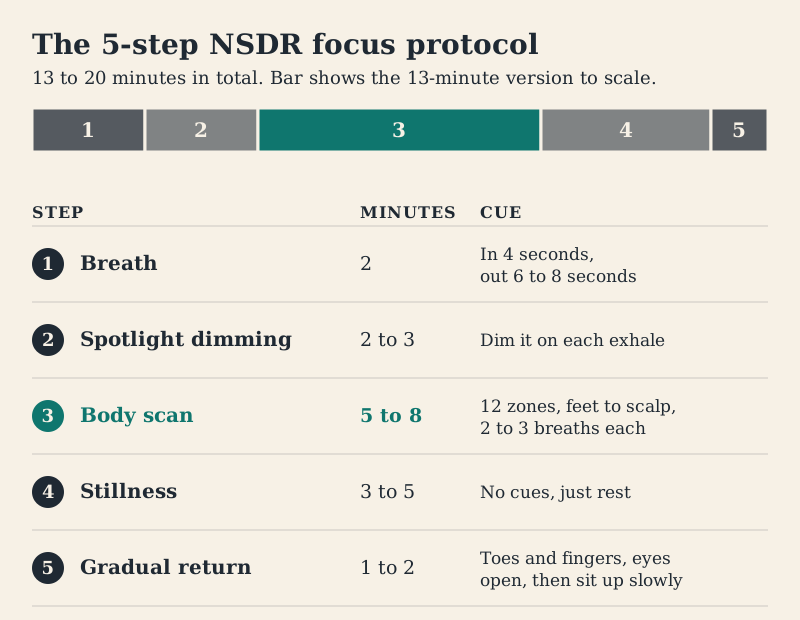
The full sequence runs 13 to 20 minutes, with a cue for each step. For other lengths and goals, see the full NSDR protocol with session lengths.
Step 1: Breath calibration (2 minutes)
Lie on your back, eyes closed, arms by your sides. Breathe in through your nose for about 4 seconds, then out through pursed lips for 6 to 8 seconds, as if through a straw. Huberman's own script uses a similar pattern, in through the nose and out through the mouth, stretching the exhale a little each time.
The long exhale is the point. In a 30-person lab study, slow breathing with a long exhale raised people's sense of relaxation and their high-frequency heart rate variability, a marker of the body's rest-and-digest side (Van Diest 2014).
Cue: "Let my body get heavy against the surface beneath me." Notice your heels, calves, back, shoulders and head on the floor, and let them sink. Four or five breaths.
Step 2: Spotlight dimming (2 to 3 minutes)
Huberman's 20-minute NSDR script uses a spotlight image: you shine it on parts of your body, then dim it. This step borrows the dimming half.
Picture a soft disk of light behind your closed eyes. On each inhale it brightens slightly. On each exhale it dims. After four or five breaths it's a glow. After eight to ten it's barely there. The point is to give your attention one simple thing to follow while your body settles.
Step 3: Sequential body scan (5 to 8 minutes)
Move through your body in this order:
- Feet (both together)
- Ankles and calves
- Knees and thighs
- Hips and pelvis
- Lower back and abdomen
- Chest and upper back
- Shoulders
- Arms (both together)
- Hands
- Neck
- Face and jaw
- Scalp
At each zone, say to yourself: "I feel my [zone]. I release tension. My [zone] is heavy and relaxed." Stay for two or three breaths. Don't rush to the end; the scan is most of the session.
Step 4: Stillness (3 to 5 minutes)
Stop directing anything. No cues, no counting, no picture. Just lie there in the state you've built.
This part feels strange at first because there's nothing to do. If you drift off, that's fine. It may mean you needed sleep more than focus today.
Step 5: Gradual return (1 to 2 minutes)
Come back slowly. Wiggle your toes and fingers. Roll your wrists, shift your shoulders, turn your head from side to side. Open your eyes and stay lying down for another 30 seconds. Then sit up, take one more slow breath, and start work.
When to use NSDR for focus
Right before deep work is the best slot, because the reaction-time gain in the 102-person trial was gone within 20 minutes. Within an hour after learning and the afternoon dip are the other two; bedtime calls for a different track. More on timing by goal in best times to do NSDR.
Before a deep-work block
A 10-minute session just before your hardest work of the day. This is where the trial results point: the reaction-time gain in the 102-person 2026 trial showed up immediately after the session and was gone 20 minutes later. Start working as soon as you sit up.
Within an hour after learning
In his "Neuroplasticity Super-Protocol" newsletter, Huberman's advice is "Within 1 hour of completing a learning bout, do a short NSDR protocol." He mentions two human studies on naps and NSDR but doesn't name them or give a figure.
The wider research on rest after learning is more solid than the NSDR-specific part. In one study, 10 minutes of quiet wakeful rest after a short story improved memory of it a week later, compared with playing a spot-the-difference game (Dewar 2012). A 2010 brain-imaging study found that the more the hippocampus stayed in sync with a visual area of the cortex during rest after learning, the better people remembered the material later (Tambini et al.). For yoga nidra itself there's one small study: of 12 experienced meditators, those who did a 30-minute session three hours after training did better on the practised key-pressing sequence than those who did light work (Immink 2016).
NSDR is a structured way to take that rest. Keep your phone away between the learning and the session. More detail in NSDR after learning.
The afternoon dip
Some people hit a slump in mid-afternoon, linked to a rise in sleepiness at that time of day. It can happen even if you skip lunch, and a high-carbohydrate lunch makes it worse (Monk 2005). A 10 to 15-minute session here is an alternative to a second coffee. More on why the afternoon crash happens.
Not at bedtime, as a focus session
This protocol ends by bringing you back up, which is the wrong direction at night. Huberman does recommend NSDR at bedtime, but as a way to fall asleep. In the evening, use a track built for sleep instead.
NSDR vs caffeine, naps and meditation
Coffee, a nap and meditation are the usual alternatives, and each does a different job.
NSDR vs caffeine
Caffeine works by blocking adenosine receptors, and one review puts it plainly: caffeine "cannot substitute for sleep." NSDR is rest. In the 102-person trial, ten minutes lowered self-rated sleepiness and fatigue; in the 60-person trial, it made no measurable difference. The fairest test is your own. Swap one afternoon coffee for a session for a week and see how your work goes.
NSDR vs a nap
A nap gives you real sleep, and real sleep can leave you groggy. Without major sleep loss, that grogginess rarely lasts more than 30 minutes (Tassi & Muzet 2000). NSDR keeps you awake, so there's no grogginess to wait out.
The nap has its own advantage. In the 2026 head-to-head trial, a 25-minute nap beat 10 minutes of NSDR on readiness 40 minutes later. If you're short on sleep and have the time, nap. If you need to get straight back to work, use NSDR. More in NSDR vs napping.
NSDR vs meditation
The meditation evidence comes from weeks of daily practice, 13 minutes a day for 8 weeks in the Basso study. The NSDR trials looked at a single session and what happened in the next 40 minutes. Meditation is a long-term attention habit; NSDR is a reset for today. Plenty of people do both. See NSDR vs meditation vs yoga nidra.
Troubleshooting: when NSDR isn't working
"I can't stop thinking"
That's normal, especially in the first few sessions. When you notice a thought, label it ("thinking") and go back to the next cue or breath. Noticing and returning is the practice. A guided track helps because the voice gives you something outside your head to follow.
"I keep falling asleep"
Falling asleep now and then is fine. If it happens most times, the likeliest reason is that you're short on sleep, and no rest practice fixes that. Try a morning session when you're less sleepy, prop your head on a pillow, or keep the room cooler.
"I don't feel different afterward"
The effects are subtle, and the trials suggest they're short. Don't judge it on one session. For two weeks, jot down how your first hour of work goes on days with and without a session. If you notice nothing, NSDR may not be your tool.
FAQ
How long should an NSDR focus session be?
Ten minutes is enough for a focus session; that's the length used in three of the four NSDR trials. Huberman has recorded 10, 20 and 30-minute versions, and his site says longer sessions may help more with stress, but nobody has tested whether 20 minutes beats 10 for focus. Start with 10 and add time if it suits you.
Can NSDR replace sleep?
No. Even Huberman's site says nothing can completely replace sleep. NSDR can take the edge off a short night and help you get through an afternoon, but if you're tired most days, the fix is more sleep.
What's the difference between NSDR and yoga nidra?
The core is shared: lying still, slow breathing and a guided body scan. Huberman coined "NSDR" as a plainer name for yoga nidra, for people put off by its spiritual associations. Yoga nidra adds intention setting and more traditional language. Most of the older research, including the dopamine study, was on yoga nidra.
When is the best time to do NSDR for focus?
Right before a block of deep work is the best time, since the measured gains were short-lived. Within an hour after learning and in the mid-afternoon dip are the other two good slots. At night, use a sleep track instead.
What if I can't stop my mind from racing during NSDR?
If you can't stop your mind racing, that's normal and part of the practice. Label the thought, return to the next cue, and repeat as often as you need. For many people it gets easier with practice. If it doesn't, try a guided track with a slower voice.
Is NSDR better than a nap for focus?
NSDR is better when you need to work straight away, because you skip the grogginess a nap can bring. A nap is better when you're short on sleep and have time to recover. In a 2026 trial of 60 adults, a 25-minute nap beat 10 minutes of NSDR on readiness, and NSDR showed no effect.
Can NSDR help with ADHD focus issues?
NSDR hasn't been tested for ADHD focus. A PubMed search finds no trial of NSDR or yoga nidra in people with ADHD. It's low-risk and free to try alongside your treatment, not instead of it. NSDR isn't a treatment for ADHD; talk to your doctor before changing medication or care.
Sources
- Kjaer TW, Bertelsen C, Piccini P, Brooks D, Alving J, Lou HC (2002). Increased dopamine tone during meditation-induced change of consciousness. Cognitive Brain Research, 13(2):255-259. https://pubmed.ncbi.nlm.nih.gov/11958969/
- Boukhris O et al. (2024). The acute effects of nonsleep deep rest on perceptual responses, physical, and cognitive performance in physically active participants. Applied Psychology: Health and Well-Being, 16(4):1967-1987. https://pubmed.ncbi.nlm.nih.gov/38953770/
- Wrzeciono A et al. (2024). Non-Sleep Deep Rest Relaxation and Virtual Reality Therapy for Psychological Outcomes in Patients with Coronary Artery Disease: A Pilot Randomized Controlled Trial. Journal of Clinical Medicine, 13(23):7178. https://pubmed.ncbi.nlm.nih.gov/39685636/
- Boukhris O et al. (2026). Time course of perceptual, cognitive, physical and physiological responses to a single non-sleep deep rest session in physically active young adults. Applied Psychology: Health and Well-Being, 18(4):e70180. https://pubmed.ncbi.nlm.nih.gov/42383502/
- Boukhris O, Suppiah H, Driller M (2026). Comparing the Effects of a Short Nap and Non-Sleep Deep Rest on Perceptual, Cognitive, and Physical Performance in Active Adults. Clocks & Sleep, 8(3):52. https://pubmed.ncbi.nlm.nih.gov/42783005/
- Basso JC, McHale A, Ende V, Oberlin DJ, Suzuki WA (2019). Brief, daily meditation enhances attention, memory, mood, and emotional regulation in non-experienced meditators. Behavioural Brain Research, 356:208-220. https://pubmed.ncbi.nlm.nih.gov/30153464/
- Dewar M, Alber J, Butler C, Cowan N, Della Sala S (2012). Brief wakeful resting boosts new memories over the long term. Psychological Science, 23(9):955-960. https://pubmed.ncbi.nlm.nih.gov/22829465/
- Tambini A, Ketz N, Davachi L (2010). Enhanced brain correlations during rest are related to memory for recent experiences. Neuron, 65(2):280-290. https://pubmed.ncbi.nlm.nih.gov/20152133/
- Immink MA (2016). Post-training meditation promotes motor memory consolidation. Frontiers in Psychology, 7:1698. https://pubmed.ncbi.nlm.nih.gov/27847492/
- Van Diest I et al. (2014). Inhalation/exhalation ratio modulates the effect of slow breathing on heart rate variability and relaxation. Applied Psychophysiology and Biofeedback, 39(3-4):171-180. https://pubmed.ncbi.nlm.nih.gov/25156003/
- Monk TH (2005). The post-lunch dip in performance. Clinics in Sports Medicine, 24(2):e15-e23. https://pubmed.ncbi.nlm.nih.gov/15892914/
- Tassi P, Muzet A (2000). Sleep inertia. Sleep Medicine Reviews, 4(4):341-353. https://pubmed.ncbi.nlm.nih.gov/12531174/
- McLellan TM, Caldwell JA, Lieberman HR (2016). A review of caffeine's effects on cognitive, physical and occupational performance. Neuroscience & Biobehavioral Reviews, 71:294-312. https://pubmed.ncbi.nlm.nih.gov/27612937/
- Urry E, Landolt HP (2015). Adenosine, caffeine, and performance: from cognitive neuroscience of sleep to sleep pharmacogenetics. Current Topics in Behavioral Neurosciences, 25:331-366. https://pubmed.ncbi.nlm.nih.gov/24549722/
- Huberman Lab. 20 Minute Non-Sleep Deep Rest (NSDR) to Restore Mental & Physical Energy (video). https://www.youtube.com/watch?v=hEypv90GzDE
- Huberman Lab. Dr. Andrew Huberman's Guide to NSDR. https://www.hubermanlab.com/nsdr
- Huberman Lab newsletter. Teach & Learn Better With A "Neuroplasticity Super Protocol". https://hubermanlab.com/newsletter/teach-and-learn-better-with-a-neuroplasticity-super-protocol
- Sleep Foundation. What Is Non-Sleep Deep Rest? (quotes Brandon R. Peters, MD). https://www.sleepfoundation.org/meditation-for-sleep/what-is-non-sleep-deep-rest