Sleep anxiety is worry about not sleeping that keeps you awake. To stop it, stop fighting for sleep in bed. Get up if you're still awake after about 20 minutes, do your worrying earlier in the day, and calm your body with slow breathing or a guided session. If it has gone on for weeks, ask about CBT-I, the first treatment guidelines recommend for insomnia. The loop runs both ways. In a UC Berkeley study published in 2020, one sleepless night raised next-day anxiety by up to 30%.
TL;DR
- Sleep anxiety is a loop. Poor sleep raises anxiety, and anxiety about sleep keeps you awake.
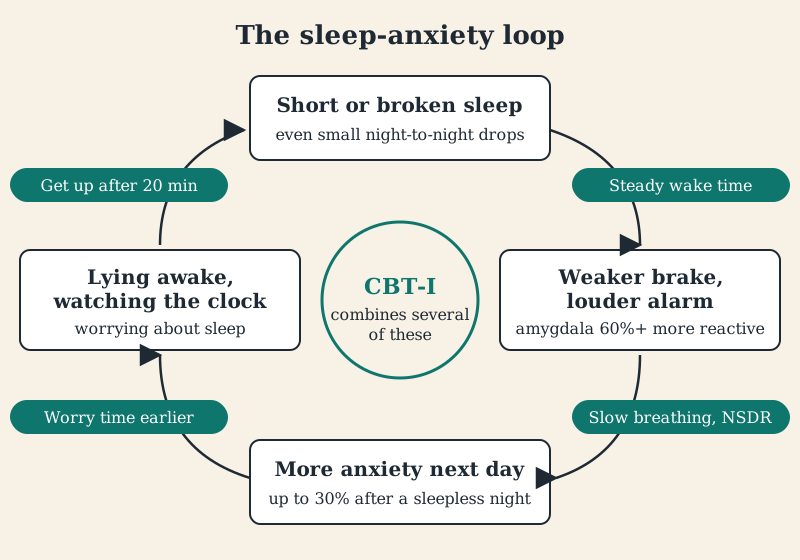
- Without sleep, the brain's alarm (the amygdala) reacts more strongly and its prefrontal brake gets weaker.
- If you're awake after about 20 minutes, get up and do something calm in dim light.
- Worry on purpose in the afternoon, and write tomorrow's to-do list before bed.
- Slow breathing, muscle relaxation and a guided NSDR session calm the body. The evidence for each is small.
- Turn the clock away, move caffeine earlier and wake at the same time every day.
- If it lasts for weeks, ask about CBT-I. A course is usually four to eight sessions.
Why sleep anxiety happens
Your brain's brake gets weaker without sleep
The amygdala flags threats. The prefrontal cortex, behind your forehead, keeps it in check. Sleep loss weakens that brake.
In a 2007 study, Matthew Walker's team scanned 26 young adults while they looked at upsetting images. Those who had been awake for about 35 hours showed amygdala responses over 60% stronger than those who had slept, and a weaker link between the amygdala and the prefrontal cortex.
A later study from Walker's Berkeley lab (Ben Simon 2020) measured the anxiety itself. After a sleepless night it rose by up to 30%, and the scans showed less activity in the medial prefrontal cortex, the region that normally helps keep anxiety in check.
Why anxiety is worse at night
In bed the day's distractions stop, and whatever you put off moves to the front. Bedtime worry, especially about unfinished tasks, is a known cause of trouble falling asleep.
Stress also lingers in the body. "If you're frequently triggering your stress response, your body never gets back to its baseline," says Luis Buenaver, a Johns Hopkins sleep expert.
The sleep-anxiety loop
A 2013 review of nine long-term studies found that insomnia and anxiety are linked in both directions.
"The more you focus on it, the less chance you'll sleep, which then makes you more anxious. That's the cycle that spins," Steve Orma, a clinical psychologist who treats insomnia, told NPR.
You don't need an all-nighter to feel it. In the Berkeley project, 280 people logged their sleep and anxiety for four days, and even small drops in sleep predicted more anxiety the next day. On the other side, people who got more deep sleep had the lowest anxiety the next day.
How to recognize sleep anxiety
Sleep anxiety is an informal term, not a diagnosis. It overlaps with insomnia and with anxiety disorders. Somniphobia, a related term, means fear of sleep itself and can stem from nightmares.
Physical signs
- A racing heart when you get into bed
- Tight shoulders or a clenched jaw
- Shallow, quick breathing
- Sweating or an uneasy stomach
These are fight-or-flight signals, arriving just when your body needs to wind down.
Mental signs
- Dreading bedtime as it gets closer
- Thoughts that speed up the moment you lie down
- Checking the clock and doing sleep maths ("if I fall asleep now, I'll get five hours")
- Catastrophising about tomorrow
- Feeling tired but wired
Much of it is anxiety about sleep itself, and watching for sleep keeps you awake. In a 2007 study, people told to watch a clock while trying to sleep worried more and took longer to drop off, good sleepers included.
When it's more than sleep anxiety
See a doctor if it has lasted more than a few weeks or your days are suffering. The same goes for panic attacks at night, nightmares after a traumatic event, low mood, relying on alcohol or pills to sleep, or loud snoring and gasping, which can point to sleep apnea.
How to fix sleep anxiety: 7 methods
Start with the first two tonight. The last is for sleep anxiety that has lasted weeks.
1. Get out of bed after about 20 minutes
This is stimulus control, a core part of CBT-I. It stops your brain linking bed with lying awake and worrying. The American Academy of Sleep Medicine (AASM) suggests it as a stand-alone treatment for chronic insomnia.
- Go to bed only when you feel sleepy.
- If you're still awake after about 20 minutes, get up. Guess the time rather than checking.
- Go somewhere dim and do something calm, like a paper book or slow breathing.
- Go back to bed when you feel sleepy. Repeat as often as you need to.
It also helps to change the goal from sleeping to resting, since sleep can't be forced. Orma's advice is to expect sleep to vary from night to night: "When you have that frame of mind, your sleep starts to get better."
2. Schedule worry time, and write a to-do list
"Use your brain space when you're more rested to do some worrying," says Aric Prather, a sleep scientist and author of The Sleep Prescription. He suggests 10 or 15 minutes at the same time each day, writing out what's bothering you. When the same thoughts show up at 1am, you can remind yourself you've already done this worrying.
At bedtime, write tomorrow's list. In a 2018 sleep-lab study of 57 young adults, five minutes writing a specific to-do list helped people fall asleep faster than writing about what they had already done. The more specific the list, the faster they fell asleep.
3. Slow your breathing with 4-7-8
- Breathe in through your nose for a count of 4.
- Hold for 7.
- Breathe out through your mouth for 8.
- Repeat for a few rounds.
The evidence is one small study. In 2022, 43 young adults did three sets of six 4-7-8 cycles. Heart rate and systolic blood pressure fell straight afterwards, whether they had slept or not. A heart rate variability marker of the calming branch of the nervous system (high-frequency power) rose only in those who had slept normally. Practise it in the daytime first. If counting makes you more alert, try other ways to calm your nervous system.
4. Progressive muscle relaxation
- Start with your feet. Tense them for about 5 seconds, then let go.
- Move up: calves, thighs, stomach, chest, hands, arms, shoulders, face.
- Notice the difference between tense and loose, and leave each part loose as you move on.
The AASM lists progressive muscle relaxation among the relaxation therapies it suggests for chronic insomnia, and Buenaver recommends it for stress-related sleeplessness.
5. A guided NSDR session
NSDR (non-sleep deep rest) is 10 to 30 minutes of guided, awake rest. A voice moves your attention through your body and slows your breathing.
The research is early. Four trials use the NSDR name: Boukhris 2024 (65 people, 10 minutes), Wrzeciono 2024 (45 heart patients, eight 20-minute sessions), Boukhris 2026a (102 people, 10 minutes) and Boukhris 2026b (60 people, 10 minutes against a 25-minute nap; the nap won on readiness, and NSDR showed no effect). In the first and third, one session lowered self-rated stress compared with sitting quietly. None of them studied sleep anxiety.
The closest sleep data is from yoga nidra, the practice NSDR is adapted from. In a 2023 study with no control group, 30 healthy young men who practised 20 minutes a day for four weeks woke for about 20 fewer minutes a night. More in our guide to a guided NSDR session for sleep.
6. Give racing thoughts somewhere to go
The evidence for these is thin, but they're harmless:
- Name and postpone. "That's a work problem. It goes on tomorrow's list."
- Cognitive shuffling. Pick a random word, then picture unrelated things starting with each of its letters.
- Body scan. Move your attention slowly from your toes to your head.
- A familiar audiobook. Quiet and low-stakes.
7. Ask about CBT-I
Cognitive behavioural therapy for insomnia (CBT-I) is the first treatment both the AASM and the American College of Physicians recommend for chronic insomnia, ahead of sleeping pills. It combines stimulus control, sleep restriction (a temporary cap on time in bed, best done with a clinician), sleep education and work on anxious thoughts about sleep. Most people finish within four to eight sessions, according to Cleveland Clinic.
Ways in:
- A therapist or psychologist trained in CBT-I
- Insomnia Coach, a free self-guided app from the US Department of Veterans Affairs
- CBT-i Coach, a free VA app built to use alongside a clinician
How to prevent sleep anxiety
Keep the same wake-up time
Prather recommends waking at the same time every day, weekends included. A steady body clock makes sleepiness arrive at a predictable hour.
Wind down instead of forcing a bedtime
Dr. Ravi Aysola, director of the UCLA Sleep Disorders Center, told NPR to focus on winding down earlier rather than forcing a bedtime: screens off, comfortable clothes, lights down. It takes away the feeling that you must fall asleep the moment you lie down.
Dim lights help on their own. In a 2011 study of 116 young adults, ordinary room light before bed delayed melatonin onset in 99% of them and shortened its nightly run by about 90 minutes, compared with dim light.
Move caffeine earlier
Caffeine's half-life averages about four hours in healthy adults but ranges from two to eight. In a 2013 study, 400 mg taken six hours before bed still disrupted sleep. A noon cutoff for two weeks is a cheap test. More on how long caffeine stays in your system.
Keep the room cool and take a warm bath
Around 65°F (18°C) suits most people, give or take a few degrees, says the Sleep Foundation (more on finding your ideal sleep temperature). A warm bath or shower 1 to 2 hours before bed, even for 10 minutes, helped people fall asleep faster in a 2019 meta-analysis. The warm water increases blood flow to your hands and feet, which helps your body shed heat, and your core temperature falls.
Go easy on the sleep tracker
Aysola describes orthosomnia, insomnia driven by anxiety about perfect sleep data. Ask whether the numbers help you change something or just stress you out. If it's the second, take the tracker off for a while.
FAQ
How do you break the cycle of sleep anxiety?
Break the cycle of sleep anxiety from both ends. At night, get up if you're awake after about 20 minutes and calm your body with slow breathing or a guided session. During the day, schedule worry time, keep a fixed wake-up time and move caffeine earlier. If it lasts for weeks, CBT-I has the strongest evidence.
What is the 4-7-8 breathing technique for sleep anxiety?
The 4-7-8 technique is a breathing pattern: in through the nose for 4 counts, hold for 7, out through the mouth for 8, for a few rounds. In one 2022 study of 43 young adults it lowered heart rate and systolic blood pressure straight afterwards. Treat it as a calming tool for the moment.
Why do I wake up at 3am with anxiety?
Waking once or so in the night is normal, Huberman's sleep newsletter notes, and at 3am nothing pulls your attention away from worries. If you can't get back to sleep, his newsletter suggests an NSDR session; the 20-minute rule applies too. The causes are covered in why you wake at 3am.
Does NSDR help with sleep anxiety?
NSDR may help with sleep anxiety, but nobody has tested it for that directly. In two of four small trials, one 10-minute session lowered self-rated stress compared with sitting quietly, and yoga nidra cut night waking by about 20 minutes in one uncontrolled study.
Is it bad to lie awake in bed?
Lying awake in bed for one night isn't bad. Doing it night after night can teach your brain to link bed with worry, which is why stimulus control asks you to get up after about 20 minutes and come back when you're sleepy.
When should I see a doctor for sleep anxiety?
See a doctor for sleep anxiety if it lasts more than a few weeks, your days are suffering, or you have night-time panic attacks, low mood or loud snoring. Occasional bad nights are common. In a national survey cited by Johns Hopkins, 44% of adults said stress had cost them sleep at least once in the past month. Considering supplements for anxiety? Check with your doctor first, especially if you take other medication.
Sources
- Yoo SS, Gujar N, Hu P, Jolesz FA, Walker MP (2007). The human emotional brain without sleep: a prefrontal amygdala disconnect. Current Biology. https://pubmed.ncbi.nlm.nih.gov/17956744/ (figures from the release: ScienceDaily, 23 Oct 2007, https://www.sciencedaily.com/releases/2007/10/071022124729.htm)
- Ben Simon E, Rossi A, Harvey AG, Walker MP (2020). Overanxious and underslept. Nature Human Behaviour. https://pubmed.ncbi.nlm.nih.gov/31685950/ (figures from UC Berkeley News, 4 Nov 2019, "Deep sleep can rewire the anxious brain", https://news.berkeley.edu/2019/11/04/deep-sleep-can-rewire-the-anxious-brain/)
- Alvaro PK, Roberts RM, Harris JK (2013). A systematic review assessing bidirectionality between sleep disturbances, anxiety, and depression. Sleep. https://pubmed.ncbi.nlm.nih.gov/23814343/
- Scullin MK, Krueger ML, Ballard HK, Pruett N, Bliwise DL (2018). The effects of bedtime writing on difficulty falling asleep: a polysomnographic study comparing to-do lists and completed activity lists. Journal of Experimental Psychology: General. https://pubmed.ncbi.nlm.nih.gov/29058942/
- Tang NK, Schmidt DA, Harvey AG (2007). Sleeping with the enemy: clock monitoring in the maintenance of insomnia. Journal of Behavior Therapy and Experimental Psychiatry. https://pubmed.ncbi.nlm.nih.gov/16793001/
- Vierra J, Boonla O, Prasertsri P (2022). Effects of sleep deprivation and 4-7-8 breathing control on heart rate variability, blood pressure, blood glucose, and endothelial function in healthy young adults. Physiological Reports. https://pubmed.ncbi.nlm.nih.gov/35822447/
- Edinger JD et al. (2021). Behavioral and psychological treatments for chronic insomnia disorder in adults: an American Academy of Sleep Medicine clinical practice guideline. Journal of Clinical Sleep Medicine. https://pubmed.ncbi.nlm.nih.gov/33164742/
- Qaseem A, Kansagara D, Forciea MA, Cooke M, Denberg TD (2016). Management of chronic insomnia disorder in adults: a clinical practice guideline from the American College of Physicians. Annals of Internal Medicine. https://pubmed.ncbi.nlm.nih.gov/27136449/
- Boukhris O, Suppiah H, Halson S, Russell S, Clarke A, Geneau MC, et al. (2024). The acute effects of nonsleep deep rest on perceptual responses, physical, and cognitive performance in physically active participants. Applied Psychology: Health and Well-Being. https://pubmed.ncbi.nlm.nih.gov/38953770/
- Wrzeciono A, Cieślik B, Kiper P, Szczepańska-Gieracha J, Gajda R (2024). Non-sleep deep rest relaxation and virtual reality therapy for psychological outcomes in patients with coronary artery disease: a pilot randomized controlled trial. Journal of Clinical Medicine. https://pubmed.ncbi.nlm.nih.gov/39685636/
- Boukhris O, Suppiah H, Kerkeni M, Holt A, Driller M (2026). Time course of perceptual, cognitive, physical and physiological responses to a single non-sleep deep rest session in physically active young adults. Applied Psychology: Health and Well-Being. https://pubmed.ncbi.nlm.nih.gov/42383502/
- Boukhris O, Suppiah H, Driller M (2026). Comparing the effects of a short nap and non-sleep deep rest on perceptual, cognitive, and physical performance in active adults. Clocks & Sleep. https://pubmed.ncbi.nlm.nih.gov/42783005/
- Datta K et al. (2023). Improved sleep, cognitive processing and enhanced learning and memory task accuracy with yoga nidra practice in novices. PLoS ONE. https://pubmed.ncbi.nlm.nih.gov/38091317/
- Gooley JJ et al. (2011). Exposure to room light before bedtime suppresses melatonin onset and shortens melatonin duration in humans. Journal of Clinical Endocrinology & Metabolism. https://pubmed.ncbi.nlm.nih.gov/21193540/
- Drake C, Roehrs T, Shambroom J, Roth T (2013). Caffeine effects on sleep taken 0, 3, or 6 hours before going to bed. Journal of Clinical Sleep Medicine. https://pubmed.ncbi.nlm.nih.gov/24235903/
- Haghayegh S, Khoshnevis S, Smolensky MH, Diller KR, Castriotta RJ (2019). Before-bedtime passive body heating by warm shower or bath to improve sleep: a systematic review and meta-analysis. Sleep Medicine Reviews. https://pubmed.ncbi.nlm.nih.gov/31102877/
- EFSA (2015). Caffeine: EFSA explains risk assessment. European Food Safety Authority. https://www.efsa.europa.eu/sites/default/files/corporate_publications/files/efsaexplainscaffeine150527.pdf
- NPR Life Kit (2026). 4 ways to end the cycle of sleep anxiety. https://www.npr.org/2026/01/15/nx-s1-5611117/beat-anxiety-insomnia-get-back-to-sleep
- Johns Hopkins Medicine. Sleepless Nights? Try Stress Relief Techniques. https://www.hopkinsmedicine.org/health/wellness-and-prevention/sleepless-nights-try-stress-relief-techniques
- Cleveland Clinic. Cognitive Behavioral Therapy for Insomnia (CBT-I). https://my.clevelandclinic.org/health/treatments/cognitive-behavioral-therapy-insomnia
- Sleep Foundation. How to Fall Asleep Fast. https://www.sleepfoundation.org/sleep-hygiene/how-to-fall-asleep-fast
- Sleep Foundation. Best Temperature for Sleep. https://www.sleepfoundation.org/bedroom-environment/best-temperature-for-sleep
- Huberman A (2021). Toolkit for Sleep. Huberman Lab Neural Network newsletter. https://www.hubermanlab.com/newsletter/toolkit-for-sleep
- US Department of Veterans Affairs, National Center for PTSD. Mobile apps: Insomnia Coach and CBT-i Coach. https://www.ptsd.va.gov/appvid/mobile/
- US Department of Veterans Affairs. VA App Store: Insomnia Coach. https://mobile.va.gov/app/insomnia-coach
- US Department of Veterans Affairs. VA App Store: CBT-i Coach. https://mobile.va.gov/app/cbt-i-coach
- Cleveland Clinic. Somniphobia (Fear of Sleep). https://my.clevelandclinic.org/health/diseases/22645-somniphobia