Andrew Huberman's core list is fish oil for at least 1 g of EPA a day, vitamin D3, about 5 g of creatine, AG1, and a sleep stack of 145 mg magnesium threonate, 50 mg apigenin and 100 to 400 mg L-theanine. Tongkat ali, fadogia agrestis and alpha-GPC are for specific goals, and he ranks all of it below sleep, light, exercise and food. In this Huberman supplements list, every dose Huberman gives comes from his own episodes and newsletter, listed in Sources, and study doses are labelled as studies.
Health note: these are Huberman's doses, not medical advice. If you take medication, are pregnant or breastfeeding or have kidney disease, talk to your doctor first, and get bloodwork before and after anything hormone-related.
Huberman's supplement list at a glance
| Supplement | Dose | When | Where he says it |
|---|---|---|---|
| Fish oil | At least 1 g EPA a day, up to 3 g | Daily | 2023 supplementation episode |
| Vitamin D3 | No dose given in the episodes checked | Not stated | 2023 supplementation episode |
| Creatine monohydrate | About 5 g | Daily | 2023 episode with Andy Galpin |
| AG1 | Not stated | Has taken it since 2012 | 2023 supplementation episode |
| Magnesium threonate | 145 mg (or 200 mg bisglycinate, newsletter only) | 30 to 60 min before bed | 2021 sleep newsletter, 2022 Sleep Toolkit |
| Apigenin | 50 mg | 30 to 60 min before bed | Same |
| L-theanine | 100 to 400 mg | 30 to 60 min before bed | Same |
| Glycine + GABA | 2 g + 100 mg | 3 to 4 nights a week | Same |
| Myo-inositol | 900 mg | Every other night, never with glycine and GABA | 2022 Sleep Toolkit |
| Tongkat ali | 200 to 600 mg | Earlier in the day, not cycled | 2021 testosterone and 2023 supplementation episodes |
| Fadogia agrestis | 600 mg | Cycled | 2022 episode with Kyle Gillett |
| Alpha-GPC | 300 mg | Before focused work or training | 2023 supplementation episode |
| PEA | 500 mg, with 300 mg alpha-GPC | Once a week or every two weeks | 2021 dopamine episode |
| Ashwagandha | His dose not given | Only in stressful stretches, 2 weeks max at high doses | 2023 supplementation episode |
How Huberman builds a stack
Supplements come third
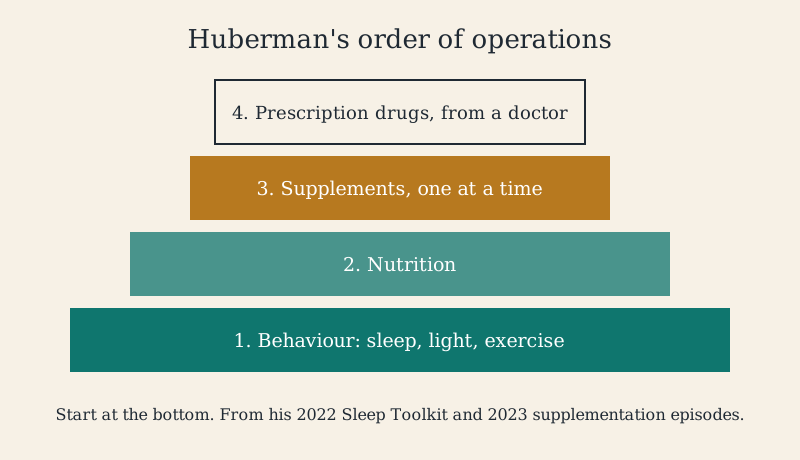
Huberman's order is behaviour first, then nutrition, then supplements, and prescription drugs from a doctor after that. In his 2023 supplementation episode he says "there is no pill replacement for sunshine", and he repeats a physician friend's line: "better living through chemistry still requires better living."
One ingredient at a time
He prefers single-ingredient products for everything except a broad foundational formula, because one at a time shows you the smallest dose that works. Add one product for about a week and change nothing else. If it causes a problem, stop at once.
Why big results come from low starting points
Huberman calls this the floor effect. The studies with the biggest results usually recruit people who start low. One man he knows started very low, took tongkat ali and fadogia together, and gained about 600 ng/dL of total testosterone, close to triple his starting level. Someone already in the normal range shouldn't expect anything like that.
Daily foundation supplements
Fish oil: count the EPA
Huberman suggests getting "above that one gram of EPA per day threshold and as high as three grams per day". Labels often show 1,500 or 1,600 mg of total fatty acids, so read the EPA line. He links omega-3s to mood, heart health and focus. Asked which single supplement to take, he answers with three questions: how you sleep, how you eat, and your budget. At about $100 a month he says a broad product like AG1. On less, fish oil with at least 1 g of EPA.
Vitamin D3 and K2
He describes D3 as cover for people who don't get enough sunshine. None of the episodes checked here gives his dose. The Institute of Medicine's daily RDA is 600 IU up to age 70 and 800 IU after, and its 2011 report found higher blood levels weren't consistently better.
AG1's ad reads on his show have bundled a D3 and K2 supplement. In a Danish study of 53,372 adults, people who ate the most K2 had a 14% lower risk of hospital admission for atherosclerotic heart and artery disease than those who ate the least. That was diet, not pills, and it shows an association. In the DO-HEALTH trial, 2,157 adults aged 70 or older took 2,000 IU of D3, 1 g of omega-3s and a home exercise plan, alone or together. All three combined came with 61% fewer invasive cancers (4 cases against 12) in an exploratory analysis.
Creatine
"Nowadays, I just take about five grams or so," Huberman told Andy Galpin, who called 3 to 5 g a day of creatine monohydrate the typical dose. He also says he can't tell whether it helps his own thinking. A 2018 review of six trials (281 people) found creatine may improve short-term memory and reasoning, with no change in young adults and bigger memory gains in vegetarians.
AG1 and the sponsorship
AG1 (Athletic Greens) covers vitamins, minerals, digestive enzymes, adaptogens, prebiotics and probiotics in one drink. Huberman has taken it since 2012. AG1 sponsors his podcast, and he says other foundational products cover the same ground. He says the best time to take a vitamin and mineral supplement is with food.
The sleep supplement stack
The core is 145 mg magnesium threonate, 50 mg apigenin and 100 to 400 mg L-theanine, 30 to 60 minutes before bed. On 3 to 4 nights a week he adds 2 g glycine and 100 mg GABA. On alternate nights he takes 900 mg myo-inositol, which he uses for waking in the night and struggling to fall back asleep. Huberman's sleep cocktail covers the rotation, an example week and the evidence for each ingredient.
Who should skip parts of it
- Theanine. His newsletter says "Don't take theanine if you have overly intense dreams, sleep-walk, or have night terrors."
- Apigenin. He calls it "a fairly potent estrogen inhibitor" and says women who want to keep their estrogen where it is should probably avoid it.
- Magnesium. About 5% of people get an upset stomach, and his advice is to stop.
The evidence is thin. Threonate raised brain magnesium in rats, and apigenin, found in chamomile, made mice less anxious in a 1995 lab study. The single-ingredient posts go deeper: magnesium threonate for sleep, apigenin for sleep and L-theanine for sleep.
Why no melatonin
"I am not a fan of melatonin," he says. It makes you sleepy but doesn't keep you asleep, most products contain far more than the body makes, and it also acts on reproductive hormones. He allows occasional use, such as for jet lag, with a note of caution. A 2017 test of 31 supplements found melatonin content from 83% below to 478% above the label. A 2013 meta-analysis of 19 studies found it helped people with sleep disorders fall asleep about 7 minutes faster.
If you wake in the night and can't drift off again, his newsletter suggests "doing an NSDR protocol when you wake up". NSDR for sleep explains how to do one in bed.
Testosterone support supplements
Tongkat ali
Huberman gives a range of 200 to 600 mg a day. Try 400 mg for four weeks, then 600 mg "but not higher", and if nothing changes, it isn't working for you. "To my knowledge, tongkat ali does not need to be cycled," he says. He describes it as freeing up testosterone by lowering sex hormone binding globulin (SHBG) and as "a slight antiestrogen", while admitting the exact mechanism isn't known. Reported side effects include "excessive alertness and insomnia if it's taken too late in the day", so take it earlier. A 2022 meta-analysis of five randomised trials found it raised total testosterone, and the authors still called for more research.
Fadogia agrestis
Fadogia raises luteinizing hormone, and with it testosterone and estrogen, by his account. He says plainly that it "can be toxic to testicular cells and perhaps other cells when taken at very high dosages". In a 2008 rat study, 28 days of the extract showed signs of harm to testicular function. He says to stay within the label dose and cycle it, 8 weeks on and 2 off, or 12 weeks on and a month off. He told Dr. Kyle Gillett he takes 600 mg a day on that kind of cycle. Gillett's more cautious regimen is 600 mg every other day or three times a week.
Boron
In one study of 8 men, 10 mg of boron a day for a week raised free testosterone and lowered estradiol. DHT, cortisol and vitamin D rose too. That's a week, 8 people and no separate placebo group, so treat it as a lead.
The training protocol he points to
Dr. Duncan French told Huberman that many testosterone studies used six sets of 10 reps at about 80% of the one-rep max, with two minutes' rest. Going to 10 sets, as Huberman summed up French's point, was "not as beneficial and might even be counterproductive." Huberman describes French's plan as two sessions a week.
Bloodwork first
"There is simply no better tool to evaluate whether or not these supplements are working ... except to take a blood test," Huberman says. For tongkat ali he suggests testing 8 to 12 weeks after starting. He describes testosterone as "making effort feel good", which he explains as lowering stress and anxiety.
Cognitive enhancement supplements
Alpha-GPC
Alpha-GPC donates choline for acetylcholine and can sharpen focus at 300 to 600 mg. It lasts about 4 to 6 hours, so skip it near bedtime. He takes 300 mg before work or training, usually with coffee or yerba mate rather than caffeine pills. More than that "tends to send my mind down a pathway that I don't like to be in".
L-tyrosine and PEA
His range for L-tyrosine, a dopamine precursor, is 500 to 1,000 mg. For Huberman it "works very powerfully to elevate my level of focus, but that I tend to crash pretty hard afterward", so he avoids it, though some people tolerate it well. He uses 500 mg of PEA (phenylethylamine) with 300 mg alpha-GPC once a week or every two weeks. The dopamine rise lasts about 30 to 45 minutes and feels more even to him.
Caffeine
His range is 1 to 3 mg per kilogram of body weight, about 30 minutes before mental or physical work. Past 2 pm, he warns, it can hurt sleep.
Supplements he uses only now and then
Ashwagandha
Huberman calls ashwagandha "a very potent supplement in terms of reducing cortisol levels" and says not to take it for more than two weeks at a time at high doses. He keeps it for stressful stretches, never year-round. Trials have run longer. One 8-week study of 60 stressed adults found lower cortisol at 250 and 600 mg a day. The trial details are in ashwagandha and cortisol.
NMN and NR
In an October 2023 AMA episode, as reported by NAD.com, he said he takes NMN and NR within an hour or two of waking.
Before you copy any of it
His newsletter advice is to "start with one supplement (or none!)" and add one at a time. He also reminds listeners he is not a physician and to talk to a doctor about anything he covers. Tongkat ali, fadogia and boron change hormones, so test before and after. If you take a sleeping pill or anxiety medication, ask before adding the sleep stack. In lab work, apigenin binds the same receptor site as benzodiazepines. Kidney disease matters for magnesium, because dangerously high blood magnesium shows up almost only in people with poor kidney function who take a lot of it.
FAQ
What supplements does Andrew Huberman take daily?
The foundation of the Huberman supplements list is fish oil for at least 1 g of EPA a day, vitamin D3, about 5 g of creatine a day and AG1, plus his nightly sleep stack of magnesium threonate, apigenin and L-theanine. Tongkat ali and fadogia are for testosterone, and fadogia is cycled.
What is Andrew Huberman's exact sleep supplement stack?
Huberman's sleep supplement stack is 145 mg magnesium threonate, 50 mg apigenin and 100 to 400 mg L-theanine, 30 to 60 minutes before bed. He adds 2 g glycine and 100 mg GABA on 3 to 4 nights a week, and 900 mg myo-inositol every other night, never on glycine nights.
Does Huberman recommend melatonin for sleep?
No, he doesn't recommend it as a nightly sleep aid. He says it doesn't keep you asleep, most products contain far more than the body makes, and it affects other hormones. He allows occasional use, such as for jet lag.
How does Huberman cycle Tongkat Ali and Fadogia?
He cycles only fadogia: 8 weeks on and 2 off, or 12 weeks on and a month off, because of possible testicular toxicity at high doses. He says tongkat ali doesn't need cycling.
What time does Huberman take his supplements?
Huberman times his supplements by goal. Tongkat ali, alpha-GPC and caffeine go earlier in the day, with caffeine stopping by 2 pm. NMN and NR come within an hour or two of waking, according to NAD.com's report of an October 2023 AMA episode. The sleep stack goes 30 to 60 minutes before bed, and vitamin and mineral supplements go with food.
Sources
- Huberman A. 2023. Developing a Rational Approach to Supplementation for Health & Performance. Huberman Lab podcast, 9 January 2023. https://www.hubermanlab.com/episode/developing-a-rational-approach-to-supplementation-for-health-and-performance
- Huberman A. 2021. Toolkit for Sleep. Huberman Lab Neural Network newsletter, 20 September 2021. https://www.hubermanlab.com/newsletter/toolkit-for-sleep
- Huberman A. 2022. Sleep Toolkit: Tools for Optimizing Sleep & Sleep-Wake Timing. Huberman Lab podcast, 8 August 2022. https://www.hubermanlab.com/episode/sleep-toolkit-tools-for-optimizing-sleep-and-sleep-wake-timing
- Huberman A. 2021. Master Your Sleep & Be More Alert When Awake. Huberman Lab podcast, 11 January 2021. https://www.hubermanlab.com/episode/master-your-sleep-and-be-more-alert-when-awake
- Huberman A. 2021. The Science of How to Optimize Testosterone & Estrogen. Huberman Lab podcast, 12 April 2021. https://www.hubermanlab.com/episode/the-science-of-how-to-optimize-testosterone-and-estrogen
- Huberman A. 2021. Controlling Your Dopamine for Motivation, Focus & Satisfaction. Huberman Lab podcast, 27 September 2021. https://www.hubermanlab.com/episode/controlling-your-dopamine-for-motivation-focus-and-satisfaction
- Huberman A. 2021. Tools for Managing Stress & Anxiety. Huberman Lab podcast, 8 March 2021. https://www.hubermanlab.com/episode/tools-for-managing-stress-and-anxiety
- Huberman A, Galpin A. 2023. Dr. Andy Galpin: Optimal Nutrition & Supplementation for Fitness. Huberman Lab podcast, 22 February 2023. https://www.hubermanlab.com/episode/dr-andy-galpin-optimal-nutrition-and-supplementation-for-fitness
- Huberman A, French D. 2021. Dr. Duncan French: How to Exercise for Strength Gains & Hormone Optimization. Huberman Lab podcast, 8 November 2021. https://www.hubermanlab.com/episode/dr-duncan-french-how-to-exercise-for-strength-gains-and-hormone-optimization
- Huberman A, Gillett K. 2022. Dr. Kyle Gillett: Tools for Hormone Optimization in Males. Huberman Lab podcast, 12 December 2022. https://www.hubermanlab.com/episode/dr-kyle-gillett-tools-for-hormone-optimization-in-males
- NAD.com. Stanford's Dr. Andrew Huberman takes two NAD precursors daily: NMN and NR (report of Huberman Lab AMA #12, 31 October 2023). https://www.nad.com/news/stanfords-dr-andrew-huberman-takes-two-nad-precursors-daily-nmn-and-nr
- Ross AC et al. 2011. The 2011 report on dietary reference intakes for calcium and vitamin D from the Institute of Medicine: what clinicians need to know. Journal of Clinical Endocrinology & Metabolism. https://pubmed.ncbi.nlm.nih.gov/21118827/
- Bellinge JW et al. 2021. Vitamin K intake and atherosclerotic cardiovascular disease in the Danish Diet Cancer and Health Study. Journal of the American Heart Association. https://pubmed.ncbi.nlm.nih.gov/34369182/
- Bischoff-Ferrari HA et al. 2022. Combined vitamin D, omega-3 fatty acids, and a simple home exercise program may reduce cancer risk among active adults aged 70 and older: a randomized clinical trial. Frontiers in Aging. https://pubmed.ncbi.nlm.nih.gov/35821820/
- Avgerinos KI et al. 2018. Effects of creatine supplementation on cognitive function of healthy individuals: a systematic review of randomized controlled trials. Experimental Gerontology. https://pubmed.ncbi.nlm.nih.gov/29704637/
- Slutsky I et al. 2010. Enhancement of learning and memory by elevating brain magnesium. Neuron. https://pubmed.ncbi.nlm.nih.gov/20152124/ [rats]
- Viola H et al. 1995. Apigenin, a component of Matricaria recutita flowers, is a central benzodiazepine receptors-ligand with anxiolytic effects. Planta Medica. https://pubmed.ncbi.nlm.nih.gov/7617761/ [lab and mouse study]
- Erland LA, Saxena PK. 2017. Melatonin natural health products and supplements: presence of serotonin and significant variability of melatonin content. Journal of Clinical Sleep Medicine. https://pubmed.ncbi.nlm.nih.gov/27855744/
- Ferracioli-Oda E, Qawasmi A, Bloch MH. 2013. Meta-analysis: melatonin for the treatment of primary sleep disorders. PLoS ONE. https://pubmed.ncbi.nlm.nih.gov/23691095/
- Leisegang K et al. 2022. Eurycoma longifolia (Jack) improves serum total testosterone in men: a systematic review and meta-analysis of clinical trials. Medicina (Kaunas). https://pubmed.ncbi.nlm.nih.gov/36013514/
- Yakubu MT, Akanji MA, Oladiji AT. 2008. Effects of oral administration of aqueous extract of Fadogia agrestis (Schweinf. Ex Hiern) stem on some testicular function indices of male rats. Journal of Ethnopharmacology. https://pubmed.ncbi.nlm.nih.gov/18023305/ [rats]
- Naghii MR et al. 2011. Comparative effects of daily and weekly boron supplementation on plasma steroid hormones and proinflammatory cytokines. Journal of Trace Elements in Medicine and Biology. https://pubmed.ncbi.nlm.nih.gov/21129941/
- Van Laecke S. 2019. Hypomagnesemia and hypermagnesemia. Acta Clinica Belgica. https://pubmed.ncbi.nlm.nih.gov/30220246/
- Salve J et al. 2019. Adaptogenic and anxiolytic effects of ashwagandha root extract in healthy adults: a double-blind, randomized, placebo-controlled clinical study. Cureus. https://pubmed.ncbi.nlm.nih.gov/32021735/